
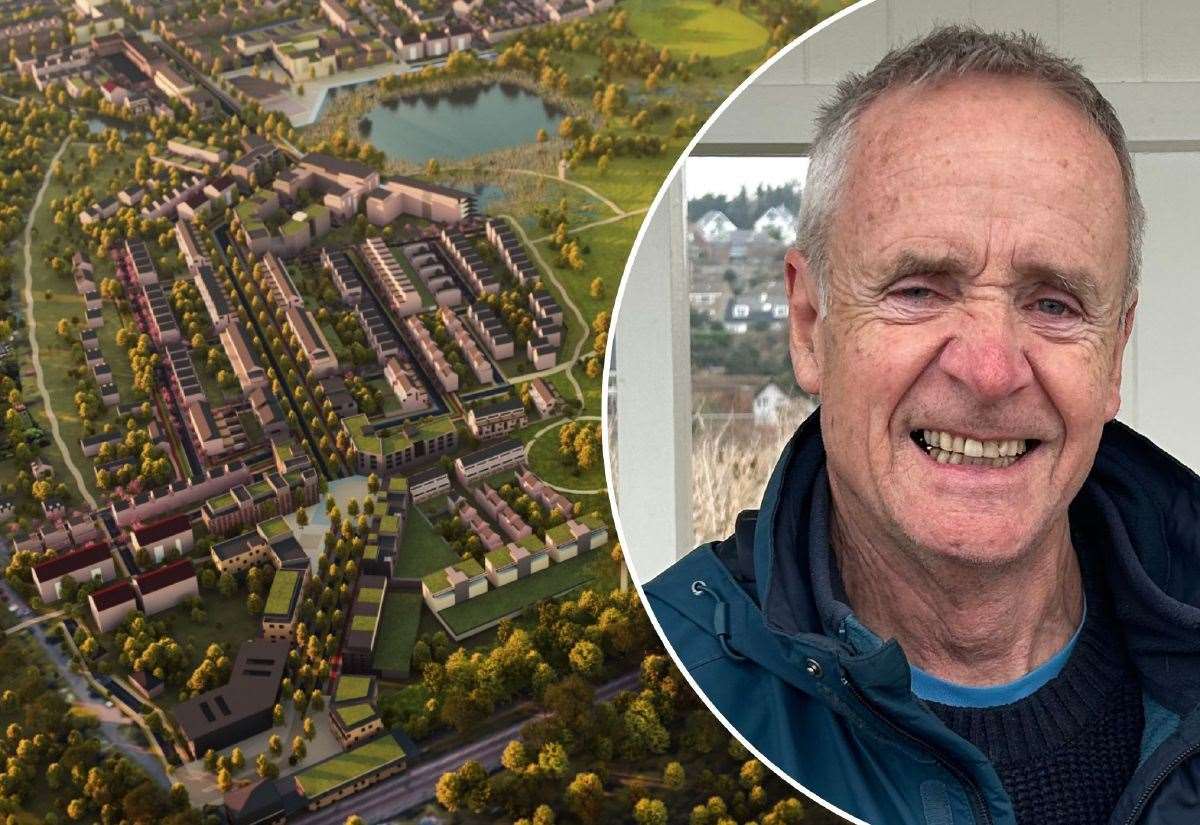
Here’s where the huge development now stands, what has held it up and when construction could finally begin.
What happens next?
 CGI of Otterpool Park near Sellindge. Picture: Otterpool Park LLP
The most immediate hurdle is completing the Section 106 agreement linked to outline permission for the first 8,500 homes.
Although councillors voted on a resolution-to-grant basis in April 2023, the development has yet to receive its formal planning sign-off because the legal agreement remains incomplete.
A Section 106 agreement secures contributions towards roads, schools, affordable housing and other infrastructure needed to support a development of this size.
Cllr Martin says the council’s latest collaboration agreement with Homes England should help push that work over the line.
“From our point of view, we need to be in a partnership with someone who’s got access to a huge amount of money,” he said.
Jim Martin remains positive over the future of Otterpool Park
“So effectively, the only game in town is the government, and that’s what we are working towards.
“The first collaboration agreement was to prove the viability and that it represented a good investment for them.
“Now, we’re focusing on obtaining outline consent, so there’s a different emphasis in the two collaboration agreements.”
The new deal gives Folkestone and Hythe District Council (FHDC) access to Homes England’s technical expertise as negotiations continue with Kent County Council and other agencies.
It is hoped outline planning permission can finally be signed off by the autumn.
The major issue holding it up
One of the biggest barriers has been the need for a dedicated wastewater treatment plant.
The Otterpool Park ‘garden town’ masterplan
Without it, sewage from the new town would flow into the Stodmarsh catchment area, where phosphate pollution rules have already delayed thousands of homes across east Kent.
Large developments such as Otterpool require their own treatment solutions, making the plant central to the project’s future.
Cllr Martin said the infrastructure is not only essential for Otterpool, but could also help wider efforts to tackle pollution issues affecting neighbouring districts.
“The wastewater treatment plant, because it cleans the East Stour, is viewed as a very favourable contribution to the Stodmarsh problem, so we want to be as cooperative as possible with our neighbours, Ashford and Canterbury,” he said.
“We want the sewage to be treated responsibly, but the reason it’s been painfully slow is that this is complex stuff.
“A lot of people – officers, consultants, experts and advisers – all have to give their opinion on different aspects of the whole deal.
“It’s just complicated stuff, but it is an essential part of the future of Otterpool. I describe it as the key that unlocks the door. Effectively, without it, the project doesn’t work.”
The former Folkestone Racecourse, near Hythe. Picture: Andy Jones
Recently, Kent County Council validated the planning application for the treatment plant.
A decision is expected in April or May, subject to Stodmarsh mitigation requirements being met.
The development is also expected to include 47 acres of dedicated wetlands.
How we got here
Otterpool Park has been in development since 2016 and, once complete, would have a bigger population than nearby Hythe.
The original vision was to create a new settlement rather than continue ribbon development along existing roads.
FHDC acquired land near the former Folkestone Racecourse, working alongside Cozumel Estates on the garden-town concept for land south of the M20 between Folkestone and Ashford.
But the project faced huge opposition – with protest marches held in Hythe in 2019.
Residents marched in opposition to the Otterpool Park development. Picture: Matt Bristow
Today, the council owns 44% of the more than 700-hectare site and has land options covering a further 46%.
Homes England owns the remaining 10%.
Although planning permission currently covers 8,500 homes, the wider ambition remains a full 10,000-home community.
When Cllr Martin became council leader in 2023, the authority was already facing major financial exposure after Otterpool Park LLP requested a further £80 million on top of £120 million already borrowed.
Last year, the council entered into an initial six-month collaboration agreement with Homes England to prove the scheme’s viability to government.
Artist’s impressions of how the Otterpool Park development could look with street scenes designed as part of the masterplan application. Picture: Folkestone and Hythe District Council
That has since been followed by a second agreement designed to move the planning process towards completion.
Homes England is also covering 50% of the immediate upfront collaboration costs, easing short-term pressure on the council.
Why no private partner has come forward
Another key delay has been the failure to secure a major development partner.
Cllr Martin says the housing market has not properly recovered since the pandemic in 2020, making it difficult to attract the level of investment needed.
“What we had was more or less a market collapse in terms of the housing market, which has never recovered from Covid,” he said.
Folkestone racecourse, near Sellindge, will eventually be turned into Otterpool Park garden town. Picture: Barry Goodwin
“So developers coming in, throwing around wads of cash, just hasn’t happened.
“Someone is going to have to invest a monster amount of money. I’m not talking loose change. It’s a sum my council just don’t have and could never even borrow.”
That is why the council increasingly sees Homes England as the realistic long-term route to delivery.
The solar farm plans
Taking more of a back seat for now are proposals for a major solar farm on agricultural land at Court-at-Street near the site.
The location of Otterpool Park and the proposed solar farms to power it
The project is intended to meet about 40% of the new town’s energy needs.
Two phases are planned, each generating 12 megawatts of electricity.
The scheme is expected to be run by renewables firm SNRG.
Cllr Martin said the technical work on the solar plans is largely ready, but progress depends on the wider development moving forward first.
“In terms of technical issues, solar is really the least of them, but we need a development for them to feed electricity into, and then we’ll all go forward together,” he said.
The numbers associated with the ongoing Otterpool Park development
Why Otterpool missed the government’s new towns list
Despite being in development for years, Otterpool was not included when the government recently named seven priority new towns.
But Cllr Martin insists that may actually work in the project’s favour.
“I think we’ve got an awful lot more flexibility by not wearing the mantle of one of the seven chosen,” he said.
“Otterpool is in a very strategic location, and once it gets rolling, I’m sure it will prove to be enormously popular.”
He argues the council’s control over roughly 90% of the land puts the scheme in a stronger position than many rival sites dealing with multiple landowners and planning authorities.
When could building start?
Despite the setbacks, the council is now working towards visible construction activity beginning in 2028.
That could initially include roads, utility cables and enabling works before homes themselves start rising.
It’s understood that land close to Westenhanger Station has been earmarked as where work could begin on the site.
“I think the end of 2028 is when we’ll see bricks being laid,” Martin said.
“Everything’s a guesstimate. We may see roads or cables being laid before that, but 2028 is when we’ll probably see progress on the site.”
In a normal market, Martin believes about 150 homes a year could be built.
But with government pressure to accelerate housebuilding, that rate could potentially rise to 300 homes annually once the development is fully under way.
Comments are closed.