
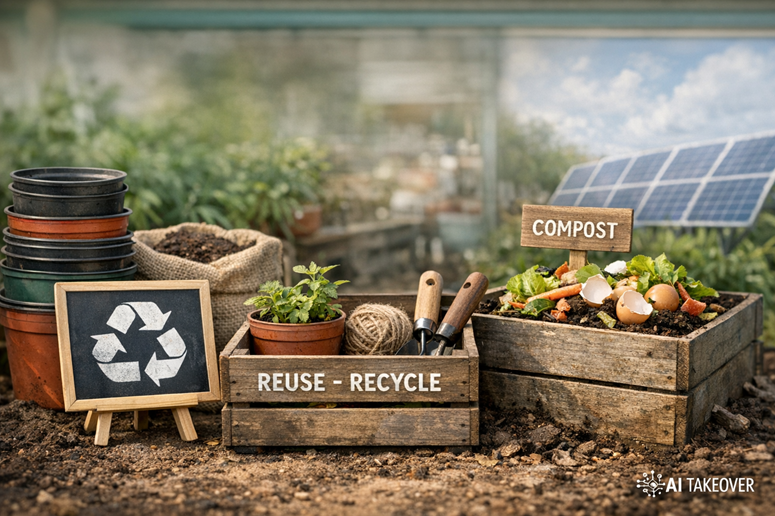
Each day in April, Garden Centre Retail will be posting an article ‘written’ by AI, following a list of topics that affect the garden retail landscape in the UK. Today’s topic is the circular economy.
The circular economy is becoming a defining theme for UK garden centres as sustainability expectations rise, costs increase, and customers look more closely at how retailers manage resources. What was once seen as an environmental aspiration is now a commercial imperative, shaped by tighter margins, growing scrutiny of waste, and a consumer base that increasingly rewards businesses that demonstrate responsibility. As the sector heads into another season marked by weather volatility and shifting buying patterns, the ability to reduce waste, extend product life, and create value from materials that would previously have been discarded is becoming central to long‑term resilience.
What Garden Centres Are Experiencing on the Ground
Garden centres across the UK are feeling the pressure of waste management challenges, rising disposal costs, and customer questions about the environmental impact of horticultural products. Plastic pots continue to accumulate faster than they can be reused or recycled, compost bags and packaging create visible waste streams, and unsold seasonal stock often ends up heavily discounted or written off. Many centres are also seeing customers ask more frequently about peat alternatives, sustainable sourcing, and the lifecycle of plants and products. At the same time, operational teams are stretched, making it difficult to introduce new processes or manage additional sorting and reuse systems. These pressures are compounded by unpredictable weather, which can leave centres with excess stock during slow periods or shortages during sudden spikes in demand, both of which contribute to unnecessary waste.
Why These Challenges Exist
The drivers behind these challenges are rooted in a combination of structural and behavioural factors. The horticultural supply chain has long relied on single‑use plastics because they are lightweight, durable, and cost‑effective. Consumer expectations have also shifted rapidly, with customers now expecting retailers to take responsibility for the full lifecycle of the products they sell. Weather unpredictability continues to distort demand, making it harder to order accurately and avoid waste. Labour shortages mean teams have less time to manage recycling or reuse schemes, and many centres lack the infrastructure to process materials efficiently. In addition, traditional retail models are built around linear consumption—buy, use, dispose—which makes the transition to circularity a cultural as well as operational shift.
Opportunities Emerging from Circular Thinking
Despite these pressures, the circular economy presents significant opportunities for garden centres willing to rethink how materials flow through their business. Reuse schemes for pots and trays can reduce purchasing costs and strengthen customer loyalty by offering a tangible sustainability benefit. Partnerships with local growers or community groups can create new uses for surplus plants, reducing write‑offs and enhancing community engagement. Composting green waste on‑site or through local partners can reduce disposal costs and create a valuable product for sale or use in the plant area. Repair and refurbishment services for tools, furniture, or outdoor equipment can open new revenue streams while reinforcing a centre’s sustainability credentials. By embracing circular practices, garden centres can differentiate themselves in a competitive market and build stronger relationships with environmentally conscious customers.
Practical Steps to Begin the Transition
Practical steps can help centres begin integrating circular principles without overwhelming teams or requiring major investment. Reviewing waste streams to identify the most common material such as pots, trays, cardboard, or damaged plants, can highlight quick wins. Establishing simple, clearly signposted pot return points encourages customer participation and reduces the volume of new pots required. Working with suppliers to reduce unnecessary packaging or switch to recyclable alternatives can cut waste at the source. Introducing small‑scale composting for green waste can reduce disposal costs and create a useful resource for the plant area. Training teams to identify products that can be repaired, repurposed, or donated rather than discarded helps embed circular thinking into daily operations. Even small changes, when consistently applied, can significantly reduce waste and improve efficiency.
How Leading Centres Are Embracing Circularity
Leading garden centres are taking a more strategic approach to circularity, treating it not as an add‑on but as a core part of their commercial and environmental strategy. They are redesigning customer touchpoints to encourage reuse, such as offering incentives for pot returns or promoting refill stations for garden chemicals and bird food. Their buying teams are working closely with suppliers to source products with longer lifecycles, recyclable packaging, or modular designs that make repair easier. Some centres are experimenting with leasing models for high‑value items like tools or machinery, reducing the need for customers to purchase products they use infrequently. These centres recognise that circularity is not only about reducing waste but also about creating new forms of value and strengthening customer loyalty through visible, meaningful action.
Where AI Can Support Circular Economy Goals
AI is beginning to play a role in supporting circular economy initiatives by helping centres understand where waste is occurring and how to reduce it. By analysing sales patterns, AI can identify products that frequently become end‑of‑season write‑offs, enabling more accurate ordering or alternative merchandising strategies. It can also help forecast demand more precisely, reducing the risk of overstocking and the waste that follows. AI‑driven image recognition tools can support sorting processes by identifying materials for recycling or reuse, while predictive models can highlight opportunities to repurpose surplus stock before it becomes a liability. Although AI cannot replace the operational changes required for circularity, it can provide insights that make those changes more effective and easier to manage.
What the Future Holds for Circularity in Garden Retail
Looking ahead, the circular economy will become increasingly central to the garden centre sector as regulatory pressures grow, customer expectations rise, and the cost of waste disposal continues to increase. Centres that begin integrating circular practices now will be better positioned to adapt to future requirements and to capture the commercial benefits of reduced waste, lower costs, and stronger customer loyalty. The shift will not happen overnight, but the direction of travel is clear: linear models are becoming less viable, while circular approaches offer a path to resilience and differentiation.
The essential insight is that the circular economy is not just an environmental initiative; it is a strategic opportunity for garden centres to reduce costs, strengthen customer relationships, and future‑proof their operations. Centres that embrace circular thinking today will be the ones that thrive in a market where sustainability and commercial performance are increasingly intertwined.
Comments are closed.