
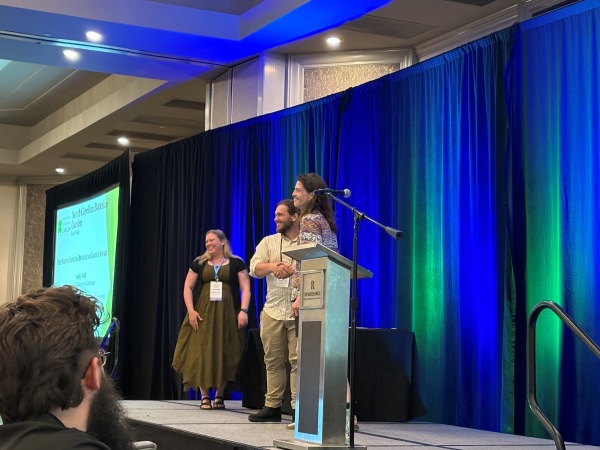
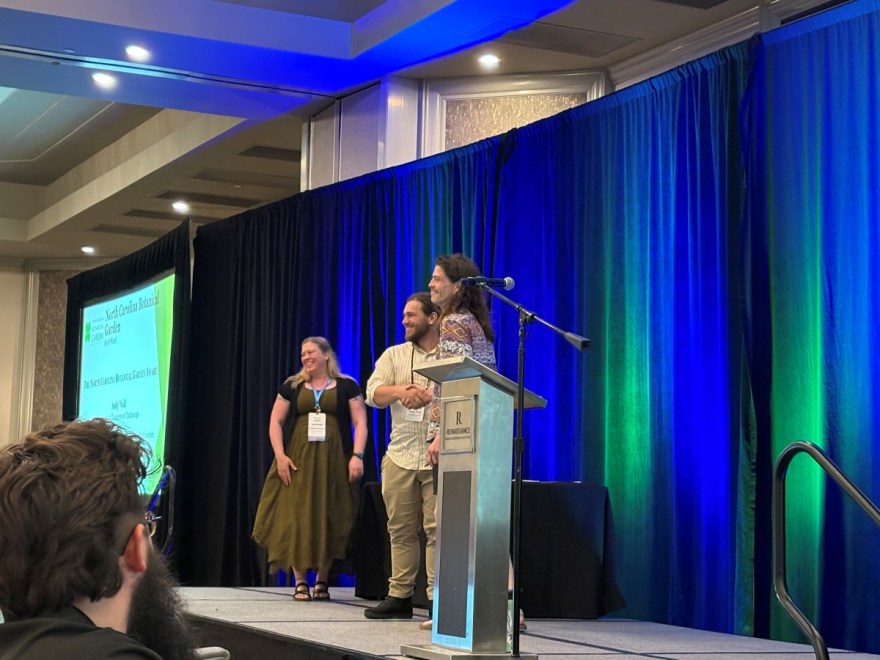
Andy Wall, center, was presented with the North Carolina Botanical Garden Award by Dr. Heather Joesting, president of the Association of Southeastern Biologists, and Scott Ward, research botanist at the North Carolina Botanical Garden. Photo courtesy of Dr. Gretchen Potts.
University of Tennessee at Chattanooga graduate student Andy Wall was selected for the 2026 North Carolina Botanical Garden Award at the recent Association for Southeastern Biologists conference in Mobile, Alabama.
Wall was the second consecutive UTC environmental science graduate student to win the honor, following 2025 recipient Julia Prins.
The North Carolina Botanical Garden Award is given for an outstanding presentation that best advances understanding of the biology and conservation of southeastern plants and their ecosystems.
“It definitely felt good. It was validating to be recognized in that way,” said Wall, who will graduate from UTC in May.
Working under UTAA Distinguished Service and UC Foundation Professor Joey Shaw, Wall’s research, titled “The Vascular Flora and Species Distribution Modeling of Two Rare Species in Cloudland Canyon State Park, Dade and Walker Counties, Georgia,” focused on Cloudland Canyon State Park in northwest Georgia—an area known for its rugged terrain and ecological diversity.
Shaw said Wall was “a strong fit for the project,” citing his background in field botany.
Between late 2023 and the end of the 2025 growing season, Wall conducted a comprehensive floristic inventory of the park, documenting hundreds of plant species and building a dataset that will support conservation efforts. He completed 52 site visits to Cloudland Canyon and, combined with existing herbarium records, documented 665 species and subspecific taxa spanning 361 genera and 122 plant families.
A floristic inventory, he explained, provides a baseline understanding of what species exist in a given area. This information is essential for future research and land management.
“We need to understand what these plant distributions are and where they’re occurring. It begins with this boots-on-the-ground floristic research,” he said.
The research also identified 28 rare species and produced more than 200 county-level records—data that park managers can now use to make informed decisions about conservation, invasive species management and long-term stewardship.
“They know where the rare species are so that they can keep an eye on them,” Shaw said. “When it comes to invasive species, park managers can go in and help eradicate them so that they don’t take over.”
In total, Wall collected hundreds of specimens representing roughly 600 species, creating a verifiable record of the park’s biodiversity, and contributed those samples to UTC’s herbarium, where they will serve as a resource for future students and researchers.
Each specimen, Shaw said, strengthens a growing scientific record.
“If there weren’t specimens and he just said, ‘Oh, I saw all these wonderful things there,’ how can that be verified?” Shaw said. “He’s collected all these specimens … and every student who contributes to it expands that library.”
Those specimens are also digitized and shared through a global database, making the research accessible to scientists beyond UTC.
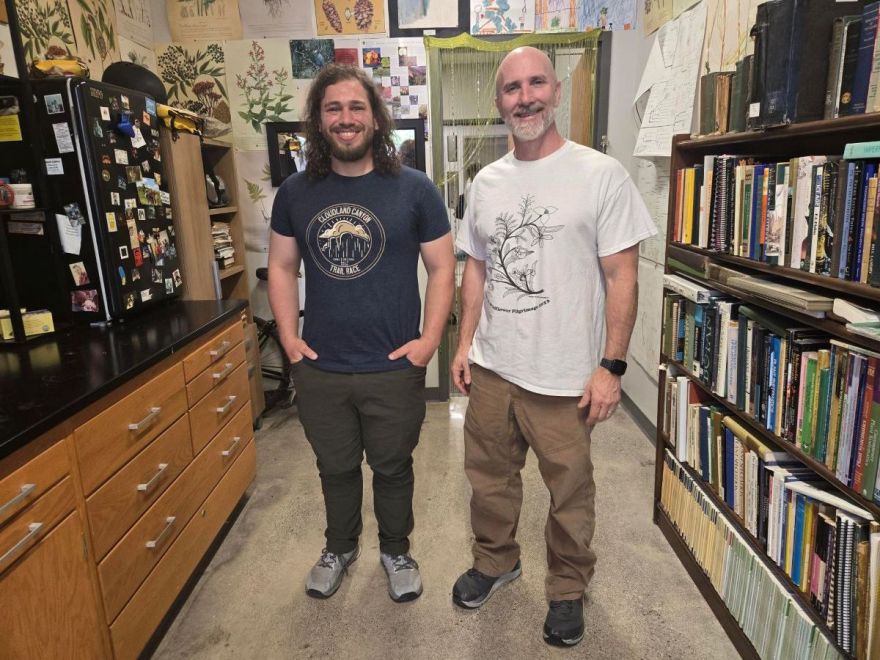
UTC graduate student Andy Wall and UTAA Distinguished Service and UC Foundation Professor Joey Shaw.
For Shaw, having a second consecutive UTC student win the award reflects both the quality of Wall’s research and the strength of the University’s environmental science program.
“I think it says that we’ve got great continuity between generations of students that can feed off of one another and learn from one another,” he said. “Students learn from those ahead of them and are pushed to reach that same level.”
For Wall, the path to UTC began in the Baltimore area, where he developed an early interest in plants and the natural world. He grew up near a state park and spent time exploring the woods, sparking an early curiosity about plant life. He earned his undergraduate degree at Frostburg State University in Maryland and later worked as a field botanist in West Virginia and a researcher in California before coming to Chattanooga.
“I spent a lot of time in the woods and was just fascinated by the plants there,” he said.
After connecting with Shaw, he chose UTC for graduate school to deepen his expertise in field botany and plant identification.
Now, with his thesis defended and graduation approaching, Wall is looking ahead to a career in conservation, whether through floristic research, habitat restoration or related work across the eastern United States.
“I’m looking to work in the conservation field … something that I can make a difference for rare plants,” he said.
Shaw believes he is well prepared for what comes next.
“He’s done what he needs to do,” Shaw said, “and he’s started building his reputation as a capable field botanist and scientist.
“He is someone who can not only do the field work but also write the reports and analyze the data. He’s the whole package.”
Learn more
UTC Department of Biology, Geology and Environmental Science
Visit UTC
How to apply

Comments are closed.