
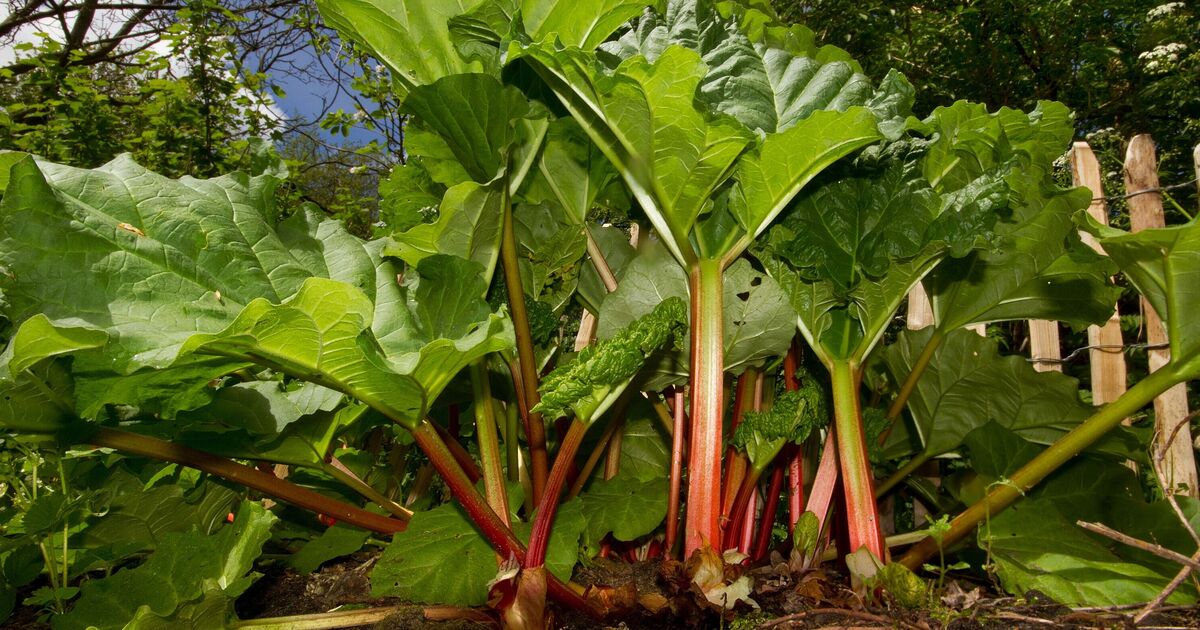
Now that spring has arrived gardens are coming back into full bloom, with flowers, fruit and vegetable plants bursting into life once again.
While vegetable harvesting in the UK peaks later in the year, rhubarb – which is often thought to be a fruit – is actually ready much earlier, and most varieties can be picked from April or May. Despite being a vegetable, the tasty ingredient is traditionally eaten as a dessert and is often used in crumbles, pies, fools and jams. But gardeners keen to tuck into some homegrown rhubarb this spring should be wary before eating it, as only part of the plant should be consumed.
While the long, reddish stalks of a rhubarb plant are absolutely safe to eat and can be eaten raw, gardeners are warned to avoid eating the leaves of the plant as these are poisonous and can cause some nasty symptoms if consumed.
Rhubarb leaves contain high levels of oxalic acid, a naturally occurring compound which is toxic to both humans and animals, so it’s very important to remove and discard these before cooking or eating the stalks.
This acid can be found in many plants, but rhubarb leaves have a particularly high concentration which makes them toxic. If these leaves are eaten it can cause vomiting, diarrhoea and kidney problems in some severe cases.
In its online guidance about consuming rhubarb, Healthline warns: “Rhubarb leaves are considered inedible due to their high concentration of oxalic acid. In fact, both the stalks and leaves contain oxalic acid, but the leaves have a much higher content. Oxalic acid is a natural substance found in many plants, including leafy greens, fruits, vegetables, nuts, seeds, and cocoa.
“Too much oxalate in the body can lead to a condition known as hyperoxaluria, which is when excess oxalate is excreted in the urine. This can also lead to an accumulation of calcium oxalate crystals in the organs. In the kidneys, this can lead to the formation of kidney stones and eventually kidney failure.
“Symptoms of mild rhubarb leaf poisoning include vomiting and diarrhea that resolve within a few hours. More serious oxalate toxicity causes sore throat, difficulty swallowing, nausea, vomiting (sometimes including blood), diarrhoea, and abdominal pain. Very serious symptoms include kidney failure, numbness, muscle twitches, and cramps.”
The Royal Horticultural Society (RHS) says rhubarb stems remain edible through the summer, but it’s best to stop harvesting them in late June or early July, and to only take a few stalks to avoid weakening the plant.
The RHS said: “To harvest, choose a young stalk about 30cm (1ft) long, with a leaf that has only just fully opened. Hold the stalk at the base and twist gently to ease it out of the ground. Try to avoid snapping it off, and don’t cut it, as you’ll leave a stump that is prone to rotting.
“Then remove the leaf, which is not edible, and add it to your compost bin. Only ever take about a third of the plant’s stems, so there are plenty of leaves left to keep it in active growth.”
While rhubarb leaves should never be consumed, they don’t have to go completely to waste as it is safe to use them for composting in your garden.
In its online advice on composting rhubarb, Gardening Know How said: “Composting rhubarb leaves is perfectly safe. Although the leaves contain significant oxalic acid, the acid is broken down and diluted fairly quickly during the decomposition process.
“In fact, even if your entire compost pile was made up of rhubarb leaves and stalks, the resulting compost will be much akin to any other compost.
“Of course, initially, prior to the microbial action of composting, rhubarb leaves in compost piles would still be toxic, so keep the pets and kids out.”
Comments are closed.