
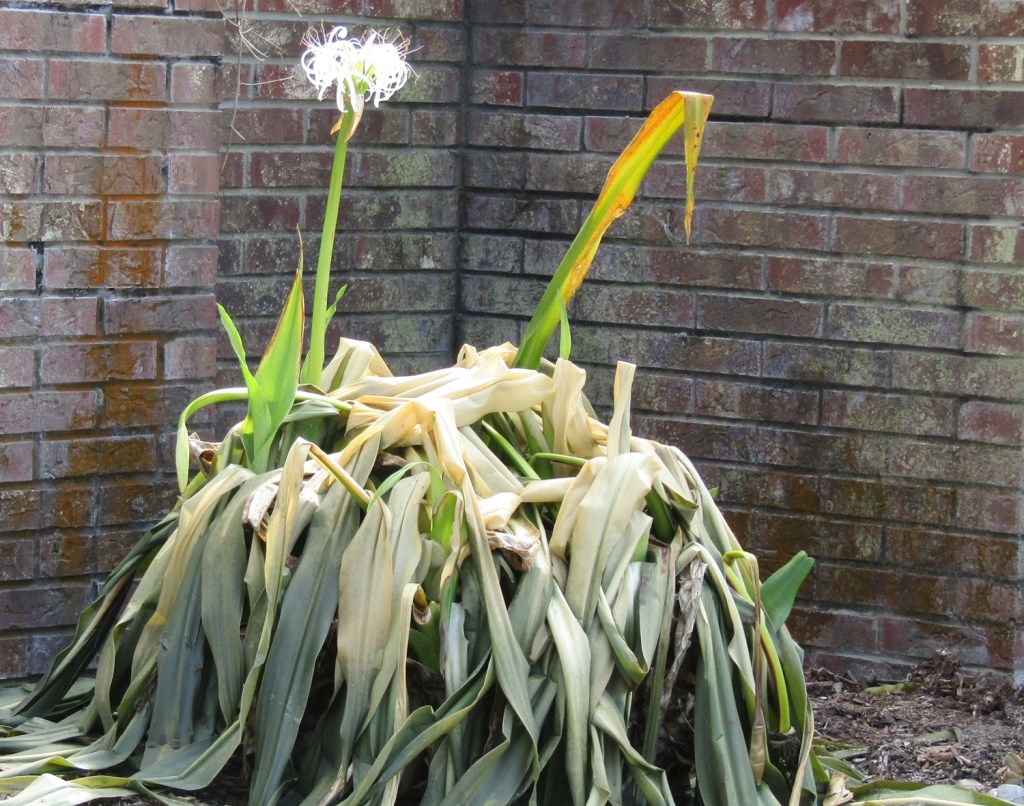
Q: The leaves were damaged on my crinums. How far do I prune them back?
A: Each year about this time crinum lilies receive a renewal pruning. Mother Nature may have helped with the trimming by sending a freeze to cause many leaves or portions of leaves to decline. These large bulb-forming plants of white-, pink- or white and-maroon blooms are durable, and even when the tops are frozen rapidly being new growth with the return of warm spring weather. Use this time to remove frozen leaves back to the bulbs. It is a good time to also trim away diseased or otherwise damaged leaves.
Q: My containers of caladium have produced a lot of bulbs. Is now the time to divide and replant the bulbs?
A: Many caladium bulbs, which are actually tubers, are starting growth. So hurry to do needed dividing. Most gardeners are amazed at the number of new tubers found in a pot of caladiums from last year. Similar quantities of caladiums can be found in ground plantings. Now is a good time to divide and replant all these tubers to expand the collection or share a few with friends.
Plant Doctor: Dahlias popular with transplanted Northerners present challenges locally
Q: We have some large areas of weeds in our St. Augustine lawn. Is now the time to resod these areas and if so what preparation is needed?
A: Start this renovation project by raking or digging out weedy portions. Then till the soil several inches deep. You may want to have the soil acidity tested and apply a treatment to adjust the pH if needed to the entire lawn. Form straight edges to the prepared site and add the new sod. Abut the new sod pieces together and at the edge of the old lawn. This is important to keep weed seeds from germinating. Keep the new sod and soil moist and apply the first fertilizer application in four weeks. Sod should be watered daily the first week, every other day the second week and every third day during week three. By week four normal watering can occur. If weather condition are extremely dry additional watering may be needed. Also, apply a fungicide at week two.
Q: I was told to wait to fertilize our zoysia lawn. Is now the time?
A: You were given good advice as zoysia turf is slow to begin spring growth — especially after a cold winter. Early fertilizer applications are wasted and may stress the zoysia turf. Normally by early to mid-April zoysia lawns start to regreen and are ready for a fertilizer application. Use a slow-release product that can feed the lawn for several months. This may be the only fertilizer application needed until fall.
Q: I have several large crape myrtles. Can I use a chainsaw to thin them out and prune them back a little?
April in the Garden for Central Florida
A: Feel free to use power equipment to perform needed pruning but don’t let this become a “Chainsaw Massacre.” Most crape myrtles assume a very pleasant shape and size with very little pruning. Use the saw to remove crisscrossing limbs and perform a little thinning. If the tree is too tall or wide for the site, prune limbs back to branch angles or to the trunk. Try to avoid cutting them off leaving stubs. All seed pods and short stems can be removed if needed. Crape myrtles can be grown very successfully with no pruning at all.
Q: My carambola is severely damage by the freeze and full of dead leaves. Do you think it will grow back?
A: Heavily damaged carambola trees, also called star fruit trees, are very cold sensitive and when frozen, portions are often lost to the ground. Scrape the bark to determine the extent of damage. Look for areas of green and moisture under the bark to determine what might be alive. Regretfully, the tree may be completely frozen, but there is good news. Carambolas normally grow back from at or near the ground to produce more of a shrub-looking tree. These can be retrained to a single trunk if you don’t like the multiple trunk look
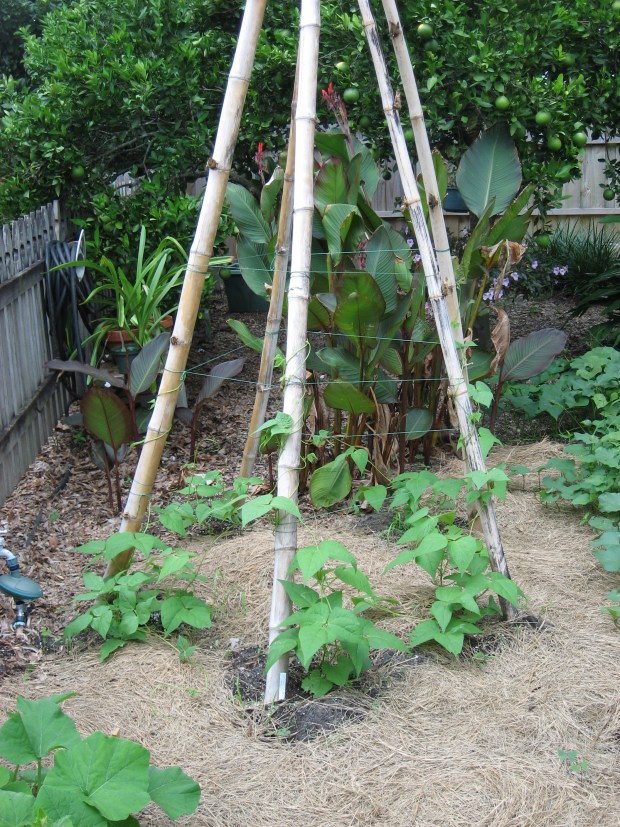 Bamboo or other wooden stakes found at garden centers or lumberyards are useful for making a tepee or similar structure to conserve space and send vining bean plants up a rope grid. (Courtesy of Tom MacCubbin)
Q: I would like to grow pole beans. What is an inexpensive way to build a support?
A: When I was a young boy, my dad would take us out into a woodland area of the farm to find saplings 8 to 10 feet tall to cut and use as bean poles. Today these may not be available to most of us, but can be substituted with bamboo or wood stakes found at garden centers or lumberyards. Consider making a tepee or similar structure to conserve space and send the vining bean plants up a rope grid.
Q: We have a somewhat weedy St. Augustine lawn. What is a good weed control and fertilizer program for this turf?
A. Apply a weed-and-feed as labeled for use with St. Augustine as soon as possible. This helps control unwanted greenery and provides nutrients to promote spring growth. Since many counties do not allow summer feedings, make a second fertilizer only application at the end of May. Select a fertilizer with slow-release properties that feeds the lawn for months. When you are allowed to fertilize again in October, apply a weed-and-feed, or if weeds are no longer of concern, a lawn fertilizer. Weeds that linger or grow at other times can be controlled with liquid products following label instructions for St. Augustine. Do note that some St. Augustine types are excluded from treatment with certain products.
Tom MacCubbin is an urban horticulturist emeritus with the University of Florida Cooperative Extension Service. Write him: Orlando Sentinel, P.O. Box 2833, Orlando, FL. 32802. Email: TomMac1996@aol.com.
Comments are closed.