
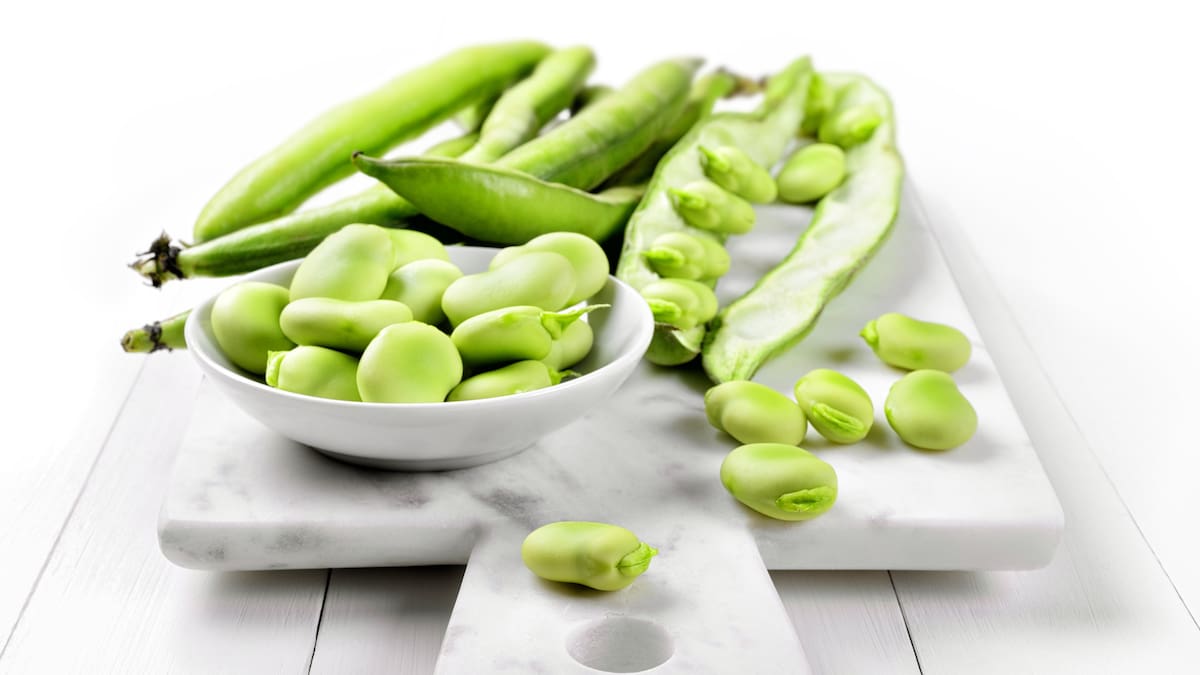
But it deserves to be written about.
I was never fussed on broad beans as a child, and I can well imagine that I was not the only one.
My mother used to cook them till they turned grey … they were not nice.
How times have changed.
Broad beans can now be found smashed on top of sourdough toast at trendy cafes. Or, with the outer shell removed, the bright green succulent beans are a welcome addition to a fresh green salad.
They are also great in pasta, added to a green soup or made into a dip.
You need to use them the day they’re picked to get maximum enjoyment.
Broad beans were one of the first vegetables I learnt to grow, and that was because they grew when there was not much else in the vegetable garden, and I always had success with them.
Also worth remembering: as legumes, they fix nitrogen in the soil, which makes chop‑and‑drop an ideal way to recycle nutrients.
When to plant broad beans
It is said you should plant broad beans in the late autumn or early spring.
These are tough little beans that withstand the coldest of weather.
For regions with mild winters, a late autumn planting can yield an early spring harvest, ensuring your garden remains productive across seasons.
If you do not wish to plant from seed, check out your local nursery for seedlings.
They are always pretty hardy and seem to do well once in the ground.
Growing broad beans
Plant in double rows about 10-15cm apart, in well-composted soil.
Broad beans grow upright; they do not cling on with tendrils, and they do not climb like runner beans.
As they get taller, they do need some sort of support, especially if the area they are growing in tends to get windy.
Everyone seems to have their own method of keeping them upright.
Mine is a little rough and ready, but it works fine.
I use sturdy canes at each corner of my double row, then twine halfway up the cane, and then another at the top.
This seems to keep them secure, and the two rows lean against each other, keeping them upright, while secured by the twine fence.
Harvesting broad beans
When the pods feel and look full, and the seeds are outlined through the skin, then it is time to harvest.
Do not let the pods get too big, as that is when the vision of what you ate as a child will come rushing back.
Begin picking your broad beans from the bottom of the stalk, as these mature first.
You need to harvest your broad bean plants regularly to promote further flowering and growth.
Use one hand to steady the stem and the other to gently twist off the pod, avoiding plant damage.
Choosing your seed
Cold-resistant Coles Prolific is better suited for harsher areas, whereas the large, succulent pods of superaguadulce, renowned for their large 25cm pods, might tempt you.
If you have limited space, check out dwarf varieties.
Also, remember the variety Hughey Crimson or Red Hughey, well worth checking out for its vibrant crimson flowers.
Happy growing, and please give broad beans a second chance.
Comments are closed.