
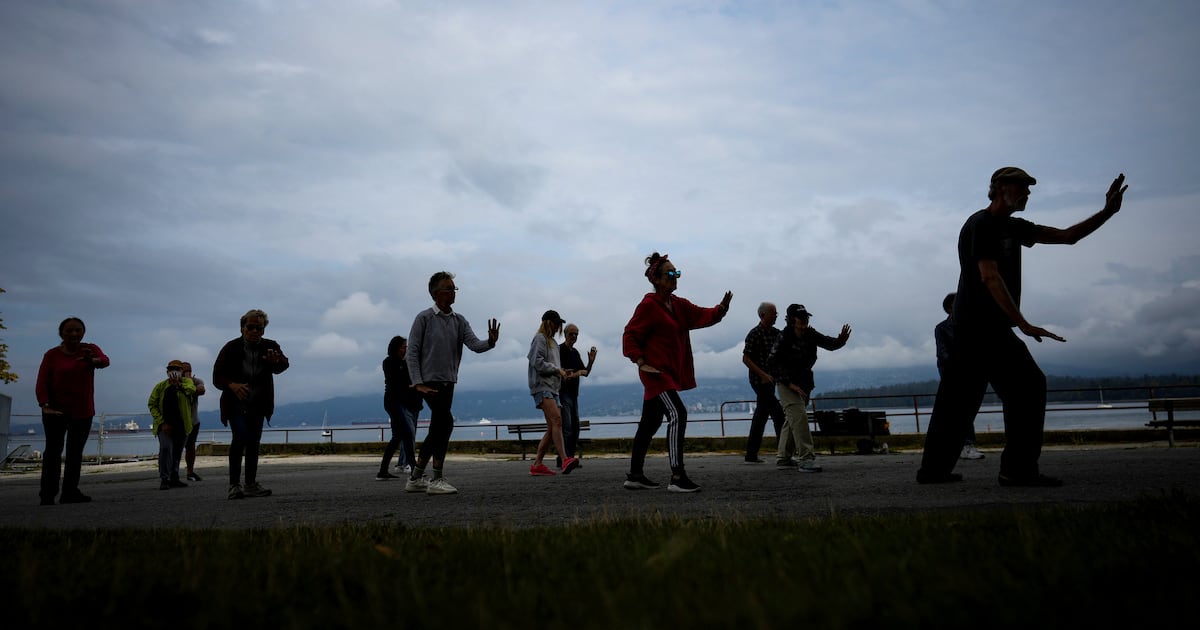
 People practice tai chi on the seawall at Kitsilano Beach, in Vancouver, British Columbia. (Darryl Dyck/The Canadian Press via AP)
I am sitting in front of an extremely sunny window, or at least trying to sit. My back is out. Way out! I am hurting, that’s for sure.
The spring light is brightly reflecting off melting snow, actually blinding me from seeing what I have written so far. I need to move to a better place in which to write. I am in too much pain.
I am not complaining about my back being out. Well, actually I am (just ask anyone around me), but that’s not what I’m writing about.
If you’re a perennial gardener, meaning one who gardens every year no matter what the crappy Alaska summer weather brings, then you’ve undoubtedly had a backache too. It is not fun. In most cases they can be prevented.
With that in mind, it is time to start doing the back exercises you should have doing all winter. There are specific stretches and sets for gardeners to strengthen muscles, and all are free from the internet.
Some of you may be old enough to remember a great TV show starring an iconic David Carradine. It was the introduction, grasshoppers, of gentle tai chi. What a TV show!
That was then. Now there are tai chi routines for walkers, sitters and the even the bedridden, just to give you a few examples.
The concepts of tai chi sort of fit with the concepts of the soil food web. Step back, grasshopper, provide water and microbes, and then just let the plant go with the natural flow and do its own thing.
Obviously, I have passed the “cannot really remember last summer” threshold, and I’m quite sure you have too. This is where you cannot remember much about last year‘s gardens.
Even if you can’t remember last year‘s gardens, and maybe even more so if you can, it is time to make a rough plan of what you want to do this year. I know it may seem way too early, what with all the snow on the ground, but I see you out looking at the seed racks and even buying packets of seeds.
As Alaskans, we have changed the way we buy seeds. We used to go to a nursery and pick up what we needed. Sometimes we’d go to more than one nursery.
These days, however, you can have a perfectly good garden and find a great selection of seeds and starts without ever stepping into a nursery or commercial greenhouse.
You really need to make a rough plan of what you expect from the yard this summer. It can be as detailed as you want, with both the types of plants and, perhaps, the number that you want in each of your garden areas.
Don’t worry about making your garden plan beautiful, and it doesn’t have to be complicated. However, since we buy seeds and starts from more than one location these days, it makes a great deal of sense to have this rough plan in your glove compartment so you have it with you whenever you stop to buy plants.
Jeff’s Alaskan Gardening Calendar
Alaska Botanical Garden: I am going to tell you one more time that the best piece of advice I have given in these columns is to join the Alaska Botanical Garden. Membership is not expensive, and what you get from discounts at the garden’s nursery and early notice of events with limited space is very, very worth it.
Flowers to start from seed: Dianthus, stock, lock spar, asters, nicotiana, cleome, ice plant, zinnia, salpiglossis, schizanthus, nigella, phlox, portulaca, nemesia, marigold and nasturtiums.
Vegetables to start from seeds: Broccoli, kale, cabbage and cauliflower.
Gladioli: What are you waiting for? Check out the new “Teaming With Microbes” podcast, read the Teaming series of books and plant a row for the hungry.
Comments are closed.