
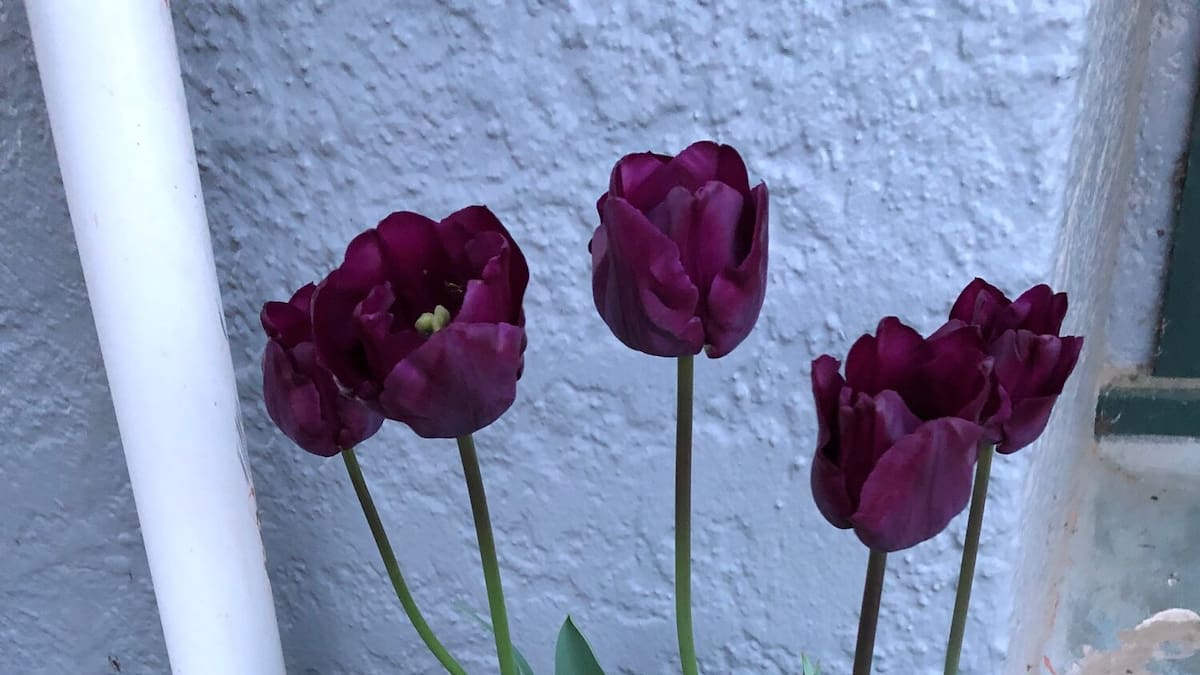
Tulips immediately make me think of pictures I have seen of Holland, with fields of tulips and windmills. While this is a common association, tulips actually originate from central Asia. There are about 150 “wild” species, many historically found along the Russian and Chinese border, all the way to France and Spain. They first captured the interest of the Turks in the Ottoman Empire around 1000AD, when they were cultivated for their beauty.
Tulips got to Holland in the 1500s when Ogier Ghiselan de Busbecq, the ambassador to the court of Sultan Suleiman in Constantinople, the seat of the Turkish Ottoman Empire, gave some tulip bulbs from Central Asia to a botanist named Carolus Clusius, who was working at the University of Leiden.
Many in Holland had seen paintings of tulips and the bulbs became highly sought-after. From 1634 to 1637, prices for tulip bulbs skyrocketed and a period now known as Tulipomania was experienced. It is reported that at the peak of this interesting phenomenon, a single tulip bulb sold for 10 times the annual income of a skilled artisan (a craftsperson producing, say, cheese, wine or furniture). There are also reports of a famous sale of a single bulb for the equivalent of US$2250 (almost $4000) – plus a horse and carriage.
The bubble burst and the cost of the bulbs became more reflective of the intrinsic value of producing a tulip bulb. However, the love for tulips by the Dutch did not decrease and today the country has one of the best-organised production and export businesses of tulips in the world.
With fascination for centuries, tulips today are the result of much hybridising and the range of sizes, colours and flower styles is varied. They are as spectacular as ever. I have found it hard to resist planting a few tulip bulbs at every house I have lived in over the years.
Tulips are easy to grow. Buy a few packets of bulbs now, dig a hole and bung them in.
There are a few different ways tulips can be treated and it is worth having a go to see what works for you.
Tulips come naturally from Central Asia, where they experience a cool winter period. This causes a process called vernalisation, which can sometimes be important to give good flowering.
The process of vernalisation can be replicated easily by the home gardener placing purchased bulbs into the fridge for four weeks before planting them out in the garden. Before planting, it is great to enrich the soil with Tui Sheep Pellets, Tui Compost and Ican Bulb Food, ensuring all is well mixed together. If you are growing in pots, using a specialty mix such as Tui Bulb Mix will offer excellent results.
They should be planted at a depth of 1.5 times the height of the bulbs. A few weeks later, foliage will start to appear through the soil. The varieties vary in the timing of their flowering but generally are within the period of August to September.
When the bulbs finish flowering, they should be fertilised, as this active growing period is when the bulb stores up reserves which will determine the success for next year’s flowering. The foliage should be left actively growing and the temptation to remove foliage should be avoided – leave it to completely die off itself during the summer. Once this has happened, the textbook would tell you to lift the bulbs and store them in a cool, dry position with good air flow (a tray or box in the shed) until refrigerating in March-April and planting out four weeks later.
Some will treat tulip bulbs like annuals, simply removing them after flowering and throwing them away. Councils often do this with public displays.
Others, such as myself, simply leave them in the garden.
Despite the mild winters we have here in Whanganui, I have found that 80% of the tulips I plant will come back and flower each year without being lifted or refrigerated again. I do recommend that to succeed in this “lazy” method, they need to be planted in a free-draining position, which lessens the likelihood of the bulbs rotting. Fertilising twice a year with Ican Bulb Food, firstly as they emerge through the soil and again as they finish flowering, will help encourage good flowering when using the lazy method for tulip growing.
For more gardening information, visit www.springvalegardencentre.co.nz.
Comments are closed.