

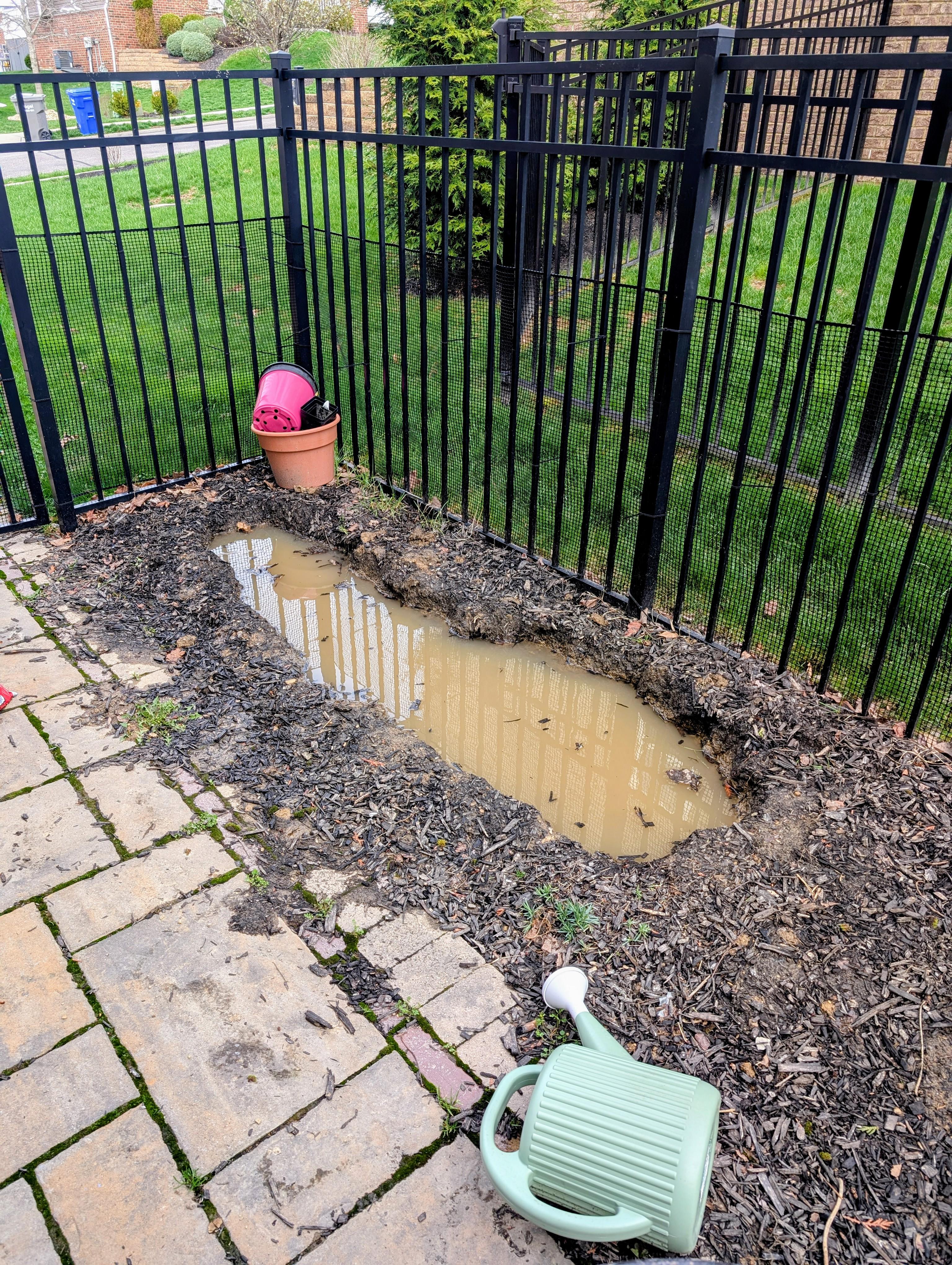
I moved into this house a few years ago, and am now getting around to making the landscaping my own. In the past few years, I've noticed that things planted in the mulched areas of the yard didn't really do very well. They were alive, but not thriving. Upon further inspection, I found that the ground is essentially all clay. Like, 1 inch of dirt before you hit pure clay.
My idea was to dig out a decent bit of the clay and replace it with topsoil so that anything planted there had a fighting chance. I got started with the process, and then we had a few days of heavy rain. As you can see, the trench (like 18 inches deep thus far) is just filled with water following the rain.
What is the move here? Will replacing some of the clay with topsoil make much of a difference, considering that the clay under it prevent further drainage anyway?
EDIT: I'm in zone 6b, western PA.
ANOTHER EDIT: Thanks, all. I think I'm probably going to just do raised beds. I don't have it in me to make it a multi-year process or to install a French drain or keep digging it out.
by phdeeznuts_
45 Comments
I had this problem in my front yard, and i mixed the clay with a lot of topsoil and compost 3 feet deep, but I also have much more room than you have. It also looks like it’s a pour point, and it’s collecting excess water. May I suggest a gardening box? Perhaps 2 feet tall. That’d be my way to go there.
I started out with a yard that was almost all a mixture of red and black gumbo clay. I tilled in a few bags of hummus and it got better each year. Just cut your plants down to the base of the soil when they are done and leave all those roots in and it helps add more nutrients and texture to your soil and is good for the natural biome you have going on down there.
Clay isn’t really that terrible to grow in as people think, I was still growing tomatoes in clay soil in ground beds that I could only add in one bag of hummus and compost into each one because of a bare bones budget so I didn’t have much other choice. Planting root veggies helps a lot too like carrots but rutabagas are really strong and long and will break down deep into the clay so when you add more hummus next year you will see a huge difference. You can make chips and fries out of the rutabagas too.
Mix it with other soils / compost depending on what you plan on growing there
Mix in compost as deep as you can get it and plant deep rooted things to help break it up.im talking like break it up 2 feet plus deep so that anything planted above has a chance to grow large enough roots. If you have a few years and don’t want to dig that far daikon radish are supposed to be good for breaking up the clay.
Clay isn’t as bad as it looks. It’s hard to cultivate, yes, but for a lot of demanding plants it’s the best soil and holds water for a long time.
How long until that puddle is gone? If it goes away within an hour or so, that’s pretty good soil.
Have you done a jar test to see what you have?
Generally, the answer is add carbon. Whether that be with compost, mulch, biochar, fungi, and plant roots.
Claybuster soil amendment with a digging fork or your dirt mover of choice to improve on a faster timeline. Slower timeline: find clay loving plants native to your region to loosen up the soil for you and add drainage via their roots. Check with your local native plant society for species lists.
gypsum
If you plan on putting in trees, be sure to add something that can grow in clay, like red maple, black gum, black willow, etc.
Mix in rice hulls, coir coconut fiber, or vermiculite to help drain.
Feed the clay with things like fallen leaves, crushed egg shells, and woody bits. It will take time, but it can be done unless you have the funds to blow on removing it all and buying a bunch of rich soil. I woukd consider setting up a compost bin to make soil as well.
If you find your yard has alot of dandelions in the spring, it will be because of hard compact soil. You can soften the soil with calcium, then they will leave. The purpose of a dandelion is to bring calcium to the top layer of dirt. They work on softening the ground.
Hope this info helps.
Mix the clay about 50/50 with sand. Plus whatever compost/humus you would normally add. The sand prevents it from packing down and improves drainage.
How far down you dig depends on what kind of plant you want there. Generally you want about 2 inches below the roots of the mature plant.
If you want to put in the work, and the slope of the land allows, you can install a french drain underneath. Or you can dig it out, put down about 3 inches of gravel, then fill the flowerbed on top. But I find the sand usually does the trick.
Another option is to plant things that have a strong taproot that will break through the clay.
One other hack that helps plants thrive in poor soil is to water with compost soup. (Fill a bucket with compost, then add water. Repeat until it becomes soup.)
Top with compost, grow daikon (tillage) radish this fall, let it die back and compost in place (i.e. don’t harvest it) over winter, add more compost in spring and plant what you want. Leave all roots in place when removing dead plants (though you shouldn’t remove the dead plants until spring to provide nesting sites for overwintering pollinators). Plant more daikon each fall as a cover crop and let it compost in place each winter. Pretend you’re cultivating worms there and the soil will improve quickly.
Raised beds!
Grow rice or start a brickmaking company
r/ponds
I would just get water loving wetland plants. Blue lobelia, bearded irises, Cardinal flowers and Astors would all do great there.
Are you set on growing in ground? If that was my soil I would just build a raised bed. Oh wait, I built 7. Just use a 2 x 12 to build it. Fill it with topsoil & compost. Lots of Ideas on YouTube.
As a resident of N. Georgia we just gave up and went to raised beds
Good news: Plants will help break up clay overtime.
bad news: Yes, this will impact drainage. You can mitigate this slightly by taking a garden fork and poking a bunch of holes in the bottom of the trench to increase the surface area for drainage.
This looks like NC Clay. Like others are saying, yes, dig some of it up and mix in organic materials to start to get worms breaking up the clay. And, don’t plant down in a hole. You’re going to need to mound up your plants so you don’t get root rot.
Sunflowers, or anything else with deep taproots. This is how you get your clay to work for you. The deep taproots go beyond the clay layer, and once the deep rooted plants die off, other plants use the root systems’ holes leftover after they rot away to get beyond the clay.
Don’t walk on it while it’s damp or wet, especially since it’s clay. Clay compacts real easily when wet.
Have you done any exploration to see how deep the clay goes?
I’ve had some luck using long drill bits to create deep drainage channels through clay down into more permeable layers below. Drill and fill with coarse sand worked for me, but if you were really ambitious you might add a casing to keep the clay from migrating in from the sides.
Full acre of clay here in zone 6b – I have been planting + adding nutrients to soil around house now for going on four years. Has been a massive improvement but it is alot of work
We aerate and seed the lawn every other year or so to try to turn over nutrients and ensure less water logging.
https://youtu.be/aWcU8r6sxVo
This guy has good advice.
Do not work in the soil while it is wet.
I have blue clay in my yard (clay, but also nutrient-poor and anoxic, oh boy!) and am very careful to only dig when the ground is totally dry. I mix in gypsum and organic matter to help remediate the clay, but it’s important to avoid over-improving. What can happen is that you end up with a bowl with clay sides that water runs into (because your improved soil that is water permeable collects the water draining off the clay around it), then can’t drain out. So there’s definitely a balance in how much to amend. You don’t want such a stark difference between your planting hole and the surrounding soil that you end up with a water issue.
I think layering compost and soil on top of the clay, à la lasagna gardening, is one of the better options, since mechanical tilling can mess up your soil structure. You can also plant deep-rooted vegetables like daikon turnips to grow deep into the clay as sort of a Nature’s own clay-breaker – when they’re mature, cut the tops off and leave the turnips underground to rot, which gets organic matter deep into the clay for you. The whole thing is a multi-year project, where you need to layer organic matter on top every year, but it does get better with time and diligence.
Build a raised bed on top?
Sunflowers in the spring, Daikon Radishes in the fall.
Congratulations, you have a pond! I think you are right that raised beds are the way to go.
I jackhammer it & amend with organic matter.
Compost and compost more every year
Fellow SW PA gardener, I feel your pain! When I pulled up the tarps and rubber chips and found nothing but CLAY underneath, I was seriously considering burying a voodoo doll of the previous homeowners under the chips lol.
I’m lazy, so I did planters everywhere and all that’s planted in the ground is susans, susans, and more susans lol. Good luck to you!
I had clay and had tremendous results. Get a bunch of compost and turds and leaves and till it. You’ll have a forest.
A sunken grave, RIP whoever was buried there i guess 😿💯
Do not simply just remove all the clay. Plant things that do well in your existing soil or lightly amend it to be more palatable – but be aware that this will lead the plant down a false road when its roots eventually hit the clay.
Just buy a bunch of gypsum and till it in very good
In addition to organic matter, add gypsum
Raised beds.
As a Texan, I sympathize. Crepe myrtles seem undeterred by crappy, packed soil, if you wanted something tall.
You have 1/3 of an organic soil mixture already LOL now you need 1/3 sand and 1/3 peat moss,
Someone mentioned tilling in a Humic layer that is spot on look into how organic humic is sourced/made,
Do you compost? Purchase some for now but I would start if you have the space you are going to need A LOT
Personally I would probably excavate the clay and backfill with a high quality soil or do large raised beds bc I am not 3+ years patient to achieve a high quality soil,
You can throw all the clay into a pile and use it to make your own soil to top dress tho etc down the line so it’s still worthwhile to learn how to make use of it
Clay is the best, it is a blessing once you get some organic matter in there.
Find a native plant nursery near you. Native plants will thrive in the clay, are low maintenance and support pollinators!
My fix for this was buying manure compost from Lowe’s. Black gold was the label of that’s any concern (it’s fairly cheap). Dug out a trench, filled with the compost, some straw and wood chips.
Lots of organic matter, add a little every year. Do cover crops.
Compost. The answer is always compost!