
You’ve heard of farm-to-table dining? But how about roof-to-table?
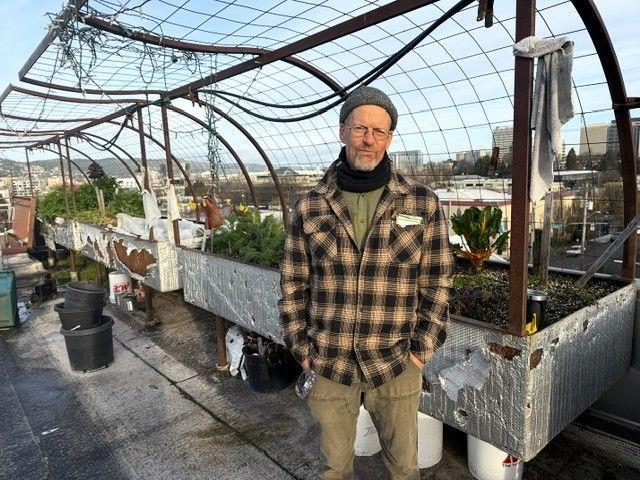
In a city shaped by dense neighborhoods and a growing skyline, Marc Boucher-Colbert set out to create something distinctive in Portland: a rooftop garden.
Boucher-Colbert has been doing rooftop gardening in Portland for about 20 years. For those who dine at Noble Rot on East Burnside Street, you’ve likely tasted his harvest.
Sneaking up a steep metal ladder and through a red hatch door is where you’ll find this hidden realm of spices, herbs, lettuces and more. One edge has raised garden beds, while the ground is an open playing field for pots and planters. Initially, Boucher-Colbert used kiddie pools to grow his goods, filling the entirety of the roof.
Even in the early spring, there were lettuces, parsley, chard, French tarragon and other bits and bobs awaiting the warmer months. Boucher-Colbert snagged a taste of the arugula flowers, which yield the signature spicy flavor with a hint of sweetness from their nectar.
The idea grew from a small inspiration. Well, actually a rather large inspiration. A 6-foot-tall birch tree growing out of a gutter, to be precise.
“How is that working? What is that? Where are your roots?” Boucher-Colbert remembered thinking as he passed by.
He’s been the primary rooftop gardener at Noble Rot for decades, while the chefs are the main harvesters. Executive Chef Joe Hickey can step in intermittently when Boucher-Colbert is away, but otherwise, he’s the main man.
Everything that goes up comes down into the restaurant.
“That’s the only reason why we exist,” Boucher-Colbert said.
Guests will find items from the roof in capitals on the menu, including drinks from the bar, which utilizes fresh herbs and flowers. Noble Rot has even made things like fennel seed-infused liquor. Look out for the rooftop salad, which comes and goes as the garden is depleted and then regrows.
Plus, it all fits with their branding: Wine. Booze. Food. View.
Finding freedom in farming
Most of his life was spent in Manchester, New Hampshire, where he was born, before attending postsecondary school in Washington, D.C. Boucher-Colbert moved to Portland in 1992.
Gardens were neither part of his childhood nor part of his initial career. Boucher-Colbert taught theology at a high school in New Hampshire.
“I wasn’t happy and I needed to do something different,” he said. “I got in with this crazy guy who told me about a farm in Western New Hampshire.”
He knew that the “crazy guy” was a German man running a farm, but he turned out to be one of the people who brought the community-supported agriculture movement from Europe to the States.
“Just by chance, I landed on his farm,” Boucher-Colbert said.
It was biodynamic, following the philosophy of Rudolf Steiner, which wasn’t his “cup of tea.”
But still, he loved what he saw – milking cows and tending to veggies.
“I got a big, huge dose. It was like a big dose of radiation and it totally changed me,” Boucher-Colbert said.
From there, he told himself it’s what he would pursue. He found his passion. Plus, right around that time, he found the woman he’d marry.
Boucher-Colbert was about 23 years old and started writing postcards to Portland-area farmers, seeking an escape from the rural isolation of New Hampshire, he felt.
Starting at a Wilsonville farm
A little mom-and-pop shop welcomed him in. It was called the Dennis Farm.
Here, he would learn to farm while traveling between New Hampshire and the Portland area to visit his partner. Through her, he met another woman who was apprenticing at a farm in Canby. Together, they started a community-supported agriculture farm called Urban Bounty.
It was 1993, and Urban Bounty was on Johnson Creek. It was one of Portland’s first community-support agriculture farms, and at the time, the first within city limits.
Today, it’s called Jean’s Farm, which still operates as an educational farm.
Boucher-Colbert eventually moved to Zenger Farm several years later and helped develop Friends of Zenger Farm. This is a nonprofit urban and organic farm that helps educate about sustainable food systems, environmental stewardship, community development and accessibility to good food for all.
In 1999, he and his family left for a two-year stay in Brazil.
Developing a day job and a rooftop garden
By the time he returned to Portland, an opportunity arose to teach youth gardening, but it came with one stipulation: he had to be a grad student. Boucher-Colbert received a scholarship to Portland State University for a master’s degree in education.
During school, he was challenged to implement a project – something beyond just research.
It’s when he contacted Leather Storrs, a renowned Portland chef, proposing they grow a few fruit and olive trees on the roof of his restaurant.
With the support of Storrs, he developed a bountiful and ever-expanding rooftop garden that was highly productive for about 12 years, when the restaurant concept Rocket, which was replaced by Noble Rot, was on Southeast 28th Street and Ankeny Avenue.
Storrs eventually left Noble Rot, which is owned by Courtney Storrs and Kimberly Bernosky, but Boucher-Colbert followed the restaurant to its current location at 1111 E. Burnside St., Portland, to continue the garden.
During the day, he teaches first through eighth grade at Franciscan Montessori Earth School. He’s been teaching there for as long as he’s been doing rooftop gardening.
Limitations do exist
It may come as a no-brainer, but limits to rooftop gardening do exist. It’s more than just filling some pots with soil and seeds and letting them soak up the sun up high.
“Whoever owns the building kind of owns the vision. You’re at the mercy of that person of what they want,” Boucher-Colbert said. “So we’re getting our wings clipped progressively over the last few years.”
There have been fewer yeses and more nos.
With this comes the reality of aging buildings, wonky roofs and structural integrity.
For Noble Rot, the space was designed like a parking garage, making it a fortunate place for a rooftop gardener to land. Loading the deck with soil isn’t a cause for concern.
Other issues include accessibility. While the ladder and hatch door at Noble Rot are fairly accessible, it didn’t make lugging a backpack strapped with soil any easier.
Beyond the architecture, the components of successfully growing a harvest from up high are minimally impacted. Boucher-Colbert anticipated a significant difference in heat, but was proven wrong.
The main culprit is wind. Lots and lots of wind. Enough wind to produce a force called wind uplift. How it essentially works is that as wind passes over a building with small enclosure walls, it creates spirals around them, creating an updraft, and can suck things off the roof’s surface.
Boucher-Colbert said they’ve never had that happen, but it is a danger. He explained that other rooftop gardens have seen entire sheets of plywood picked up and flown through the city.
Benefits big and small
While not every rooftop is equipped to handle a garden, it doesn’t mean the concept can’t be broadly applied to urban environments.
Do you live in an apartment in the city with a sunny patio? Throw a few pots out there with flowers, herbs or a vegetable of your choice.
“It can be good for pollinators and other creatures migrating or taking up habitat where they’ve lost their quality of life,” Boucher-Colbert said.
It can also encourage self-sufficiency and provide a sense of purpose.
“If all you have is a fire escape, you might not get a whole summer’s harvest, but, you know, you could grow one bowl of salad,” he explained.
Or choose a persistent herb like basil. It will come and come again, providing a wealth of flavor that can be used fresh or dried for later.
As for restaurants, it’s all about freshness. Boucher-Colbert explained that Leather Storrs liked the idea initially because he thought it would teach chefs to respect the product.
“There was a sense of, instead of just your prime material arriving in a case, you were, you know, seeing it from the soil, seeing its growth cycle and harvesting it,” Boucher-Colbert said.
Having it on your rooftop is just about as close as you can get.
Follow Marc Boucher-Colbert on Instagram @UrbanAGSolutions for more. Visit Noble Rot, 1111 E. Burnside St., Portland for a taste of his garden.
Comments are closed.