

I think we can all agree: The weather has been weird this year. We had the hottest December through February on record, then a historic heat wave in March. Just before that last stretch of heat, I hiked Gabrielino National Recreation Trail near Pasadena and saw hundreds of native chaparral whitethorn in full, striking bloom. (Its typical bloom, according to the Forest Service, occurs from April to June.)
I’m sure you have your own stories about California poppies popping in January and wilting now or loquats ripening early or seeing jacarandas, which more often bloom in May or June, getting an early start! Or maybe you’re posting about how you’re using cocktail umbrellas to protect your seedlings from the sun. With all of this in mind, I turned to some L.A. experts for advice on how to better care for your home garden this year.
Sanjay Gupta typically uses April 1 as a tidy deadline day. The founder of local backyard edible landscaping service Orchard Hour, Gupta often receives spring questions from clients about the status of their prized tree: “Is it on track? Will it produce fruit this year?”
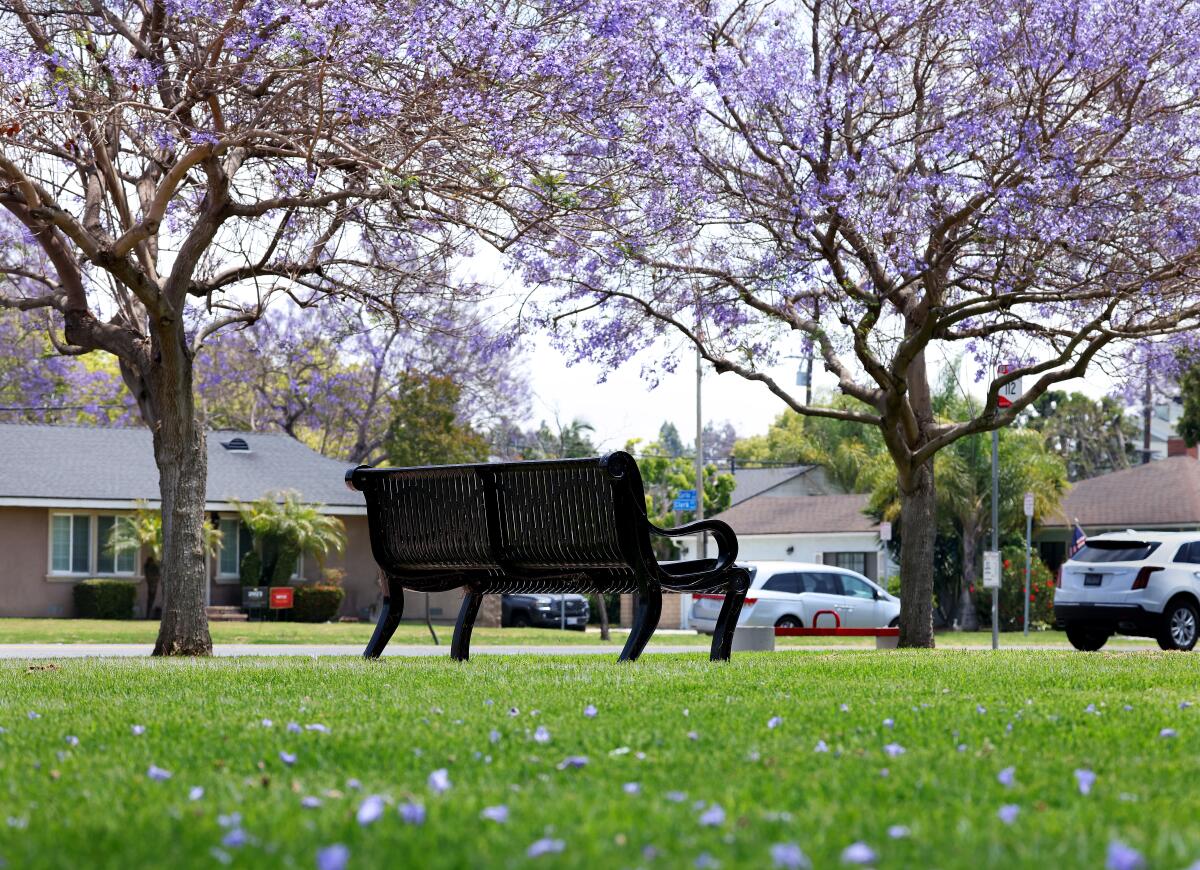
Jacarandas in bloom in Long Beach in May 2024. This year, because of the recent hot weather, those familiar purple blooms have started to pop up already on Fairfax Avenue and Hollywood Boulevard in Los Angeles.
(Christina House / Los Angeles Times)
“If your tree hasn’t leafed out by April Fools’ [Day],” Gupta likes to say, “then you’ve been fooled.”
To commercial growers and home gardeners alike, this year offers the opposite concern.
In Panorama City, Cottonwood Urban Farm’s namesake tree leafed out almost a full month ahead of schedule. “Larger organisms have just been like, ‘OK, I guess I’ll put my flowers out now,’” said Elliott Kuhn, the farm’s founder and steward.
Across the region, smaller plants, too, are sending similar signals.
“There’s definitely an early transition to flowering and seeding for a lot of the crops in the garden,” Kuhn said. “For the average home gardener, hey, the winter crops that you planted thinking we’d still be in cool weather, they’re probably gonna bolt and flower.”
Is that bad? Call it a matter of perspective. We could have beautiful tomatoes by Memorial Day.
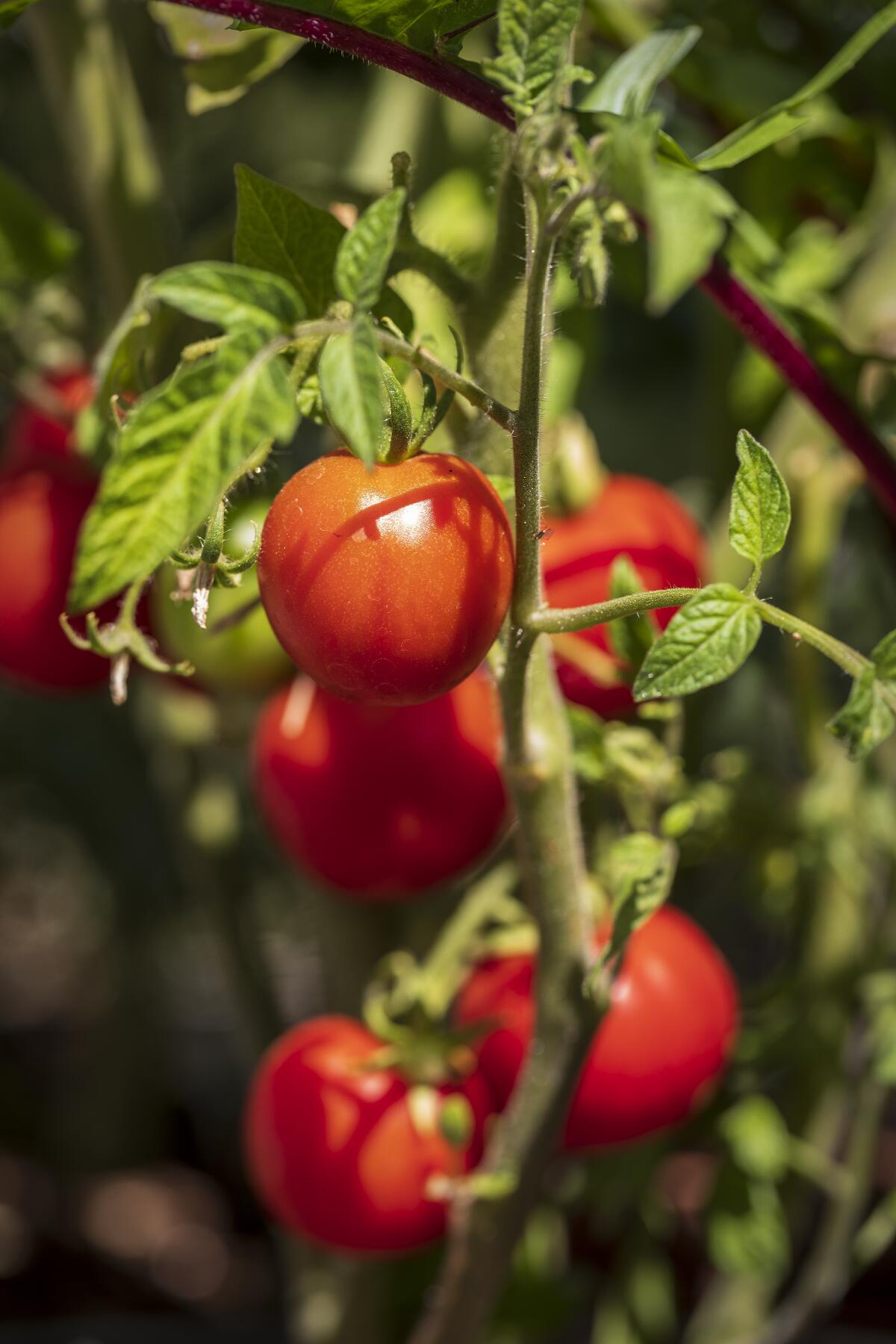
Heirloom Stupice tomatoes grow happily in a raised-bed vegetable garden. Because of recent weather, we might get a harvest of tomatoes later this spring.
(Ricardo DeAratanha / Los Angeles Times)
It’s a perfect opportunity to collect seeds and transition to summer crops early. If you haven’t done so yet, transition as soon as possible. Steve List, a farm-to-classroom advisor for the Los Angeles Unified School District, said he began removing winter vegetables like broccoli and spinach in mid-March, a month ahead of normal years.
“Probably the worst thing with the heat was the early execution of our winter vegetables,” List said. “But we are getting our summer vegetables in early, which is great.”
Fruit trees, though, require different strategies. Early-season varieties of stone fruit, which require fewer chill hours, seem on schedule thanks in part to all the early winter rain. On his orchard, Kuhn gleefully reported, sizable quantities of Desert Delight nectarines and Eva’s Pride peaches have set on their respective trees.
Everyone I interviewed agreed: This won’t be a banner year for late-season fruit, as those trees generally require 500 or more chill hours, like August Pride or Autumn Flame peaches. Even accounting for the rain this winter, there simply wasn’t enough cold weather to approach that number.
The question now is: What will become of everything else, all the mid-summer stuff, like glorious Mid-Pride peaches? That, Gupta suggested, might depend on those trees’ caretakers. He noted that humans have for centuries bred our fruit for specific characteristics: small (or no) seeds, juicy fruit. Think seedless watermelons or clementines.
“They don’t have the same kind of resiliency that a native plant would have,” Gupta said. “So we have to take care of them, baby them.”
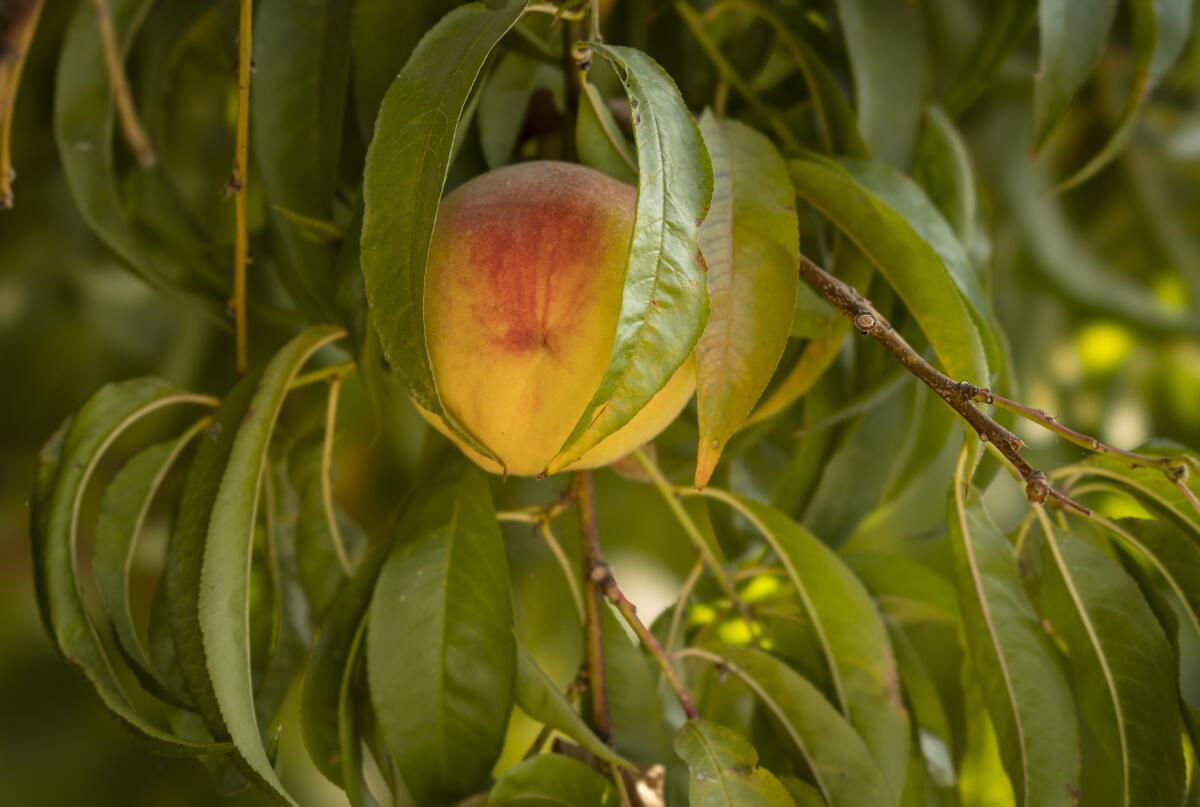
A peach grows in September 2022. This year might not be a big year for late-season fruits because of the recent heat wave.
(Tomas Ovalle / For The Times)
Gupta is fond of utilizing anthropomorphic metaphors to illustrate plant principles. He has found they stick with clients far longer than scientific explanations. For this moment, he happened to have an array ready for me:
The idea that the early winter rain could be helping most trees now: It’s like the idea of hydrating for a marathon months in advance.Mulching tree bases: It’s akin to handing them a thermal blanket to insulate against heat. Pulling leaves off young trees after pruning to force them into dormancy: It’s like giving the tree a sleeping pill — a rare but occasionally necessary method. (“You need to go to bed now,” he said, “and you’ll wake up feeling refreshed.”)
Leaves, Gupta said, are a tree’s air-conditioning system, or, through the stomata on their underside, its breathing and sweating mechanism. But, at this stage in the spring, the system is not yet fully developed, and human intervention is necessary. We must water more.
“Really, what it is is that we have to simulate rainfall through irrigation,” Gupta said. “We have to adjust and help these trees stay cool, because those tender leaves that come out right now, they can be really susceptible to just getting fried if there’s no water running in their veins.”
Fried fruit, anyone? The fear is there. Fifty years into his horticulture career, List said he’s not expecting much from this year’s fruit.
“But you know what?” he said. “Mother Nature always surprises me.”
Speaking from the San Fernando Valley recently, where temperatures continued to hover around the mid-80s, Kuhn said the situation is not as catastrophic as it feels.
“On the average day, you’re like, ‘God, what is this? This is so disheartening,’” he said. “But gardens are models of resilience and adaptability.”
Responding to the SoCal heat
Vegetables
Whether you garden in containers or in the ground, if you haven’t moved on yet from your winter crops, now is a fine time to do so. If you are right on the coast, maybe you haven’t yet experienced the signal of a bolting plant this spring. But this weekend will be warm. It could be a great time to put in some tomatoes. Or you could start them from seeds now and harvest them a little later in the year.
Fruit trees
Follow Gupta’s advice and make sure your trees are receiving a bit more water than usual as long as it remains hotter than usual. Deep watering is great. Make sure there are at least two, ideally three or four, inches of mulch all around the tree, but not touching the trunk itself. That will help keep roots moist. Compost can help too.
Native plants
If your plants have been in the ground for less than one year, pay special attention to how they’re doing given this heat. Like with fruit trees, deep, infrequent watering is the way to go. Calscape.org recommends watering levels for any plant native to the state.

Consider subscribing to the Los Angeles Times
Your support helps us deliver the news that matters most. Become a subscriber.
Free seeds at L.A. Public Library system
Circling back to Kuhn: At his Panorama City farm, he has just finished an ambitious project in partnership with the Los Angeles Public Library system. Fifteen thousand seed packets will be distributed across the city’s 72 branch libraries. By Earth Day, April 22, each branch library should have 200 packets of various seeds. Patrons will be able to take some packets home. Kuhn selected the seeds for their ability to weather any weather event — or at least most of them. “These are crops that can be grown 365,” he said. Choose from bunching onion, radish, Swiss chard and more.
Altadena All-Stars lineup of trees
Altadena Green, a grassroots organization of volunteer landscape professionals, last month released a curated list of trees it’s calling All-Stars as a guide for locals replanting in Altadena yards. The list is separated into small, medium and large trees, taking into account the mature size of each tree. The organization explained its criteria: Trees must be available nearby in 15-gallon containers or larger; must provide wildlife habitat and not be listed on the California Invasive Plant Council’s inventory of invasives; and must be suited to thrive in the area’s modern climate.

A roundup of upcoming plant-related activities and events in Southern California, along with our latest plant stories.
By continuing, you agree to our Terms of Service, which include arbitration and a class action waiver. You agree that we and our third-party vendors may collect and use your information, including through cookies, pixels and similar technologies, for the purposes set forth in our Privacy Policy such as personalizing your experience and ads.
Upcoming events
April 1
Forest Bathing: Full Moon at the Los Angeles County Arboretum and Botanic Garden, 7 to 9 p.m. in Arcadia. Inspired by the Japanese tradition of shinrin yoku, or forest bathing, you’ll engage all your senses from dusk through darkness below a full moon. Tickets are $25 for members and $35 for non-members and include garden admission. arboretum.org
April 3
Habitat restoration at the Audubon Center at Debs Park, 8:30 to 10:30 a.m. in Montecito Heights. Volunteers who don’t mind getting dirty are welcomed to water and help remove invasive species in partnership with local landscape firm Terremoto’s nonprofit arm, Test Plot. audubon.org
April 3 and 4
Poppy Days spring sale at the Theodore Payne Foundation, 8:30 a.m. to 4:30 p.m. in Sun Valley. The long-standing native plant foundation will run a short sale, offering 10% off plants to non-members and 15% off to members. theodorepayne.org
April 4
Guided Garden Tour at UCLA’s Mathias Botanical Garden, 10 to 11 a.m. in Westwood. Join a free tour exploring global plants collected on the college campus. eventbrite.com
April 8
From Ashes to Action at the Los Angeles County Arboretum and Botanic Garden, 5 to 7 p.m. in Arcadia. Attend a free community conversation about Eaton Canyon’s new Landscape Recovery Center, discussing the seed banking and conservation that will guide the area’s continued restoration. arboretum.org
April 10
“Joy in the Garden” exhibit opening at California Botanic Garden, 8 a.m. to 6 p.m. in Claremont. The state’s largest botanic garden is celebrating the opening of a new woodland geared toward children, featuring artworks by local artists ages 2 to 18. Free with $5 to $15 garden admission. calbg.org
April 10 to 12
Veggiepalooza at the Arboretum and Botanical Garden at Cal State Fullerton, varying times in Fullerton. The Orange County campus’ beautiful garden hosts its annual spring sale, with hundreds of edible plants available, plus dozens of California native and nonnative plants. arboretum.fullerton.edu
April 11
South Pasadena sustainability fair and plant swap, 1 p.m. to 4 p.m. at South Pasadena Nature Park. The city is hosting its annual event at the park. Tickets are free, and bike valet is also free. Bring a labeled plant to trade for something new. southpasbeautiful.org
April 11 and 12
Theodore Payne Foundation garden tour, 10 a.m. to 5 p.m. across Los Angeles. Visit 42 gardens all over the city that incorporate plants native to our area. The tour is self-guided, but friendly docents await you at each stop. Tickets are $55 or $49.50 for members. theodorepayne.org
April 14
Pursuing a Ban on Artificial Turf in Southern California, 7 p.m. online. The Los Angeles/Santa Monica Mountains chapter of the California Native Plant Society hosts its monthly program, discussing hazards of artificial turf installations and introducing attendees to the SoCal Stop Artificial Turf Task Force. chapters.cnps.org
April 17
Migrating Bird Watch with the Moore Laboratory of Zoology at Occidental College’s student-run urban garden, FEAST, 8 a.m. to 10 a.m. in Eagle Rock. Bring binoculars to track seasonal visitors as part of Earth Month festivities. eventbrite.com
April 18
Rewind Ojai native garden tour, 9 a.m. to 3 p.m. in Ojai. The Ojai Valley Land Conservancy is putting on its third annual tour, on a smaller scale than Theodore Payne’s longstanding event, but with plenty of worthwhile stops. Tickets are $35. ovlc.org
Parent & Me: Pollination Exploration at South Coast Botanic Garden, 11 a.m. to noon in Palos Verdes Estates. Children and chaperones explore the garden together, making art that resembles what they find. Tickets are $10 to $12. southcoastbotanicgarden.org
April 18 and 19
The L.A. Times Plants booth at Festival of Books, 10 a.m. to 6 p.m. Saturday and 10 a.m. to 5 p.m. Sunday at USC. Meet experts from the Theodore Payne Foundation and the California Native Plant Society, along with Times staffers. The booth is in a new location — booth 554 in the Red Zone — and it will be a tribute to L.A. Times plants writer Jeanette Marantos, who died in February. latimes.com
April 19
Wildlife Wonders at Sherman Library and Gardens, 1 to 4 p.m. in Corona Del Mar. Meet birds of prey and participate in other hands-on activities at the Orange County garden. Tickets are $10 to $35. thesherman.org
April 22
“This Is A Gardening Show” premieres on Netflix. Comedian Zach Galifianakis hosts a six-episode exploration of gardening from small to large scale. netflix.com
April 23-26
Southern California Spring Garden Show at South Coast Plaza, in Costa Mesa. The 36th annual event includes curated garden designs and a botanical installation made exclusively out of plant materials. southcoastplaza.com
April 24-27
City Nature Challenge bioblitz, remotely. What began as a 2016 contest between San Francisco and Los Angeles has evolved into a global call to track biodiversity around us for one extended weekend. Los Angeles is one of hundreds of global cities participating. In 2016, 19,000 observations were recorded. In 2025, there were 3.3 million. citynaturechallenge.org
April 25
Rooted Workshop at Descanso Gardens, 11 a.m. to 12:30 p.m. in La Cañada Flintridge. Create a succulent arrangement under the tutelage of instructor Maritza Aguirre. Vessels and plant materials are provided. Bring your own gloves. Tickets are $55 to $65. descansogardens.org
Cheeseboro Canyon hike, 9:30 a.m. to noon in Agoura Hills. Join the lead restoration technician for Santa Monica Mountains Fund, Emily Dion-Staebell, on a two-mile hike of a native plant restoration project at Cheeseboro Canyon. The event will be put on by the California Native Plant Society’s Los Angeles/Santa Monica Mountains chapter. chapters.cnps.org
What we’re reading
Comments are closed.