
By Charlie Pike and Sarah Stebbins
Photos by Kelsey Kobik
From our April 2026 Home & Garden Issue
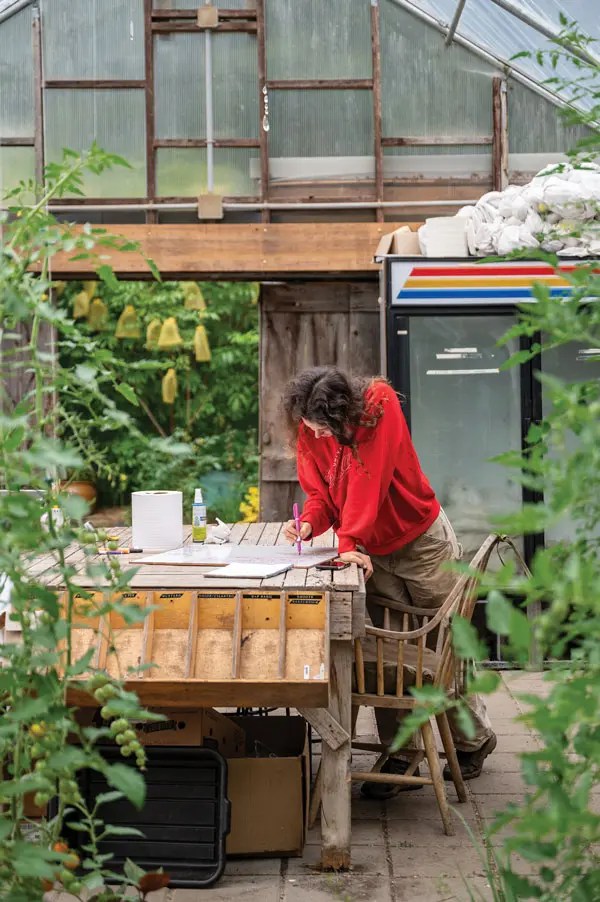
Former farm manager Abigail Gallagher (in the red sweatshirt) and farmhand Tess Killmade on the lush grounds at Primo restaurant, where chef Melissa Kelly says she “lets the garden write the menu.”
Farm to Table
In February, three months before Primo opens for the season, a farm crew starts seeds for radishes and a dozen types of greens in a pair of Gothic-arch greenhouses on the restaurant’s five-acre Rockland property. When frilly leaves fill the trays, the plants are moved to the farm’s gardens, where the lettuce and cruciferous vegetables (like kale and cauliflower) will be continuously reseeded through the fall. The greenhouses are then given over to tomatoes, summer squash, cucumbers, eggplants, peppers, herbs, and edible flowers, and cover crops like buckwheat and clover are planted in the garden beds to suppress weeds and add nutrients to the soil.
In 2000, when chef Melissa Kelly, a two-time James Beard Award winner, opened the largely Italian-inspired restaurant in an 1858 farmhouse, she envisioned a largely self-sustaining enterprise, with the majority of food grown on-site and the rest sourced from local farms. Now, in the summer, approximately 80 percent of Primo’s ingredients come from the property, which is home to organic vegetable gardens and free-range chickens, ducks, hens, and pigs. In the kitchen, the staff sorts food scraps into colored buckets designated for stock, animal feed, and compost that is worked back into the land to nourish the crops.
Kelly appreciates being able to hand-pick ingredients for dishes such as her signature fried squash blossoms filled with herbed ricotta. (“If I order squash blossoms, they come closed, which makes them difficult to stuff,” she notes.) The gardens also supply endless inspiration. Last summer, Kelly became enamored with the acidic, slightly bitter taste of tomato leaves. “We juiced them and used them in cocktails; we fried them and used them as a garnish on pasta,” she says. The leaf has so much flavor, and it’s not something you can go out and buy.” Petals from a surplus of nasturtiums and marigolds, meantime, were dehydrated and crushed into a powder that added tangy, peppery flavor to butters, sauces, syrups, and salad dressings. “It’s a creative act to walk into the garden and let your imagination run wild,” Kelly says.
Clockwise from top left: Goranson Farm co-owner Carl Johanson; co-owner Jan Goranson watering trays of seedlings; shishito peppers; harvsting Tokyo Bekana (a type of Chinese cabbage); Jan picking basil in one of the warmer greenhouses; vines and vines of cucumbers.
Vegging Out
As organic-produce growers, the family that runs Dresden’s Goranson Farm has had to get creative. In the last few years, Jan Goranson, her husband, Rob Johanson, and their sons, Carl and Göran Johanson, have begun using tools that emit blasts of pressurized steam to kill weeds and netting to keep insects off their crops. When aphids inevitably breach the nets, they unleash ladybugs to feast on them. To manage pests on potato plants, Göran fitted out a tractor with metal rods that rustle the leaves, knocking the bugs off, and a propane-fueled torch that zaps them as they drop to the ground. He calls it a “beetle beater.”
One of their most significant innovations to date, though, has been the addition of two soaring, Gothic-arch greenhouses with ridge vents and retractable polyester sidewalls controlled by sensors. “They automatically open and close throughout the day to maintain a specific temperature and vent out humid air,” Göran says. “As organic producers, there aren’t a whole lot of effective materials we can use to control pathogens on our plants. Effectively managing things like humidity keeps them drier and healthier.”
“Organic growing is a mindset,” co-owner Göran Johanson says. “It’s the idea that, if we feed our soil what it needs to be healthy, it will produce a healthy crop.”
The farm was founded in 1960 by Jan’s parents, Everett and Geneva, potato growers from Aroostook County who moved south in search of more-fertile soil and a longer growing season. For more than two decades, they harvested potatoes in the sandy loam along Route 128 and the Kennebec River. When Jan took over with Rob, in 1986, people called her “the potato lady.” Over time, the couple added more vegetables, plus fruits, flowers, maple syrup, meats, and dairy products. They sell year-round at farmers’ markets and an on-site farm stand, as well as through CSAs. The farm encompasses 14 greenhouses and fields that spread out over 145 acres. For now, the fancy new enclosures are reserved for greens in winter and herbs and tomatoes (which are highly susceptible to diseases such as blight) in summer. “Ideally, we’d have this technology in all of our greenhouses,” Göran says. “We’re just starting to dive into it as a way to produce a healthier crop.”
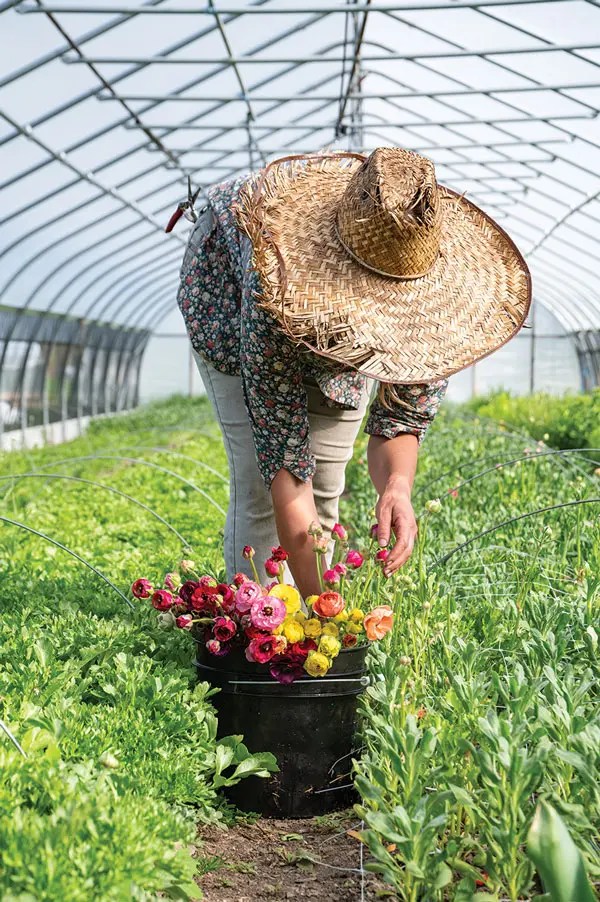
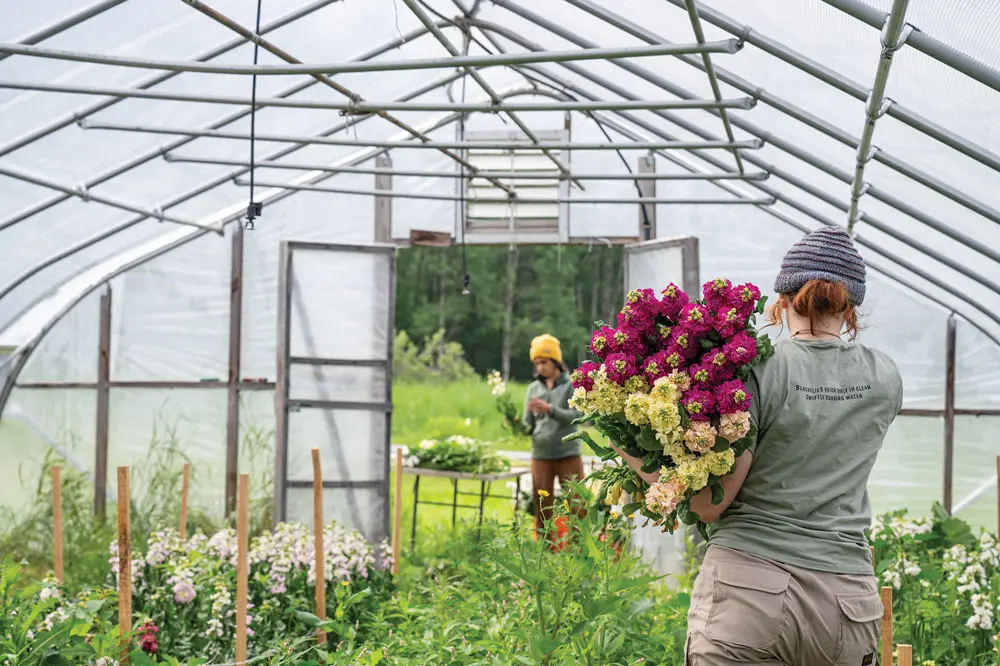
Clockwise from top left: New Beat Farm assistant flower manager Riley Plamondon and co-owner Ken Lamson at work in one of the greenhouses; draping a shade cloth, loading a wagon with stock and larkspur; a greenhouse filled with snapdragons, sweet peas, orlaya, and ammi; a rainbow of stock; co-owner Adrienne Lee with a bucket of ranunculus.
Flowers to the People
Four years ago, organic-produce growers Adrienne Lee and Ken Lamson learned that their well and more than half of the tillable acres on their 94-acre New Beat Farm, in Knox, were contaminated with PFAS chemicals. Often called “forever chemicals,” PFAS have long been used in industrial processes and consumer goods and have been linked to cancer and other health conditions. Starting in the 1970s, the chemicals began seeping into farmland via sludge, a by-product of wastewater treatment containing the residue of household, municipal, and human waste that was marketed as a fertilizer. Lee and Lamson had to pull their crops off the market, drink bottled water, and give their then-toddler daughter fewer baths. “It was devastating,” Lee says. “It takes years to build up your market base, your name, your reputation.”
Over time, though, the couple began to see the tragedy (which compelled them to install a new well and water-filtration system and conduct in-depth soil and plant-tissue testing) as an opportunity to turn over a new leaf. They dedicated five domed and Gothic-arch greenhouses they had been using to grow lettuce and other greens in the winter—edible crops they could no longer safely accommodate as transplants in their diminished fields come spring—to flower seedlings that bloom from May through September. Lee, who heads up the floral operation, focuses on hardy varieties less commonly found in florists’ shops, such as snapdragons, sweet peas, ranunculus, delphiniums, and zinnias. “People don’t just want roses and your typical wedding fare,” she says. “They’re starting to see and appreciate the amazing variety of blooms that can grow in our state.”
Today, Lee and Lamson grow tomatoes in their greenhouses through the summer and switch over to flowers in October. Come spring, their fields host more flowers and nearly two dozen varieties of fruits and vegetables they sell at retail shops and through CSAs. Lee also has a side business creating floral arrangements for weddings and other events. “Flowers are a pivot for us, and it’s proved fruitful,” she says. “They’ve allowed me to have more artistic expression, and they attract beneficial insects that help with our vegetable pests. I see the benefits of growing flowers alongside our vegetables every day.”
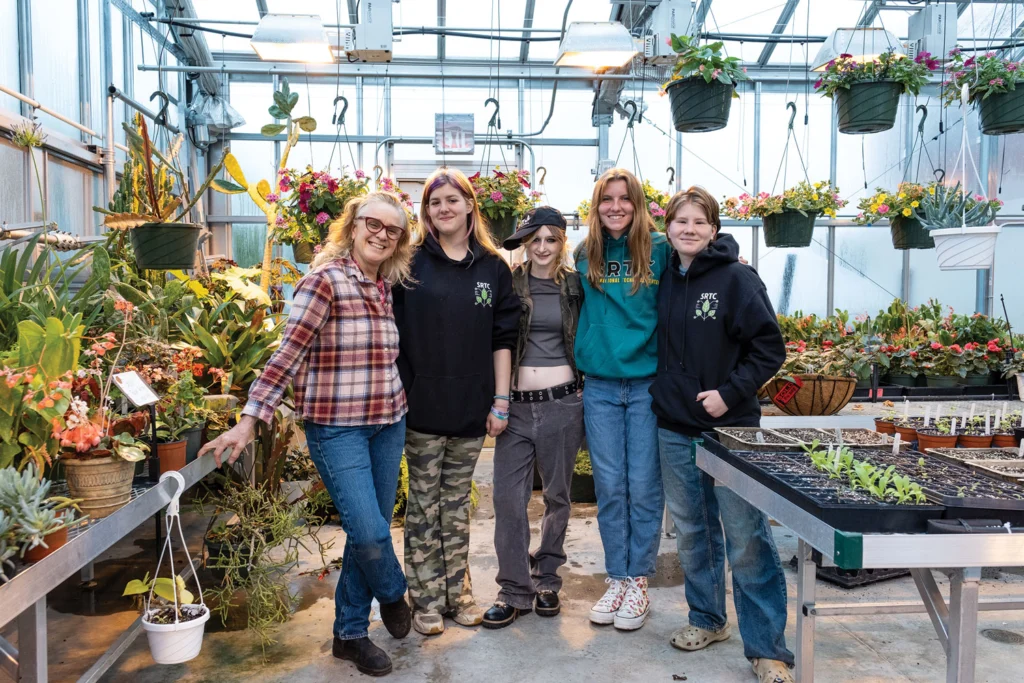 Former agriculture teacher Pamela Durack with students in the high-tech greenhouse at Sanford Regional Technical Center. Photo by Alex Daley-Clark
Planting a Seed
When Pamela Durack joined Sanford Regional Technical Center as an instructor in the agriculture program, in 2020, there wasn’t much around that was agricultural. Two years earlier, the school had moved to a new campus surrounded by a lot of pavement. “Zoning had the prerequisite number of trees, but that was it,” Durack says. Together with her high-school students, who study greenhouse management, sustainable agriculture, and landscape design as part of a hands-on, two-year program, Durack set about beautifying the grounds. In front of a student-run café, the crew put in a vegetable garden for the school’s culinary-arts students. They planted an apple orchard and installed ornamental hedges too. “I wanted the students to understand the design process and how to care for a landscape,” says Durack, who retired from teaching last year.
“I had professionals come in and say there’s nothing like this greenhouse locally,” Durack says. “The weather station tells the windows to open, the heat to come on, the fans to run.” It would have taken care of watering too, but Durack preferred to do that herself.
The agriculture students also help manage two greenhouses. One is a dome-shaped, unheated structure, while the other is gable roofed and equipped with heat lamps and a weather station that controls temperature and humidity. “The only thing I did manually was adjust the shade cloth,” Durack says. During the school year, they grow flowers, houseplants, herbs, and vegetables in the greenhouses. In a nearby hydroponics lab, they experiment with raising plants without soil.
A few times a year, the students host a plant sale with potted flowers and arrangements they create, plus wreaths at Christmastime. The biggest event happens around Mother’s Day. “That’s when we’d sell everything we had grown, from seed or cuttings or plugs, to members of the community,” Durack says. “People want to support the school, and we were able to offer a lot of really lovely things for not very much money.” Her favorite part was watching the kids proudly showing off their plants. “There were a lot of students who weren’t really comfortable in a lot of other settings,” she says. “But they were attracted to the greenhouse because it has a healing vibe to it.”
Help Us Celebrate Maine
If you enjoyed this story, I hope you’ll consider supporting Down East. For more than 70 years, Down East has been a leading ambassador and advocate for Maine — spreading stories across the country about its talented characters, chefs, organizations, and towns and places that make it so special.
When you subscribe to Down East, you help ensure we can continue reporting on the people and places that make this state extraordinary. Additionally, when you join our community of readers throughout the country, you also support small businesses across the state, including all the artists and craftsmakers that help define the culture of Maine.
In exchange for your support, you get a year of stories, stunning photography, insider guides, and that unmistakable emotional connection to Maine. You can also sign up for our newsletters for weekly updates, or give a gift subscription to share Maine with someone special.
Maine is home to all our writers, editors, and photographers, and your support will help us continue to do what we do best. Together, we can ensure local Maine journalism stays strong.

Lawrence Hollins
Publisher, Down East magazine

Comments are closed.