
LOWNDES COUNTY – Josh Tilley has been a backyard tomato grower for more than 15 years, and while he wouldn’t consider himself an expert on the subject, he’s become well-versed with the ins and outs of raising the plants.
On Thursday, Tilley joined Exchange Club of Columbus members during their weekly meeting at Lion Hills Center, sharing what he’s learned about growing tomatoes successfully, and inviting others to give it a try.
“Tomatoes, and gardening in general, we get a lot of satisfaction from growing gardens,” he said. “It can be a hobby of sorts. Some of us put more into it than others … and anyone can take part. … That’s one of the great things about it, young or old, everybody enjoys it and gets something out of it.”
Starting a tomato garden comes with a long check list, Tilley said, including site selection, choosing tomato varieties, soil and fertilizer, planting methods, disease and pest control.
The ideal place to grow a flat area with full sun, but proximity to water is just as important.
“I remember one year I planted a new garden area … about 200 yards away from my house, and I didn’t really think about it, but it got really dry that summer,” he said, laughing. “… And here I am toting buckets of water out 200 yards across my yard there to put water on my plants every day.”
Tomatoes grow best in well-draining soils like loam, with a mixture of organic matter like leaves and mulch, to keep roots from drowning while also supplying nutrients to the plant. Soil should be slightly acidic, Tilley said, with a pH of between 6 and 6.5.
When it comes to choosing a fertilizer, the most important factor to consider is the NPK ratio, a series of three numbers plastered on each bag that represents the percentage of nitrogen, phosphorus and potassium in the fertilizer.
Tilley recommends backyard gardeners and commercial growers alike test their soil before choosing a fertilizer.
“You always want to do a soil test before because you don’t want to apply that phosphorus and potassium if your soil test comes back and says you’re high in phosphorus and potassium,” he told The Dispatch following the meeting. “… That recommendation is going to tell you the rate of what you need to apply, and … it’s going to take into account what crop you’re planting in that garden and everything.”
Soil samples can be analyzed by Mississippi State University Extension, whether at the office on Tom Rose Road in Lowndes County or Garrard Road in Starkville, for $10.
In the ground
Tomato varieties fall into two main categories: determinant and indeterminate. Determinant tomatoes will grow to a set size, produce fruit and die, while indeterminate plants continue producing as long as they’re harvested.
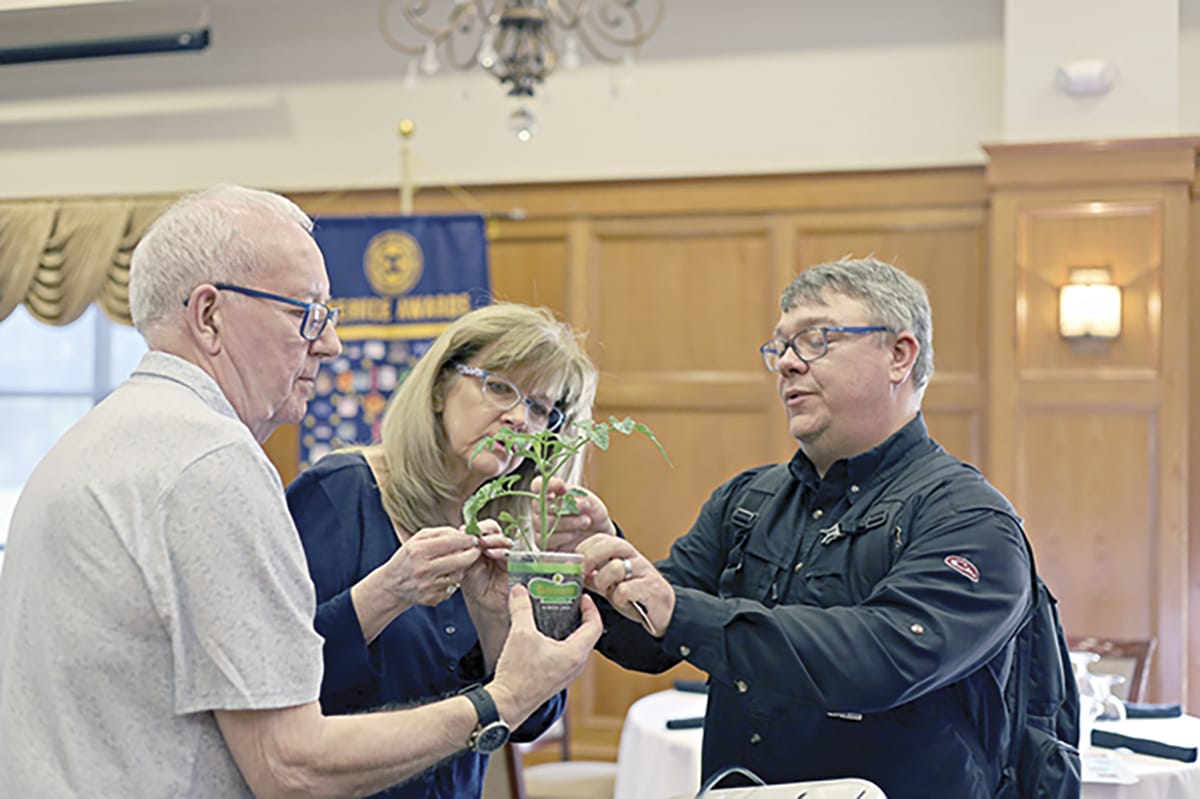
Tilley highlighted the Amelia variety, a common choice in Mississippi is the Amelia, holding up a leafy green plant that extended about 7 inches above its makeshift plastic pot.
Many varieties are bred to be heat-tolerant and resistant to common diseases like spotted wilt virus, fusarium and verticillium wilt, tobacco mosaic virus and late and early blight.
Pests are another concern. Some, Some like root-knot nematodes, can be managed by choosing resistant varieties. Others, like aphids, thrips, horn worms, leaf miners, and white flies can be controlled by insecticidal soaps, neem oil and other organic chemicals.
“There’s different ways to control pests,” he said. “… I always tell everybody, read the label. … If it’s a chemical, and it’s not labeled for tomatoes, don’t use it on tomatoes.”
Tomatoes can be grown in hay bales, pots or right in the ground and supported by trellises, stakes or cages. The key, Tilley said, is giving roots room to breathe and planting only when soil temperatures are consistently above 50 degrees.
New and experienced gardeners alike will have a chance to put their tomato-growing knowledge to the test following this year’s Tomato Growing informational seminar, scheduled for April 27 at the Lowndes County Extension office at 485 Tom Rose Road.
Following the free seminar, attendees can pay $5 and take home two hybrid tomato plants to grow through the end of August, at which point growers can participate in the Tomato Battle, a contest to determine who grew the heftiest tomato
“There’s always this satisfaction of growing something yourself and being able to take it from your yard and into your house,” Tilley said following the meeting. “I feel like … the tomatoes I grow myself taste better. They’re definitely fresher when I bring them straight in the house from out in the yard, so I think there’s probably a little bit to that.”
Posted in Columbus & Lowndes County
Quality, in-depth journalism is essential to a healthy community. The Dispatch brings you the most complete reporting and insightful commentary in the Golden Triangle, but we need your help to continue our efforts. In the past week, our reporters have posted 35 articles to cdispatch.com. Please consider subscribing to our website for only $2.30 per week to help support local journalism and our community.
Comments are closed.