

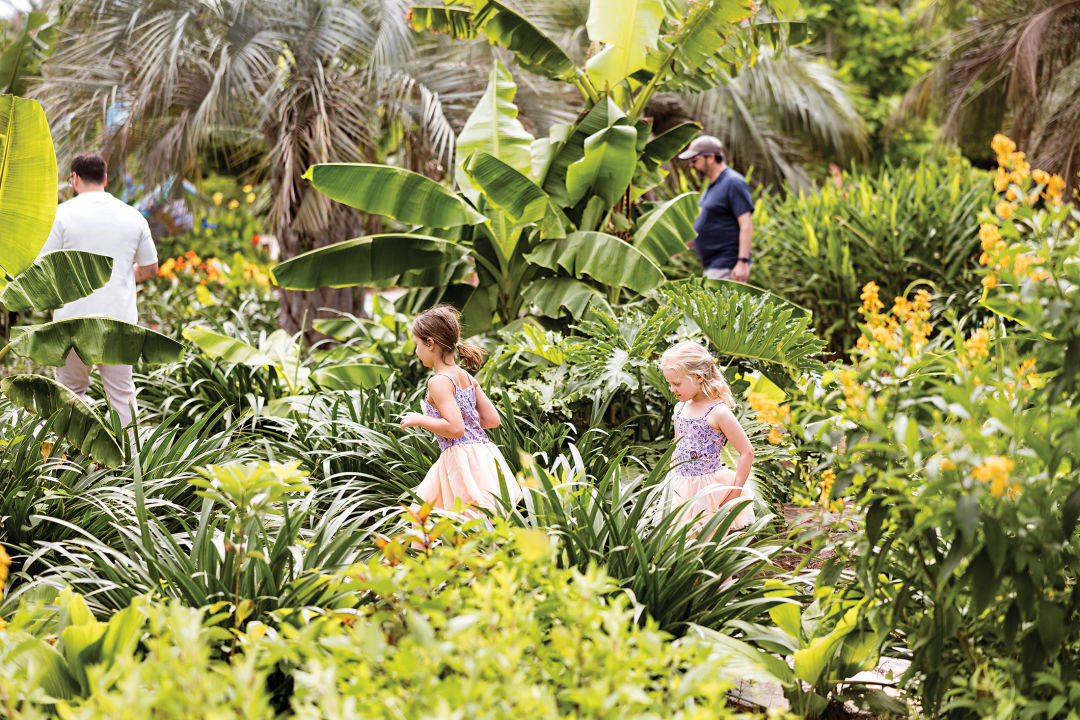
The Houston Botanic Garden is known for its wide array of plants.
Just days before Christmas, pollinators busied themselves across the tropical area of Houston Botanic Garden’s Global Collection. Bees disappeared into the dangling gold flowers of a tall datura, while a cloudless sulphur rested on the bright green leaves of a senna. Elsewhere, butterflies sought nectar in the showy bracts of dark red shrimp plants. Despite it being winter, balmy temperatures made it seem like spring had already arrived. Jill Barry, the garden’s president and CEO, didn’t fret the unseasonable warmth. “The weather is smiling upon us,” she says. “We will take 80 degrees and humidity.”
Extreme weather of a less pleasant kind has caused some harsh growing pains in the nation’s youngest botanic garden during its first five years. Some early plantings simply didn’t fare well in Houston’s climate. The Lavender Slope was a bust—lavender can’t handle humidity. Tulips were abandoned, too. This far south, those iconic spring bulbs are short-lived annuals at best. “It’s a onetime show that ends up being a large, ongoing expense with lots of labor,” says Laura Webb, the botanic garden’s senior horticulturist.
And in February 2021, less than six months after the gates opened, Winter Storm Uri killed half of the new plants in the Global Collection, the garden’s three-acre centerpiece. Though Houston’s humidity and warmth suit many imported plants from around the globe, the deep freeze wiped out some prize cycads (relatives of sago palms) and other tender species, forcing costly replacements. The following year, another brutal freeze killed the replacements. Even the once-dependable Little John bottlebrush shrubs lining the garden’s parking lot had to be pulled. “There [are] a lot of plants that have historically been mainstays in the Houston landscape that in the past five, seven years, with these colder winters we’ve been having, we just don’t use anymore,” Webb says.

The garden has had its fair share of challenges.
Of course, much of Houston has weathered the same woes. The COVID-19 pandemic reshaped daily life just months before the garden opened in September 2020. That timing, at least, proved fortuitous, offering Houstonians a new, 130-plus acre urban refuge on the site of a former golf course, with room to roam and distance to breathe. As Houston’s climate grows more unpredictable, the garden has become both a testing ground and a teacher—adapting to extreme weather while demonstrating what resilience can look like in a subtropical city. Five years in, staff are learning which plants endure, which traditions must go, and how experimentation, education, and community engagement can help shape the garden’s future.
Since Barry became president in 2023, droughts, heat domes, a derecho, and Hurricane Beryl (which damaged 90 percent of the trees to varying degrees) have prompted some of the reassessments that have helped shape the garden. “Every weather event gives us an opportunity to fine-tune,” Barry says.
Happily, the horticulture team found a spectacular alternative for those testy tulips: hippeastrums, or amaryllis, popular bulbs that often are forced to bloom indoors for the winter holidays. Many folks discard amaryllis when the lily-like flowers fade, but they can be replanted outside in Houston. They’re relatively easy to grow, and they cycle back year after year, usually blooming in April. This spring, visitors will encounter about 50 varieties of them—12,000 plants in all, including old heirloom types and newer ones bred for the florist trade. Because
few other public gardens grow them as perennials, hippeastrums have become somewhat of a signature.
Climate challenges aside, all gardens take time to “grow into their boots,” as Barry puts it. “Now that we’ve lived in it for five years and we’re seeing how people move through the space and interact with different areas, there [are] some things to tweak and change,” she adds.
The garden’s founders, including Nancy Thomas, Nancy O’Connor Abendshein, and the late Kay Crooker, spent nearly two decades bringing it to life. The site they finally secured along Sims Bayou, just south of Downtown, transformed the 94-year-old Glenbrook Golf Course into a living museum with distinctive outdoor galleries.
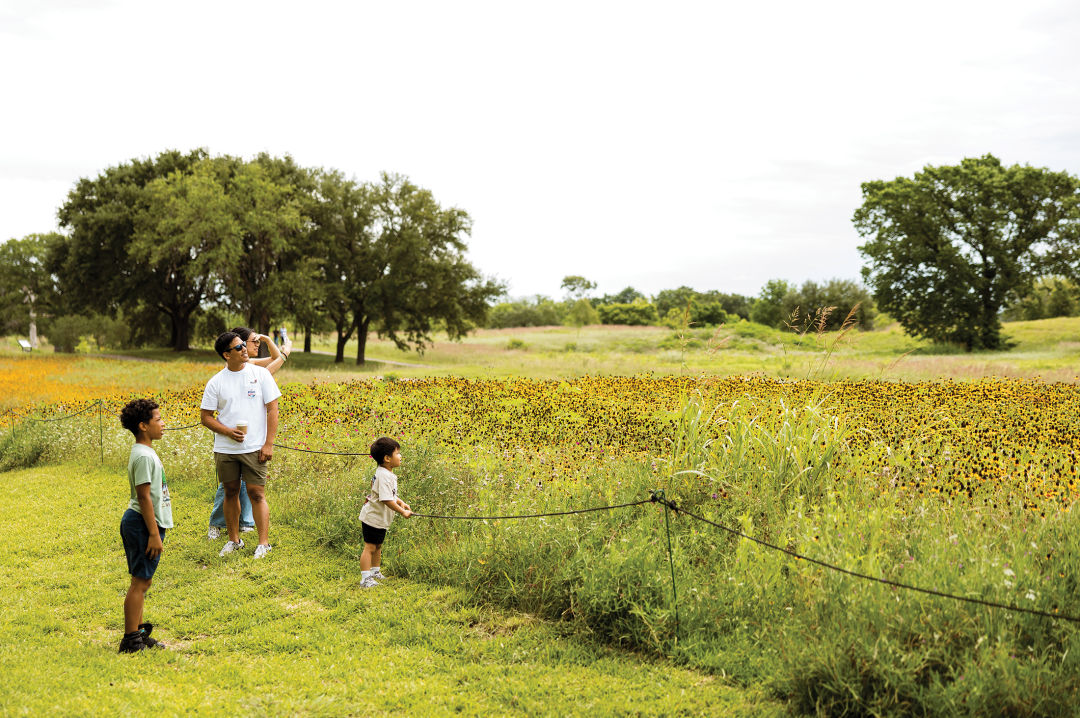
The 132-acre garden welcomes plant fans across Houston.
On maps, the 132-acre garden resembles a scraggly leaf, with the wide-open channelized bayou bisecting it like a vein. A curvy riparian remnant forms an island at the center of the property. That’s where visitors land and find the Welcome Pavilion, the Global Collection, and the Culinary Garden. Beyond that lies the Woodland Glade, which hosts weddings, while the Stormwater Wetlands and sunny Coastal Prairie offer lessons in flood control. Bridges across the channel lead to the Susan Garver Family Discovery Garden, greenhouses, and staff offices in the former clubhouse.
Much of what visitors see today was designed by the Dutch firm West 8. In January, Barry said she and the garden’s board of directors would soon hire a new team to design a Phase II master plan. Her wish list includes enclosed facilities for events and classes, additional garden spaces, and clear pathways that invite exploration across the entire site. The staff recently installed a native meadow with a winding path leading to the discovery garden, and a bird-supporting native plant area is also underway.
Balancing the vegetation in natural areas isn’t as easy as you might think. Trees that sprout in prairie grasses must be removed before they cast too much shade. Cattails and ragweed that crowd out more desirable natives in the wetlands must also be managed. Even the young water features are still finding equilibrium. Webb is excited to clear algae blooms by installing “bayou boost nests,” porous baskets of beneficial microbes.
While seasoned, die-hard gardeners will always find their way in, Barry is especially jazzed about visitors who aren’t plant nerds. “We’re realizing that we’re a really big tent that a lot of people can fit under, being as welcoming as we can to as many people as we can,” she says.
Seasonal programming plays a significant role in that welcome. In winter, the four-month-long Chinese-style lantern installation Radiant Nature draws crowds. Five shorter annual festivals held throughout the year build on seasonal plant themes with live music, food trucks, and family-friendly activities. March is marked by peak bluebonnet season, when the garden hosts the Bayou Blues Festival with soulful live music near the banks of Sims Bayou. In April, a 1960s-themed Flower Power Festival stars hippie-astrums (get it?). May’s Beyond Bouquets features sculptural arid garden plants. Come September, it’s Go Bananas! time with the garden’s 30 species of edible and ornamental bananas. And ahead of Dia de los Muertos, October brings Monarchs and Marigolds—which last year featured 10,000 marigolds in 23 varieties. A Juneteenth market, a community Trunk-or-Treat Night, K-pop and Lego nights, and foraging walks also filled the calendar last year. “At the end of the day, we want to be Houston’s garden,” Barry says. “The festival days definitely feel like that.”
Barry encourages the staff—including five full-time and two part-time
horticulturists—to lean into spotlighting unusual plants as entry points for curiosity, “because that is how all gardeners start.” One favorite is the Buddha’s hand citrus; its finger-shaped fruit resembles a human hand. “Any little boy that sees that is like, ‘Oh my god, that is so weird!’—and you got ’em,” she says. “We want to get people to flip that switch…not beating them over the head but putting out breadcrumbs that lead people along the path to really care about the garden, the environment as a whole, and our place in it.”
Signage is deliberately kept light to avoid interfering with the visitor experience. Guests can explore the gardens in greater depth and tour with the help of the Bloomberg Connects app, while the digital tool Garden Explorer describes 1,200 taxa in the collection.
Storytelling, Barry says, is the real work—helping visitors understand what they’re seeing and why they’re seeing it. Even without extreme weather, the narrative continues to change. “Every day it’s a different garden, because something is coming into bloom, something is going out of bloom,” Barry says. “That’s absolutely what I love about it.”
Comments are closed.