
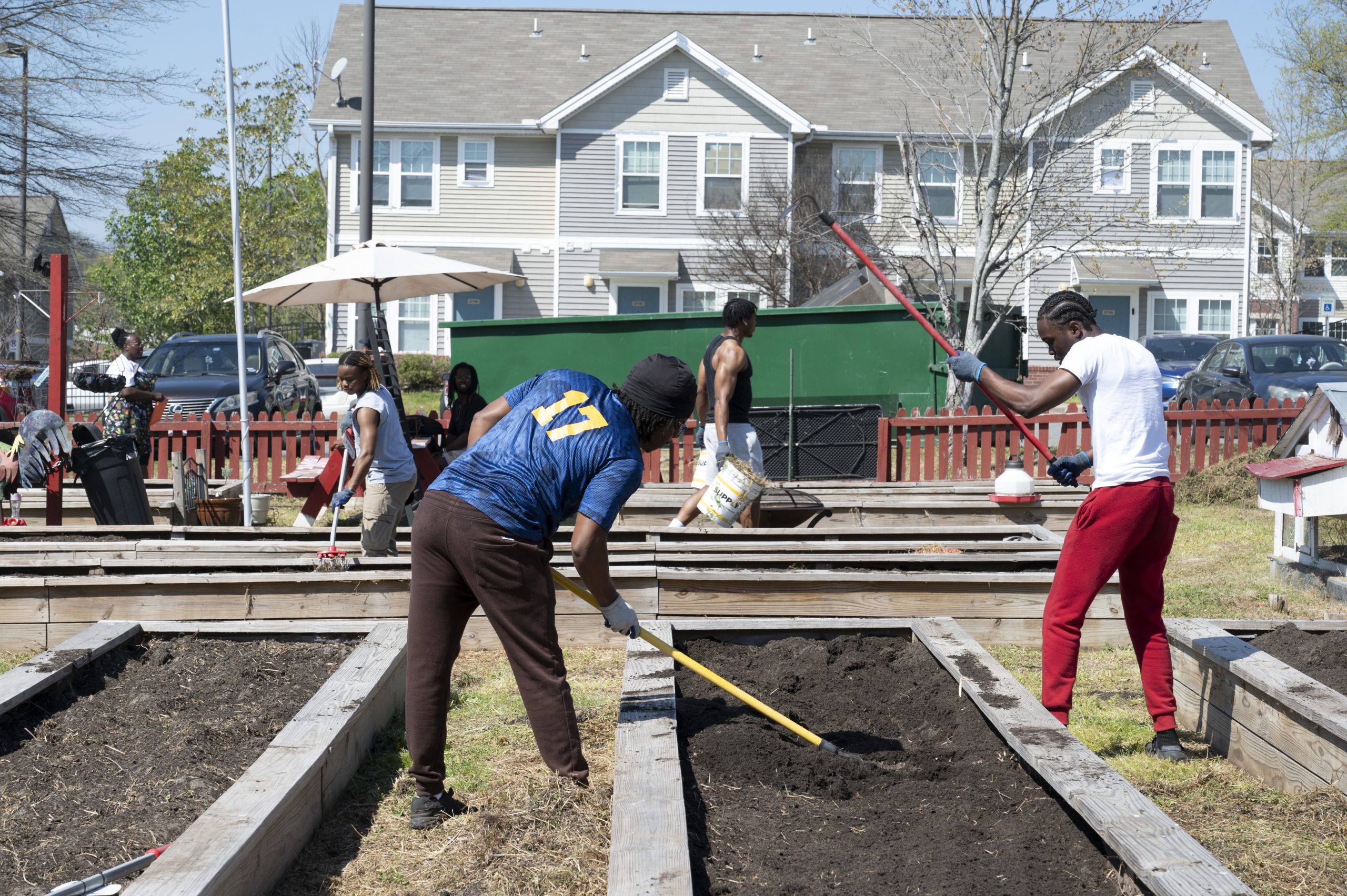
Philander Smith University’s Campus Cultivators group is revitalizing two gardens with the aim of giving them back to the local community, and the program has been growing.
Campus Cultivators is a registered student organization whose goal is to teach students sustainability and land stewardship.
On Thursday morning, a group of students, behind the playground at Cumberland Manor apartments in Little Rock, cleaned up the garden area and prepared the beds before they could plant seeds the following day. Students carted around dirt, shoveled it into the beds and then smoothed it out.
“The goal is just to give it to the community, and then they can take it over,” said Sonia Brown, who founded the Philander Smith campus garden and is an associate professor of English there.
The organization has taken on two community gardens, one is the Metro community garden and the other, the Stop community garden, which they were working on Thursday.
Tending the gardens is an alternative Spring Break activity for some students who otherwise may have had nothing to do, Brown said.
Since Monday, students have worked throughout the day with lunch provided. In addition to these gardens, the students work on the herbal medicine garden and a regular garden on Philander Smith’s campus.
Devon Clay, a Philander Smith student and president of the organization, was busy taking questions from student gardeners. He fired up the grill so students could eat lunch, weeded the Metro garden and helped put dirt in the beds.
Clay also spread the word about Campus Cultivators through sign-ups, group chats and other forms of communication – all aimed at helping the group grow.
“When I first started doing this last semester, we didn’t have this many people,” Clay said, looking out over the 15 people who were participating. “We might have had three people, so I’m very excited to see this many people out here, for sure.”
Clay is passionate about gardening and wants to continue to study it and garden after he finishes undergraduate school.
He’s unsure of what to plant right now, but will decide soon.
Students said Thursday that gardening helps them feel better.
“I’ve learned more food that I can grow, and it’s helped me stay at peace. I like being peaceful and whatnot and being outside, so I love this,” Clay said.
Zahriya Reckley helps with cooking lunch, planting and moving dirt around.
“Coming from The Bahamas, I love being outside. I love being in nature. This is more so in my element, so it was really great to meet like-minded people who want to just work out here and want to serve the community and make the world a better place,” Reckley said.
Brianna Hatfield could be seen cooking burgers on a grill and handing out snacks. She was in charge of ensuring everyone got fed.
“I don’t really like being outside and I hate being in the heat, but for my community, I’m willing to do whatever,” Hatfield said. “So I’m open to trying new things and exploring many things, even though it’s not really my cup of tea.”
Zoe Carpenter helped clean up the garden and said she has loved helping the local community.
As it got closer to noon, some kids from the surrounding apartments walked over. Reckley asked them what they would like to see grown in the garden. “Strawberries,” said one little girl. Reckley guided the youngsters to one of the garden beds and explained the steps needed to plant seeds.
Brown said Campus Cultivators plans to sell produce at the West Little Rock Farmer’s Market, which opens this spring. She said the group has also given what it has grown to the university cafeteria. And last year, some of the peppers, tomatoes, herbs, potatoes, greens and squash were given to the local Veterans of Foreign Wars (VFW) Post 1316, which is the only all-Black post in the state.
Campus Cultivators has also given its excess harvest to Kreative Expressionz Catering, a food caterer that uses it for their business and helps distribute some to foster homes.
The community garden is for exactly who the name sounds like — the local community, meaning anyone is welcome to take what they need.
“Last Fall, we grew lots of greens, so anyone could come in and cut greens,” Brown said. “Typically, when [people] see us, they say, ‘Hey, do you mind if I get greens?’ Or we use the opportunity to kind of educate them about the greens, how they grow, where to cut them and stuff like that.”
A small chicken coop is also in the garden. Brown said the plan is to refortify it so they can have chickens and eventually eggs.
The garden is in a low-income neighborhood, and having this garden can save folks money and encourage them to also produce their own food.
The VFW Post 1316 helped serve lunch on Thursday.
Curnie Bryant Jr. with the VFW said that he likes to garden, and seeing the students hard at work in the garden made him happy.
“We just love to see this,” Bryant said. “The community is everything. We’re nothing without our community, and this is our community.”
Not only can gardening save money, but it can also help the environment.
“I don’t know if you’ve been to the supermarket lately, it’s like $3 or $4 for a head of lettuce,” Brown said. “You can grow a whole plot of lettuce for $3 or $4 — it’s going to take you some time, but these are just ways that make it more economical for our culture. It makes it so that we could survive better and thrive better.”
Brown also pointed out that local gardening reduces the need for a truck to ship items from another state or country, thereby reducing pollution.
She is also a community garden organizer for the Central Arkansas Sphinx Foundation, which donated all garden materials and secured grants to allow Campus Cultivators to have the gardens.
Land stewardship, Brown said, is an important part of life, and it’s part of Black life in particular.
“And just like Indigenous tribes believe — when you take care of the land, the land takes care of you,” Brown said. “And the way this world is going right now, we’ve got to focus on the land. We’ve got to get back to the basics, taking care of each other, taking care of the community, and then everything else somehow will fall into place.”
Comments are closed.