
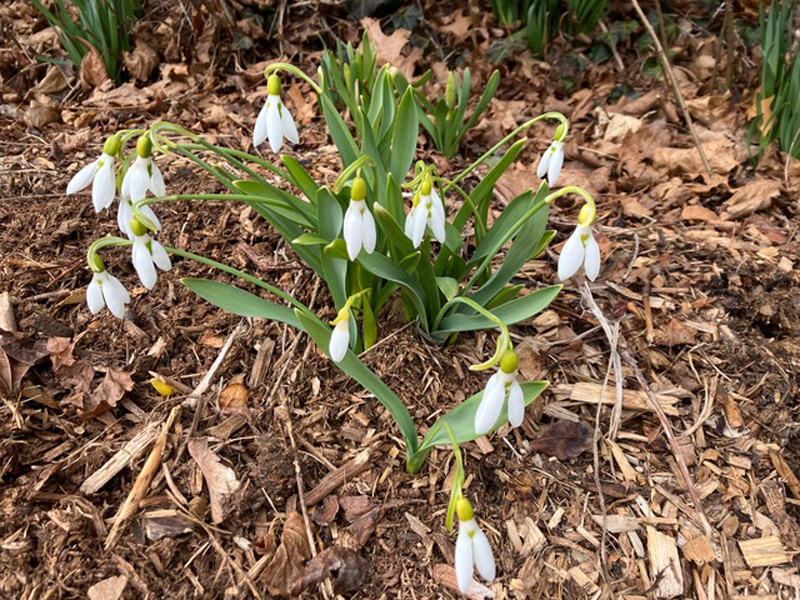
Spring 2026 is off to a chilly start: It’s not so much like the bitter cold of the past winter, but the penetrating, maritime damp that is such a bone-chiller. It continues to envelop the Island while the rest of the East is bouncing into spring fever, or even heat waves.
Luckily, though, spring gardening usually entails raking — such a good way to boost body temperature! Raking revitalizes lawns after winter’s abuse. They immediately green up, while blustery winds continue to find plenty of leaves and debris to sweep around. Compost it all; it is incomparable for soil-building.
The dismaying parts of getting outside this year include discovering the extent of damage that has occurred. Many “candle-flame” red cedars lost their tops to snow load. They now assume another familiar form, the craggy and timeworn veteran, another badge of years and winters weathered.
As mentioned in a previous Garden Notes, rhododendrons all over took a hard hit with the February blizzard’s heavy snow load. Horizontal splitting, lengthwise of the trunk, is the damage these plants typically sustain, usually hard to recover from without sacrificing the limb. The Catawba and rosebay rhododendrons here had much damage.
Although I realize it is no consolation for Island gardeners looking at major losses, these conditions must be a factor of the “laurel hells” of the Southern Appalachians.
The distinctive habitat is an almost impenetrable tangle of the native rhododendron species, which have grown like this in the hollers, coves, and slopes for eons. Snow load, storms, great age — these all probably contribute to make the laurel hells superlative wildlife habitat.
When repairing storm damage, remember to make undercuts, so that the limb falls away cleanly, without downward tears that add insult to injury. If there is space, use fallen branches to make dead hedges and hugelkultur mounds. They are useful cover for wildlife or privacy, and eventually break down into more great soil.
Choosing pelargoniums
Memorial Day in May usually sees pelargonium sales peaking at garden centers, although many planters will be filled well before then. Indoors, they are budding and blooming now, with the longer and stronger daylight.
“Geraniums,” our indispensable porch and bedding color, are actually pelargoniums. An article about pelargoniums with useful information is bit.ly/HHG_GeraniumChoice. Pelargonium breeders produce ranges of varying sizes, habits, and uses. Most useful is how the different series grow, depending on the use you plan to make of them.
Of the zonal geranium series usually sold here, Tangos are the most compact, 10 to 12 inches. Americanas are larger, 12 to 14 inches, with Rocky Mountains the tallest at 16 to 18 inches. Each series is produced in the usual wide choice of colors. Ivy-leaved pelargoniums with trailing habit perform well in hanging baskets and window boxes.
Pelargoniums have a way of fizzling out after a season or two as plants age and become woody. Purchased plants may also be used to propagate more, ideally in late summer, a cost-saving measure. Any time is fine, though; and pelargoniums may also be wintered over. This link from Fibrex, one of the U.K.’s most well-known pelargonium growers, gives detailed information: bit.ly/F_PelargoniumCuttings.
Dahlia (tuber) time
Dahlia tubers may be started indoors now. The Royal Horticultural Society has this advice: bit.ly/RHS_DahliaGrowing.
Cut apart clumps of tubers, leaving a piece of stem and an eye on each one you plan to use. Pot up in small pots in free-draining potting soil, and leave in a warm place until sprouts appear. The tubers first grow a network of fine roots before sprouting, so be patient. Avoid watering until plants are up and growing well, since the tubers rot easily. Pinch sprouts when the third pair of true leaves has grown. Dahlia roots may be planted directly in the ground, but wait until the soil warms.
Garden prep
Do you have compost that is finished enough to go out onto garden rows or raised beds? Good — but first, lay down a layer of low-number, organic soil food (fertilizer) to feed the soil’s micro-biome. Then lay compost over, sieving first if needed. Unless composting achieved high temperatures, the product may contain seeds, such as tomatoes, that germinate. If so, tarp the bed to eliminate volunteers.
Starting seedlings for your garden is fun and educational. Whether they grow well or not — it is all learning by doing, regardless. Persist: There is always next time.
The earliest to go outside are the things that are cold-hardy, such as onions, lettuce, parsley, and peas. Until they can go out, feeding with diluted liquid seaweed readies seedlings for the stress of transplanting.
Cold-hardiness is but one factor, however. Once hardened off, seedlings need protection from birds and other hungry mouths — all are eager for tender, new, green garden seedlings. Plan for floating row covers and hoops, or a cold frame.
In most gardens, spring flowers will be early perennials and bulbs. The earliest species crocus, aconites, rock garden iris, and snowdrops are in bloom. We love daffodils here because they are not deer food! Edgeworthia and male skimmia are on the verge of blooming.
It is too early for flowering annuals, though, such as zinnias, which for the most part have a warm climate of origin. Check seed packets for the number of weeks until last frost (usually around the first week of May) to calculate seeding schedule.
An exception is sweet peas. Once started, keep them in cool and bright light conditions. Pinch for branching after the first true leaf. It is too soon to put them outdoors, but once hardened off and the weather becomes more settled, they can survive in the ground.
Deer-repellent spraying and tick-repellent spraying starts up. Tick products usually come with integral spray mechanisms, but deer repellent means fussing with sprayers.
Community Greenhouse of Martha’s Vineyard
Formerly known as “ComSog,” The Community Greenhouse of M.V. is a nonprofit organization for learning about plants, and growing and harvesting vegetables and flowers, located at 114 New York Ave. in Oak Bluffs. It’s been cultivating vegetables, flowers, and community since 1983. Join now.
Comments are closed.