
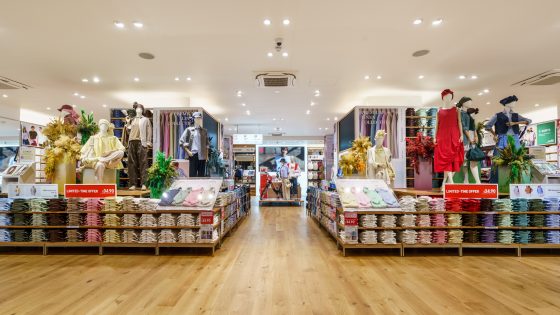
The increased store space is a direct result of customer feedback, which Uniqlo gathers via social media, online forms and its store staff, who have feedback-specific QR codes on their badges.
Uniqlo’s Covent Garden store first opened in April 2023 and closed temporarily at the end of February for the refurbishment.
Formerly office space, the store’s first floor has been extended to bring the Covent Garden store’s total trading space to 18,300 sq ft.
Customer feedback has directly informed the Fast Retailing-owned business in its decision to double the number of fitting rooms to 32 in the upsized store, introduce baby and kidswear, a dedicated “denim corner”, and reintroduce cash tills to improve access for tourists.
It has also introduced RFID (radio frequency identification) in its fitting rooms, allowing customers to place their items into a bin, which then identifies and counts the products inside. Uniqlo began using this software for its self-service tills in 2017.
Continuing its 2023 partnership, Uniqlo is collaborating with Transport for London (TfL), with a selection of embroidery such as “Baby on Board” and the Underground sign for its UT!Me customisation station. The UT!Me department is complete with an imitation tube carriage.
Uniqlo’s every move is meaningful, as Dudech told Drapers during a tour of the new upsized space. The retailer currently has 23 UK stores and is set to open the doors of its new Bristol store – its first in the South East – on 16 April, and in Leeds later this year.
Drapers sat down with Dudech to discuss the journey to tomorrow’s reopening, Uniqlo’s ongoing UK expansion, and creating LifeWear for all.
You increased the store size following customer feedback. How do you gather this information?
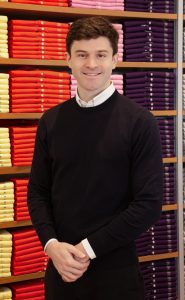
Uniqlo COO Alessandro Dudech
It is gathered through what we call ‘Voice of Customer’. As a global business, we gather more than 30 million voices a year, and the feedback specific to the [Covent Garden] store was very clear. Customers wanted more space, they wanted a bigger assortment, and they wanted a faster experience, so we were able to increase the footprint of the shop floor by 30% but by moving fixtures around and facilities around, we were able to double the number of fitting rooms and double the number of tills.
We have also been able to add some services like the digital click-and-collect machine, which, again, doesn’t require any customer-staff interaction, so customers can just go and find the product that they order. We’re also trying a new digital RFID-enabled fitting room which, again, removes any frictions: the system counts [your items], then directs you to a fitting room. It was really about redesigning the shopping experience and putting value in what customers truly wanted.
Why did you decide to add kidswear to your offer in Covent Garden?
The addition of kidswear and baby was something that really came from customers. We have a lot of tourists here, and they might have visited Uniqlo in some of our global flagship stores in Milan, Tokyo, New York, so we really wanted them to be able to find their same LifeWear for children.
On the shop floor, we’ve really tried to make the kids’ space stand out with the colours, mannequins and visuals everywhere. But also, we really want to emphasise that we have Airism T-shirts, the bestsellers of all time, for adults and for children. We’re making it truly made for all no matter the age, from toddlers all the way to adults.
Why did you choose Bristol for your next UK location?
It was very intentional. It is one of the most dynamic cities in the UK and it’s also known for a strong appreciation for quality. We also could rely on very strong signal from our digital commerce right. Sales in the southeast are very strong and we literally get hundreds of requests every month from customers asking, “When are you opening in Bristol?”. So it wasn’t just a belief, it was calculated decision. When we open stores, we open in places where we think we can provide a meaningful addition to the community and resonate with people, and I think Bristol is one of those.
Fast Retailing upped its guidance last month following double-digit profit growth in Europe. How does Uniqlo plan to sustain this momentum?
Success comes from consistency. We have three areas where we focus: the store, our product and our people, so if we keep innovating and creating products that customers enjoy, we keep focusing on the store experience, we stick to our high standards, we create stores that are meaningful, and we keep giving opportunity for our team to grow, then success will follow.
If you compare us to other brands, we are not opening stores just for the sake of achieving numbers of targets. Every time we open a store, it truly needs to be meaningful, and that is what has brought us success so far, so that is what we are going to continue.
What are the main challenges that the business is facing at the moment? How are you being affected by the war in the Middle East?
We operate all over the world, so we are always watching out for what is happening globally. I think our focus is always on the safety of our people and our partners [suppliers]. Over the years, we have been able to build a resilient supply chain. [Uniqlo manufactures mainly in China, Vietnam, Bangladesh, Indonesia, and India].
By really focusing on execution, we have been able to continuously deliver LifeWear to our customers. We just focus on what we can control, which is delivering a high quality experience to our customers, and that is what we will continue to do.
Are there any other new tech innovations you are implementing and how is the business using AI?
One of the biggest pain points in retail is waiting times for customers, so we address that through innovation. We don’t do innovation for innovation’s sake: it is innovation that is meaningful for the customer.
Every time we try to innovate, we ask ourselves ‘how will this benefit the customer experience?’. We talked about the RFID fields ‘the magic fields’ and we talked about the fitting rooms. That is laser-focused on improving an aspect of the customer experience.
It is also about product: that is really one of our core pillars. We have a lot of functional products and that is really what customers have grown to appreciate. This innovation is centered around satisfying customer latent need: the need to stay warm during the winter or stay cool during the summer.
We have also looked at manufacturing innovation. 3D technology, which allows us to minimise any waste when knitting sweaters. It also removes any seams so it is more comfortable. We focus on innovation that adds value in the customer experience or in the product. Those are all the ways where we can leverage more insights to then benefit the customer.
Comments are closed.