
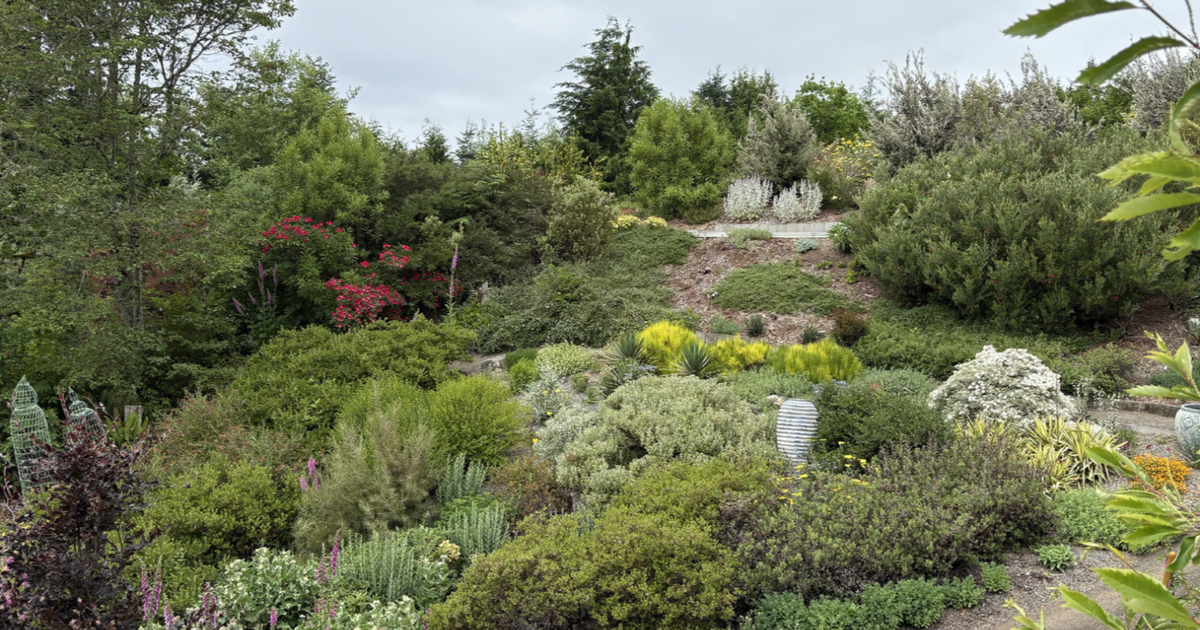

What can be done with a site colloquially referred to as Sand Hill, where trees have been logged from the steep slopes, but the remaining native vegetation becomes a home for unwelcome brambles and Scotch broom?
With an uncanny vision and knowledge guiding them, England natives John and Kathleen Bullivant have created lovely and unique gardens with great success. In 2003, a move brought the pair from the East Coast to Bainbridge Island, and in 2017, when they discovered the property in Poulsbo, John was sold by the greenhouse, which would be useful for his plant-propagation hobby.
The two-acre property, however, came with challenges. The soil was excessively sandy and steeply sloped. The next year, when the Bullivants began clearing the bindweed and brush, a moonscape was revealed. The solution for these problems would be to use drought-tolerant plants in some areas and to construct terraces for other plantings. Eighty cubic yards of sandy soil were removed, leaving a quarry-like site. In 2020, the terracing began. One-hundred tons of basalt rock were brought in for the walls, and more than 80 cubic yards of topsoil filled them.
The Bullivants selected plants for sloped areas that would be drought-tolerant.
“We decided that we were not going to irrigate large areas of the garden, which meant that we needed to use plants that would thrive in the (existing) conditions,” John said. “It was key to use young plants, mostly in four-inch pots, so that their roots could establish in the native soil.”
The property’s Dry Garden is filled with shrubs native to Australia, Africa, and the Mediterranean. Large grevillea, hakea, and olive shrubs create structure. Closer to the ground, santolina, sedum, and aloe provide color and textural interest. The red blooms of zauschneria and colletia attract hummingbirds and other pollinators. New Zealand tea tree thrives, as does manzanita, ceanothus, and coyote bush. Gravel has even been added in places for species that require very sharp drainage.
“We have also mixed in West Coast natives,” John noted. “Watering them through the first summer was all the establishment they received — they either thrive or are replaced.”
These sloped areas have no irrigation system.
A young orchard teems with apples, crab apples, Asian pears, and plums. These are drip-irrigated during dry spells. Native grass and wildflowers grow between the trees and are mowed only twice a year. “No Mow May” is in practice here, allowing the vegetation to protect ground-nesting birds as well as other wildlife.
The terraces provide an often unavailable perspective: Plants are easily viewed from below, above, and at eye- level. Self-sowers such as snapdragon and foxglove seed themselves into the gravel pathways. Japanese forest grass spills out over the tops of the rockeries. The foliage of black-lace elderberry and ninebark provides color. The Bullivants practice “cram-scaping,” so there are few open or empty spaces in the terraced gardens. Tiger lilies, peonies and rugosa roses fill gaps, and columbines peak through. Grasses of various types provide eye-catching movement with the slightest breeze. Drip irrigation is laid out on the terraces.
The Pinetum is a collection consisting of a great variety of conifers. This non-irrigated garden is a testing area, evaluating drought tolerance for different species of conifers.
Douglas fir trees provide some shade in a spot where rhododendrons are featured. Unique specimens have been carefully selected. Hellebores and ferns create an understory. This area also hosts a creative water feature. A metal rill, designed by the Bullivants, has been placed within a planted expanse, with the rusted trough angling through Rogersia, hosta, and Bergenia. This provides the sight and sound of moving water, as well as the activity of birds that are drawn to it.
Vegetables and cutting flowers are growing in several raised beds. Various planters host salvias and dahlias, and stone troughs have become home to succulents. Containers with cuttings, starts, and newly purchased specialties crowd the perimeter of the greenhouse, which is already filled.
A winter garden provides delight while other areas still sleep. Red twig dogwood and early-blooming Edgeworthia show off in this garden, along with showy tulips.
Mulching has been an important factor in the success of these gardens. Since irrigation is minimal or nonexistent, this practice helps retain moisture in the soil, reducing evaporation and runoff. The Bullivants bring in mulch or black compost in late winter, which is applied over the beds.
John Bullivant is currently the president of Northwest Perennial Alliance. He leads the Open Gardens Team, which scheduled more than 115 open garden events in 2025. He enjoys plant propagation and has done the planting at the Poulsbo property. The design of the gardens is shared with Kathleen, who spends time weeding and deadheading. The couple volunteers at Bloedel Reserve, John in the propagation house, and Kathleen with the public.
“Treloweth” means “the place of a gardens” in Cornish. Given a very challenging site, the Bullivants have used their knowledge of plants and their skills in design to create such a place lavish with gardens, full of inspiration and creativity.
John and Kathleen Bullivant
Is there a special, preferred place in the gardens?
“There is no one favorite area,” John said. “Each garden area tends to have its peaks and troughs of interest and beauty. This way, we enjoy the entirety of the garden through the seasons.”
Comments are closed.