
 3 min read
If you’re already daydreaming about sunny afternoons harvesting your vegetables from the garden, you’ll want to read this advice from a gardening professional. We learned this seed starting trick from Dr. Alan Taylor, a horticulture professor at Cornell University’s School of Integrative Plant Science whose research areas include seed treatment and modern seed technology.
Soaking your seeds in water before you plant them can help your garden thrive. According to Taylor, this is a strategy used to speed up the vulnerable germination stage. Things like frost, animals, temperature fluctuation, and flooding can easily keep your seeds from flourishing during this stage. However, by soaking the seeds before planting, you give your seedlings the chance to establish themselves more quickly so they can withstand these challenges.
This trick can help both new and experienced gardeners find more success with their crop. If you’ve tried tweaking your sun, water, and soil routines and you’re still noticing spotty or slow germination, seed soaking might be the solution you’ve been waiting for. All you need is water, a paper towel, and a little bit of patience.
Ahead, Taylor breaks down why soaking seeds can improve your success rate, which seeds benefit most, and the best way to soak your seeds.
Why soak garden seeds?
To achieve a bountiful garden harvest with baskets full of vegetables, fruits and herbs, plants must first survive the seed stage where they face adversities, such as weeds, frost, flooding, animals and more. This can be a challenging time, but seed-soaking can provide plants with a leg-up, making it a worthwhile practice for hobby gardeners.
The timeframe between sowing, otherwise known as planting, and sprouting is when a plant is at its most vulnerable. Seed-soaking can speed up this critical period. “Faster germination and seedling emergence gives your vegetable crop a good head start and competitive edge over weeds,” says Dr. Taylor.
Overall, soaking garden seeds can give your crops a better chance of survival during a pivotal growth period.
What garden seeds need soaking?
Nearly all vegetable seeds can benefit from seed-soaking. Although it is most common to practice on large-seeded vegetables because of their thick coats, which are harder to penetrate with water. Examples of large-seeded vegetables include: sweet corn, peas, cucumbers, pumpkins, squash, table beets and more.
While small-seeded vegetables can also benefit from soaking, they can be harder to manage due to their small size and finicky nature. Dr. Taylor recommends soaking “[small seeds] that take a long period of time to germinate, like carrots, parsley and parsnip.”
Some seeds, such as garden beans and lima beans, are more sensitive to injury and prone to oversaturation, so it’s best to avoid soaking them, unless you have a keen eye and experience with germination.
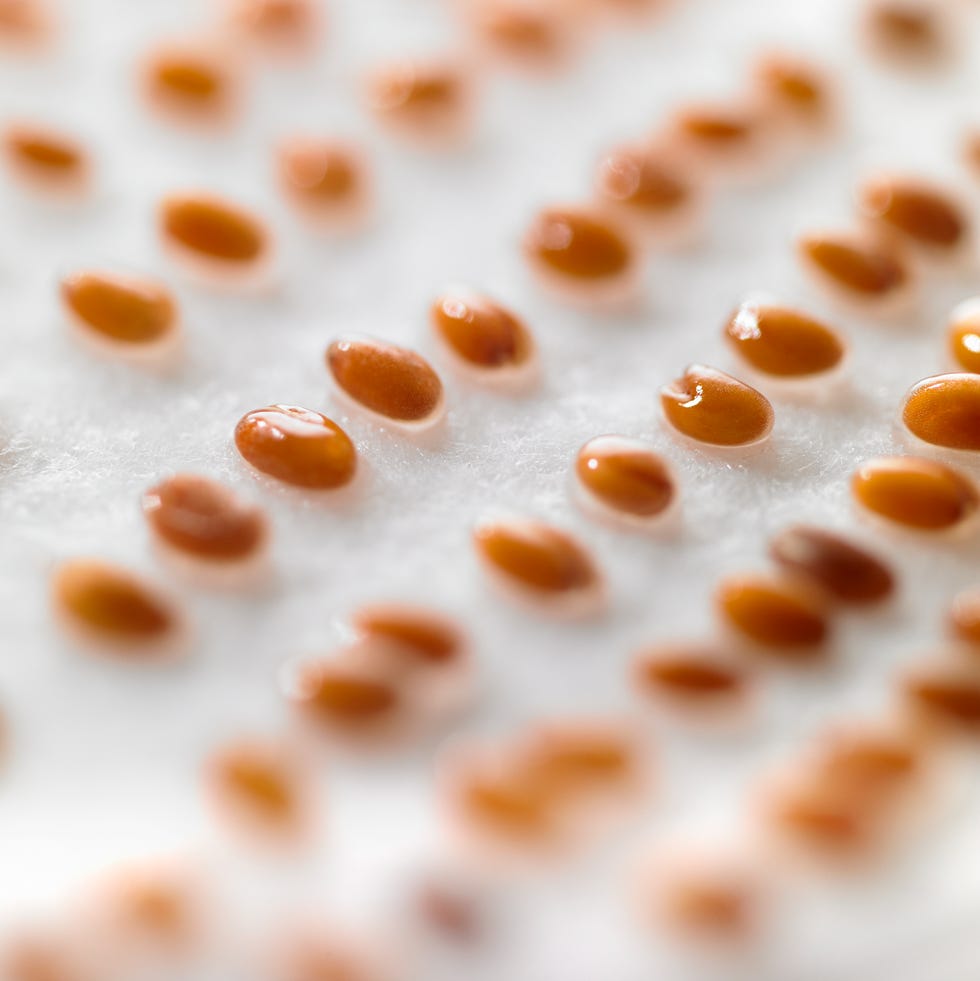
Micha Pawlitzki//Getty Images
Steps for soaking garden seeds
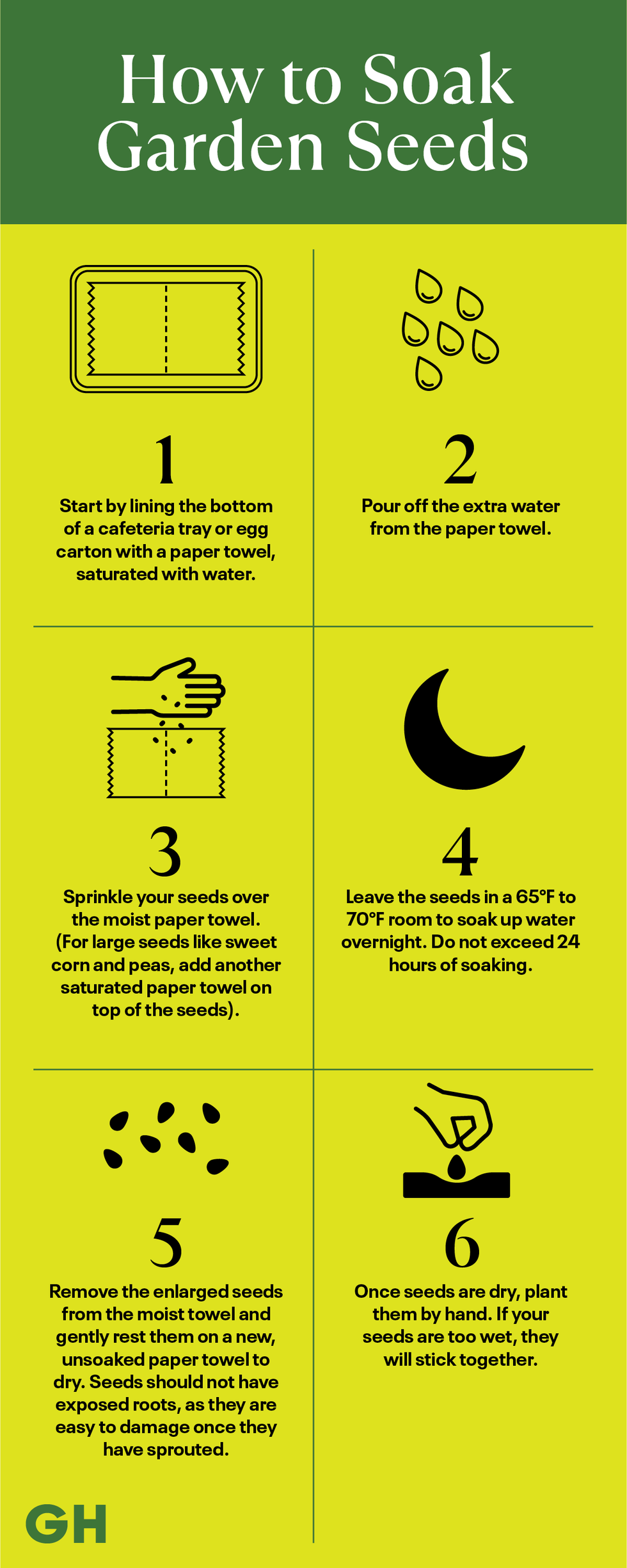
The easiest and most popular method for seed-soaking is the paper towel method, which can be used on small and large seeds. The method ensures seeds absorb water slowly and have plenty of oxygen to grow. Dr. Taylor recommends following the directions below for the best seed germination results.
Good Housekeeping
How long do you soak garden seeds
It’s best to soak garden seeds in a temperate space overnight. However, if you forget about them and leave them for longer than 12 hours, it’s okay — just don’t exceed 24 hours of soaking. If they’re left to germinate for too long, they may absorb an excess of water and begin to sprout or rot.

Kate Franke (she/her) is an editorial assistant in the Hearst Lifestyle Group, covering for Woman’s Day and Good Housekeeping. She loves all things lifestyle, home, and market related. Kate has a BAJMC in Magazine Media and BA in Writing from Drake University. She is a proud ASME alum whose work has appeared in Food Network Magazine, The Pioneer Woman Magazine, Better Homes & Gardens, Modern Farmhouse Style, Beautiful Kitchens & Baths, and more. Next to writing, Kate’s two favorite things are chai lattes and pumpkin bread!
Comments are closed.