
If I love anything more than plants, it’s a plant spreadsheet. All of those details sorted in an order that I can prioritize by any characteristic. It’s a way of communicating with a future planting about what it wants, needs and how it would like to be laid out as a community.
Therefore, I am a big fan of Mt. Cuba Center’s research (mtcubacenter.org), neatly laid out in spreadsheets and reports, downloadable from their website. The Delaware public garden dedicated to native plants has been running long-term plant trials for two decades. These have become a gold standard for gardeners, landscape professionals and growers alike, influencing demand throughout the industry and expanding plant knowledge.
At the Native Plant Center’s recent conference, Sam Hoadely, the manager of horticultural research at Mt. Cuba, gave a presentation about “knockout natives,” distilling the top performers from several trials. Hoadely described Mt. Cuba’s method as identifying “low-input and high-output plants.”
Plants in the trial gardens are not given much attention in their first season beyond watering. Hoadely said Mt. Cuba uses “average garden soil” to mimic the conditions that exist in most home gardens. The soil isn’t especially rich in nutrients, sandy, acidic, alkaline or loamy. Beyond weeding, plants don’t get supplemental nutrients or support over the course of the trials, which typically run from three to four years. That’s a decent amount of time to observe and understand a plant’s habits.
Last month Mt. Cuba released the results of its three-year study with Solidago that included 70 different goldenrods, one of the plants I try to include in every planting. They are crucial late-season perennials for pollinators, blooming in the late summer through the fall when there is a high need for migrating butterflies and bees getting ready for winter. Along with asters and milkweeds, they are true heroes in the landscape.
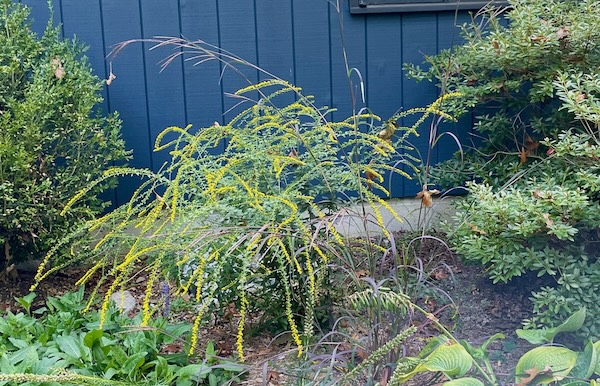
Hoadely highlighted Solidago rugosa “fireworks” as the top-performing goldenrod in the study. On a scale of 1 to 5, fireworks earned an impressive 4.6. The plants are rated weekly throughout the trial for their appearance (foliage, form, vigor, habit), floral display and disease resistance. I first planted this fireworks goldenrod a couple of years ago and its arching structure truly stands out in a flowerbed.
Another of Mt. Cuba’s metrics, insect interactions, led me to consider a retirement opportunity. Volunteers stand in the garden and record how many insects they observe in one minute. The top performers were Solidago. leavenworthii and Solidago rigida, with 12 and 9, respectively. Fireworks earned a 5.
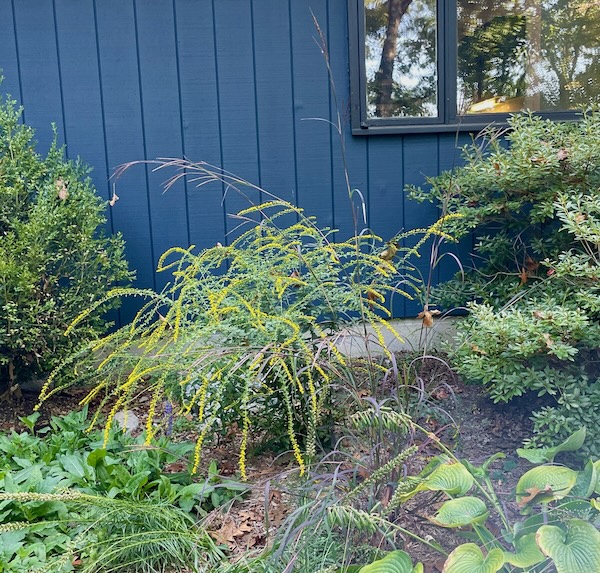 The “fireworks” goldenrod (Photo by P. Doan)
Goldenrods have a bad reputation based on misconceptions. First, they are commonly confused with ragweed, another plant with yellow flowers that is a known allergen.
Next, they are dumped into the “too aggressive for the garden” category. Notably, Canada goldenrod (Solidago canadensis) was not included in the trials. It can form monocultures by spreading quickly via rhizomes and gives all goldenrods this unfair rep. Only five of the 70 goldenrods were noted in the trials as being aggressive spreaders. Given the right space and constraints, those are still worthy of inclusion in plantings.
Hoadely noted that plants with lower scores were not to be considered “bad” plants. They might succeed well in other conditions, like rockier soil, additional moisture or part shade, and the spreadsheet notes their various other traits, including percentage of deer browsing.
Hoadely noted other top performers from the Amsonia, Carex, Vernonia and wild hydrangea trials. Gardeners can also review the results of Mt. Cuba’s trials on phlox, echinacea, monarda, Baptisia, Coreopsis, Heuchera and asters on their website. Like a gardener who can’t name only one favorite flower because there are so many, I can’t name a favorite trial.
I admire the Carex trial for pushing the category of sedges over the edge into public view in a new and important way. Sedges are useful and interesting in landscaping, but their attributes aren’t widely known. This aspect of Mt. Cuba’s work, breaking down misunderstandings about categories of wild plants and interpreting their ecological and aesthetic functions in landscapes, furthers their use by gardeners who might have been reluctant to include them otherwise.
Check out Hoadely’s highlight from the Hydrangea aborescens (“Haas Halo”) trial. He called it an “insect haven” and I learned that lacecap hydrangeas, which have flat flowerheads, are more interesting to pollinators than mophead hydrangeas, which have snowball-type flowerheads. Haas Halo is a lacecap with blooms that span 12 to 14 inches. As we’re out scouring the garden centers when they open next month, keep some of these on your list.
Have you seen these stories?
Roots and Shoots: Proceed Cautiously
Roots and Shoots: Habitat in a Pile of Sticks
Type: Opinion
Opinion: Advocates for ideas and draws conclusions based on the author/producer’s interpretation of facts and data.
Comments are closed.