

Master gardener Henry Homeyer’s tips for saving money
Learn from master gardener Henry Homeyer how to save money by starting plants from seeds and dividing mature hostas.
Journal Staff
Seek out reputable sources like a local cooperative extension service for tomato growing advice.Standard store-bought tomato cages are often too small for most traditional tomato varieties.When growing tomatoes in containers, use the largest pot possible to avoid constant watering.Consistent and even watering is crucial for growing a healthy and productive tomato crop.
March can be a challenge in the garden. Sometimes it blows in with crystal blue skies, warm sun on your back and gentle breezes floating through emerging green leaves.
Other times it’s more like a glowering, glaring 12-year-old forced to stand in front of a monument and smile at the camera for family photos. (The latter offers excellent opportunities to stay inside and plan for kinder weather).
Of course, if you’re like many gardeners, inside gardening amounts to getting online to see what tips and tricks you can learn about tomato growing from those who’ve been doing it forever. The problem is, just because someone has an opinion, or a podcast, doesn’t mean they are spouting good information.
So let’s look at the good, the bad and the ugly to help you decide what direction to go this year.
Look for reputable sources for tomato growing tips
One of my rules for evaluating social-media-based information is, the slicker looking and the faster moving the video, in general, the worse the information.
It’s a bit like the old saying, “if you can’t dazzle ‘em with your brilliance, baffle ‘em with your … bs.”
Those quick hitting, 10-second videos are usually designed more to get you to hit “share” than to provide anything you might confuse with helpful information. Whether it’s burying a 4-foot-tall tomato transplant 3.5-feet deep with a pipe in the ground to help it “breathe” or to get water to the roots, or fertilizing your tomatoes with some concoction of pine needles, old socks and grandma’s left over perfume, skip the shtick and stick to tried-and-true resources.
A good online place to start is your local cooperative extension service. Whether it’s fertilization, soil amendment, seed starting or pruning/training techniques, the information offered is based on decades of research. You rarely encounter snake oil sales promises.
Should you use tomato cages?
There’s the upside down container that was so popular a decade or so ago. Not a completely terrible idea but the container was way too small. The problem is, if you made the container the size needed, you’d have to suspend it from the Brooklyn Bridge.
Then there’s the ubiquitous tomato cage that every year causes me a bout of seasonal heartburn disorder. This time of year all across the land, garden centers and big box stores bring in thousands of those 4-foot-tall wire cages that you’re supposed to stick in the ground around one small tomato transplant.
The challenge, of course, is that most traditional tomato varieties will outgrow your puny cage by mid-June and you’ll spend the rest of the summer trying to support the whole mess with old broom handles, assorted bungee cords and scrap lumber.
Do yourself a favor and build a proper trellis. You’ll know you’re approaching correct scale when your neighbors start rolling their eyes and asking if you’re building something for Jack’s beanstalk.
You can easily solve this undersized cage problem by growing one of the smaller varieties, be then you still don’t need the silly cage because they are bred to be mostly self supporting.
What type of container is best to grow a tomato plant?
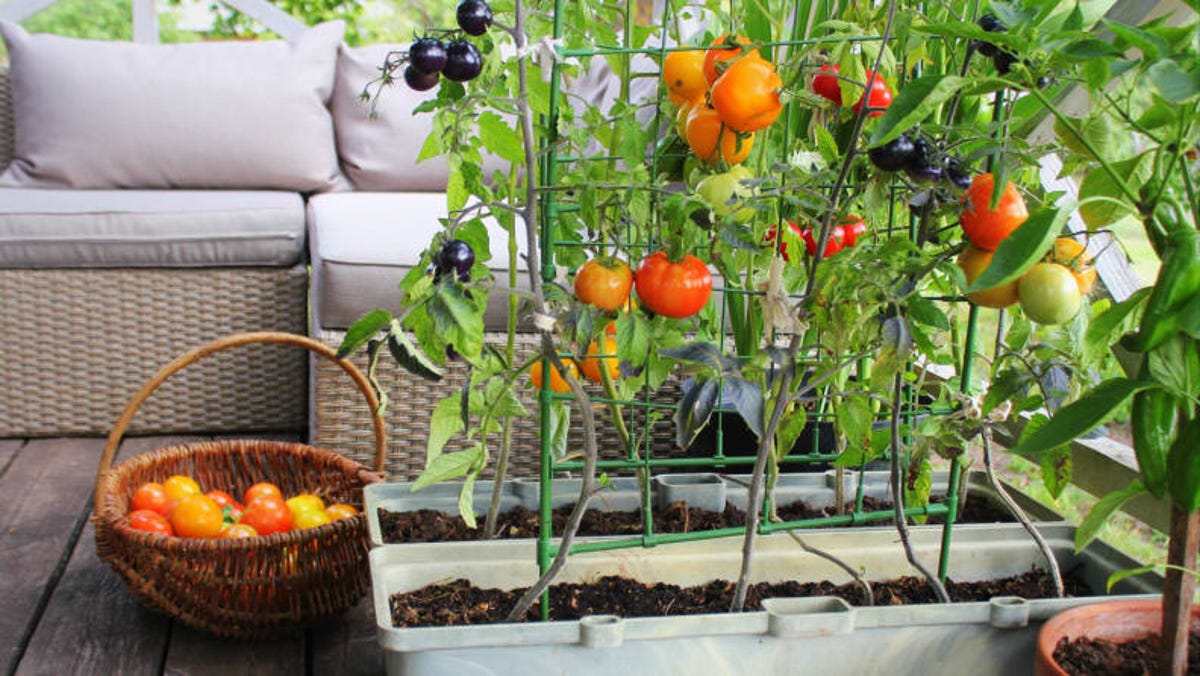
Most people grow tomatoes in cultivated garden beds, and assuming that you’ve done a good job of soil prep, your tomato’s roots will have plenty of room to roam. But increasingly, people are turning to container growing their tomato crop.
Container growing gives the gardener tons of control compared to growing plants in ground beds. In a soil-less growth medium, it is much easier to manage fertility, pH and moisture. Containers also give you lots of options if your space is limited. Patios, balconies, even dropping a few containers in your sun-drenched perennial bed can be a fun way to grow a few extra tomatoes.
And who doesn’t need a few extra tomatoes.
One way to give yourself, and your tomato plant, a little wiggle room is to oversize your container. In fact, I’d venture a guess that there is likely no container sitting in your garage right now that’s large enough to grow a full-sized tomato plant.
Case in point, I have only one small spot on my driveway that gets enough sun to grow a proper tomato plant. And I have only one container that I use to grow that one tomato plant — and it is 36 inches in diameter. It takes about five of those big potting mix bags to fill each year. But it’s about the only way I can grow the big, rangy “Mr. Stripey” variety that is my all-time favorite.
Of course you can also go the opposite direction. There are now many dwarf, compact and smaller-sized tomato varieties that are perfect for the balcony gardener. Some mature at no more than 2 feet tall and wide. But even with those smaller varieties, go as big as you can go so August doesn’t turn into a three-a-day watering regime.
How much water does my tomato plant need?
Tomatoes use a lot of water. I mean a huge amount of water. In addition, uneven moisture level in the growth medium can lead to costly growth interruptions, fruit cracking and poor overall performance.
Certainly, consistent watering is key to growing a good quality tomato crop in containers. You can’t afford to count on the predicted rain. You can’t convince yourself that you should wait until you get home from work to water that wilting tomato plant. Watering has to be consistent through the entire season.
The bottom line is that there’s really no short cut or magical gimmick to growing good tomatoes. Proper soil preparation, good, even watering, regular attention and a constant state of dirty knees is the best answer to just about any garden project. Unless, of course, you can convince that 12-year-old of yours to do all the work.
Paul Cappiello is the executive director at Yew Dell Botanical Gardens, 6220 Old Lagrange Road, yewdellgardens.org.
Comments are closed.