
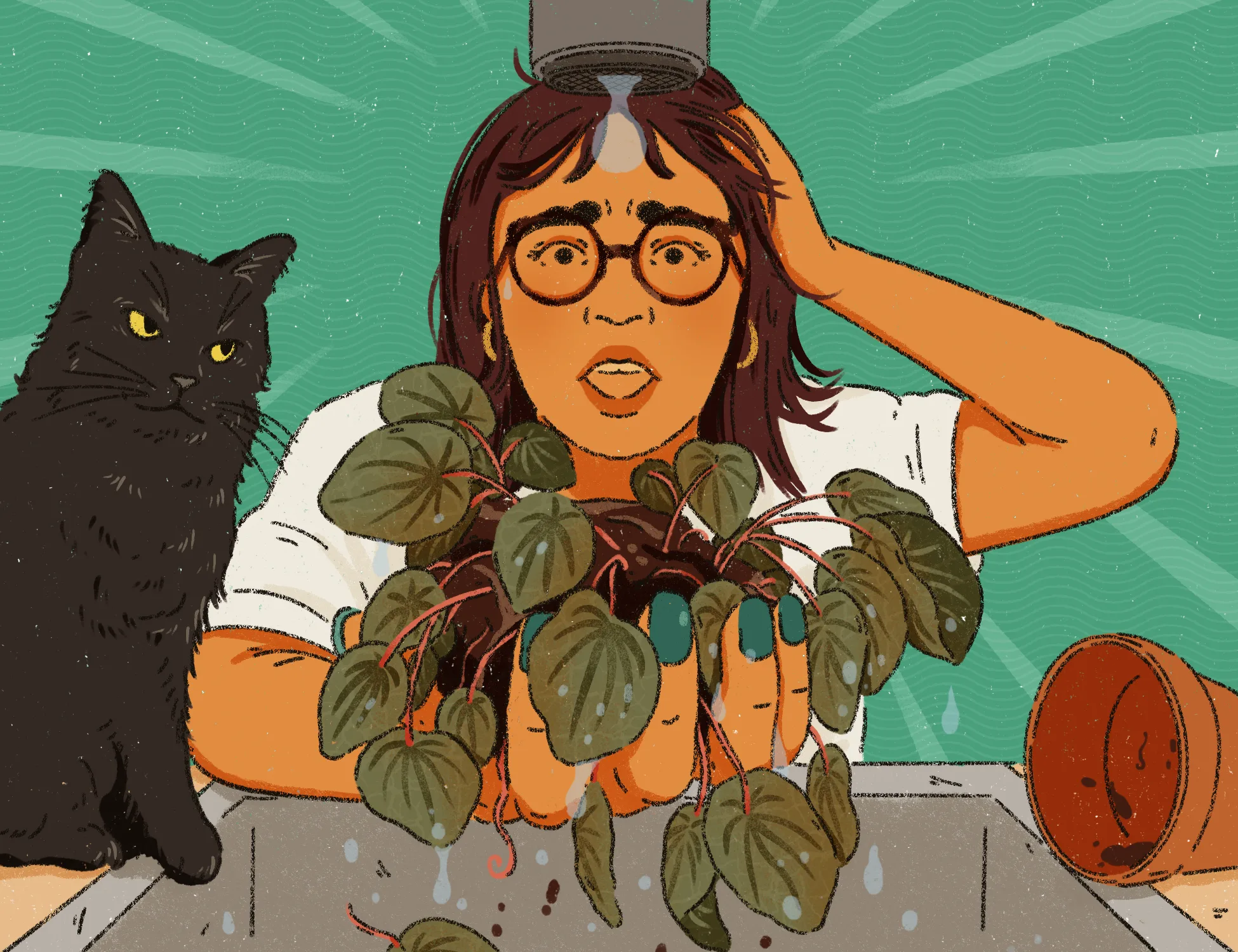
I’m sorry, I’m so sorry, I whisper as the faucet runs. Is this the best way to do it? It certainly seems like the most effective method. I hold it up, feeling like Hamlet in an existential crisis. Why am I the way that I am? It—Rosso—stares back at me like he’s disgusted. I could swear I’m being reprimanded.
It all started when I was strolling around downtown Staunton, after a nice breakfast and that newfound feeling of Today, I’m becoming a better person. I saw an inviting plant store on the corner and, in a spur-of-the-moment moment, I went in childless and came out a mother—the mother of a Peperomia caperata, “Rosso,” that is. Decidedly a “he.” The future looked bright with my brand-new green thumb.
Except for one teeny tiny problem: I’ve never had a green thumb. It usually registers somewhere in the dirt-to-mud range of browns. I’ve tried many times to be the elusive, salt-of-the-earth, cool girl whose home is floor-to-ceiling plants. But my track record wasn’t great. There was the time I got a croton plant in my sophomore year of college, thinking, I’m an adult! I’m not in the dorms anymore! I can take care of another living being! I was so committed to this new chapter that the poor thing ended up both overwatered and too dry in less than a week. There was also the time I thought I could at least take care of some cacti. They live in the Sonoran Desert after all, and conditions there are hardly hospitable. But even they couldn’t survive me.
I finally gave up. I pivoted to plastic plants until I discovered their magnetic attraction to dust mites. That chapter was a disaster, too.
Eventually, I grew up (sort of), adopted a cat, and moved into a house with a backyard and a greenhouse. So when that sunny trip to Staunton rolled around, I felt ready to reignite my dream of a green thumb once again. If I can keep my beloved black cat alive and thriving, surely a plant in dirt wouldn’t be at risk.
But as soon as I began researching Rosso and what Peperomia caperata would require, a feeling of dread crept over me. There were light requirements, liquid fertilizers, misting, and repotting. I was overwhelmed. How was I to know that a plant this small was such a big responsibility?
Yet, I soldiered on, undeterred. I found the right spot and the perfect pot for Rosso’s new home. I bought a tiny copper watering can and a mister—the care card said he would “thrive on humidity,” so an occasional spritz was in order. I was positive I’d turned a new page in the book of Embracing My Green Thumb.
With all the equipment, I was sure I’d set myself up for rousing success.
I was pleased, optimistic, confident.
Success was mine.
And then I completely, utterly, and totally blew it.
But wait … before you judge, hear me out: After rearranging the house for Christmas—between the tree, the lights, the decorations—Rosso was temporarily moved to the bookshelf in the corner. In the dark. Totally ignored. For over two months.
But there’s hope. After profuse apologies and running him under the faucet to un-cake the brick-hard soil, Rosso clings to life. A few leaves down, looking a bit dejected, but alive. Now I check on him morning and evening, even chat him up. He doesn’t purr like my cat Baby, but I swear I detected a little wiggle in his few remaining leaves.
Lesson learned, harsh as it was. I’m turning over a new leaf—literally. My grandmother grows avocados, bananas, and oranges in her coastal Brazilian garden. Lush, full, happy. I’m tapping into that DNA.
Fruit trees aren’t in my immediate future, but I’m hopeful. Spring is here, and with it, I’m spring cleaning my habits, my greenhouse, and hopefully, my brown-ish green thumb.
 Illustration by Heedayah Lockman
This article originally appeared in the April 2026 issue.
Comments are closed.