
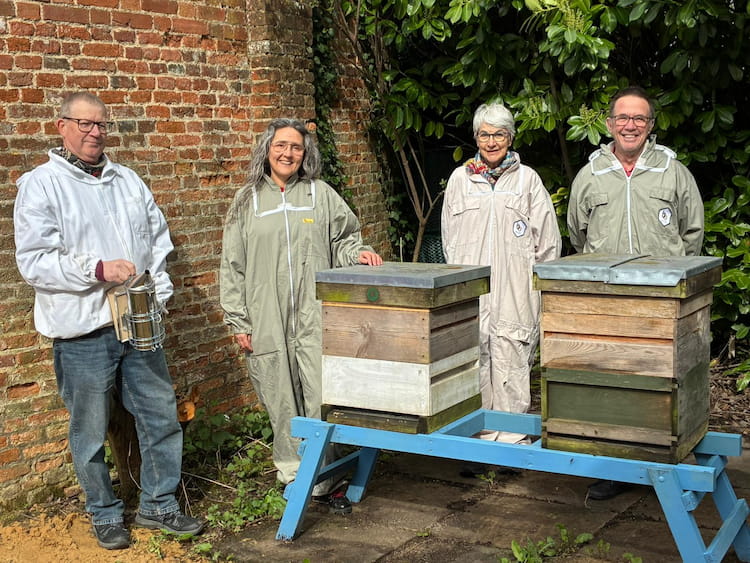
The additional hives bring the total planned to four, building on an existing pair already maintained within the garden at Lydiard Park.
The expansion has been led by Michael Carter and Barry Roberts from Swindon & District Beekeepers Association.
They recently demonstrated their work to councillors during a visit to the park.
Councillor Marina Strinkovsky, Cabinet Member for Placemaking and Planning, and Councillor Jane Milner-Barry, the Council’s Champion for Sustainability, were shown how the hives are managed and how they support pollination across the wider parkland.
If all goes to plan, jars of Lydiard Park-produced honey could be available later this summer.
The honey is expected to be sold through the on-site heritage garden centre, located behind the Coach House Tea Rooms.
The walled garden, where the hives are based, dates back to the eighteenth century.
Historically, it was used to grow fruit, vegetables and flowers for the estate.
The high brick walls created a warmer microclimate, allowing gardeners to cultivate produce that would otherwise struggle in the English climate.
At the heart of the estate sits Lydiard House, a Grade I listed Palladian mansion surrounded by parkland and formal gardens.
Today, the restored walled garden combines its traditional role as a working space with modern sustainability and education initiatives.
Bees play a key role in pollination, supporting plants within the garden and across the wider parkland.
Visitors are being encouraged to return later in the year to sample the honey, which will sit alongside plants and handmade goods already sold at the heritage garden centre.
If successful, the project could form part of a wider ambition to strengthen small-scale, sustainable food production at Lydiard Park, rooted in its historic past.
Comments are closed.