
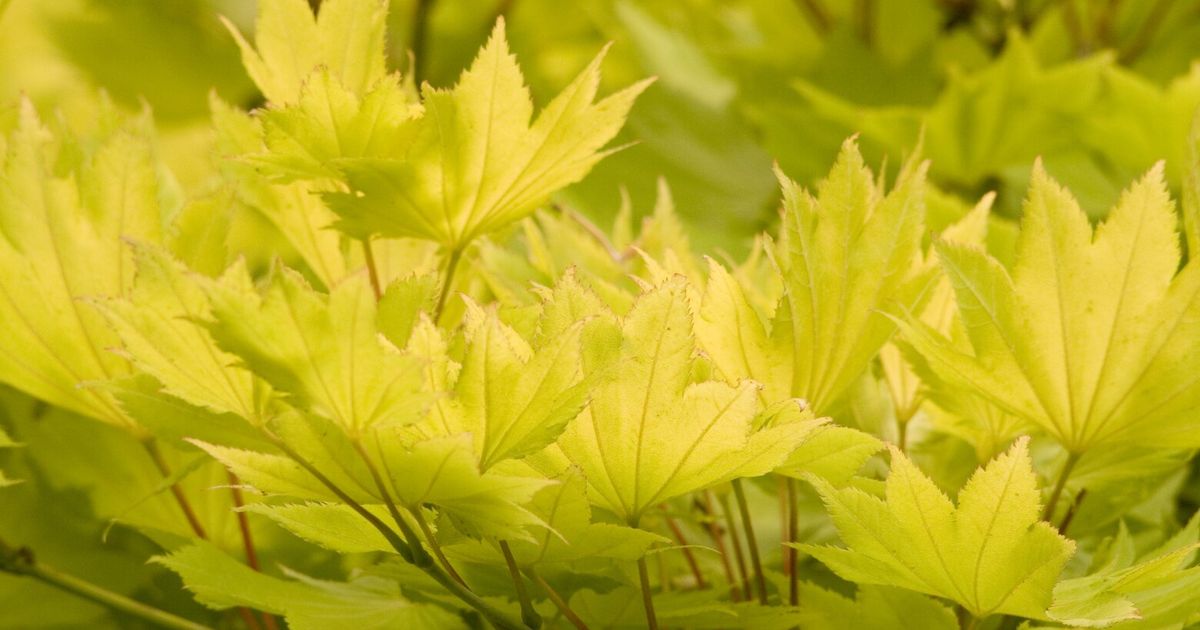
CHARTREUSE, OLIVE, MAIZE. The second installment of Cultivate the Rainbow, this year’s seasonal series exploring color in the garden, focuses on a couple of powerhouse hues in the natural world: yellow and green bringing light and life to the garden.
Before we get plant-y, let’s explore how naming color can help us see more color, in the garden and beyond. For instance, even if it’s technically accurate, calling a flower yellow is vague and at least for this color-loving gardener, lacking. But a lemon-yellow blossom, a creamy summer rose or a blanket of golden fall foliage convey different expressions of what are various shades of yellow. This is the power of language.
Yellow is one of the most common colors in nature and the brightest color on the spectrum; its blossoms remain visible, even in low light. On a stormy day, a lemony tulip or the creamy-yellow blossoms on golden winterhazel (Corylopsis spicata ‘Golden Spring’) appear like shafts of botanical sunlight. The latter carries its warm glow from spring into summer with flashy canary-yellow foliage that ripens to brilliant gold in fall. Gardeners looking for a more robust statement in the spring landscape have only to glance at the school-bus yellow blooms on forsythia — you can’t miss it.
Familiar summer perennials with deep-yellow blooms, such as yarrow (Achillea ‘Moonshine’) and black-eyed Susan (Rudbeckia fulgida var. sullivantii ‘Goldsturm’), blaze in the strong light of the season; pastel hues bleach in direct sunlight.
The rose named for renowned cook Julia Child is a floribunda with buttery-yellow blooms and a delicious example of how describing color enriches our perception. Soft-yellow evening primrose (Oenothera odorata) is lanky and frankly rather unkempt in the summer garden, but the luminous flowers seem to glow in the night garden, spilling their spicy fragrance after dark.
In many plants the shift from yellow to green is incremental. The spring leaves of golden full moon maple (Acer shirasawanum ‘Aureum’), a small tree well-suited to the urban garden, emerge an intense lemon yellow before softening to chartreuse in summer. Pro tip: Plant the tree in partial shade to avoid scorching foliage in direct sun.
Wilma Goldcrest Monterey cypress (Cupressus macrocarpa ‘Wilma’) is a columnar sentry in the sunny, dry garden. The golden conifer’s color is strongest in full sun and fades to a softer lime green in partial shade. In a delightful echo between color and fragrance, the plant’s needles smell strongly of lemon when crushed. Golden cypress shines as a focal point in the garden or in a container on the patio.
Green is the most powerful color in a landscape. Throughout human history, a landscape filled with green plants and tall grasses has indicated nourishing conditions critical to survival. Our very lives once hinged on green. Scientists think this may be why humans can distinguish more shades of green than any other color on the spectrum.
Here in the Puget Sound region, we know green. Seattle, affectionately known as the Emerald City, is the largest population center in Washington, the Evergreen State. Thanks to a damp climate and environmental preservation efforts, even our urban core is threaded with forests and ferns that collectively function as a carbon-capturing, oxygen-producing machine that powers our very existence. Think about that the next time you’re tempted to disparage a gnarled bank of juniper outside a gas station or a featureless laurel hedge.
In the garden, green is so ubiquitous that it is seemingly invisible, hiding in plain sight. When facing an all-green landscape, most gardeners yearn to add “a spot of color” to leaven the sameness. For a more nuanced approach, consider planting a verdant retreat by combining plants in various shades of green with contrasting textures. A simple planting of arborvitae, pheasant grass (Anemanthele lessoniana) and common rhubarb was an afterthought in my garden that nevertheless has proved to be a winning combination that requires very little maintenance.
You don’t need me to offer a list of green plants; the selection is vast. The next time you’re out in the garden, or visiting a nursery, look for various expressions of green — think jade, sage, olive and moss. Then look at the landscape with fresh eyes and a renewed respect for our planet’s foundational color.
Lorene Edwards Forkner is the author of the newly published “Grow Great Vegetables Washington.” Find her at ahandmadegarden.com and at Cultivating Color on Substack.
Comments are closed.