
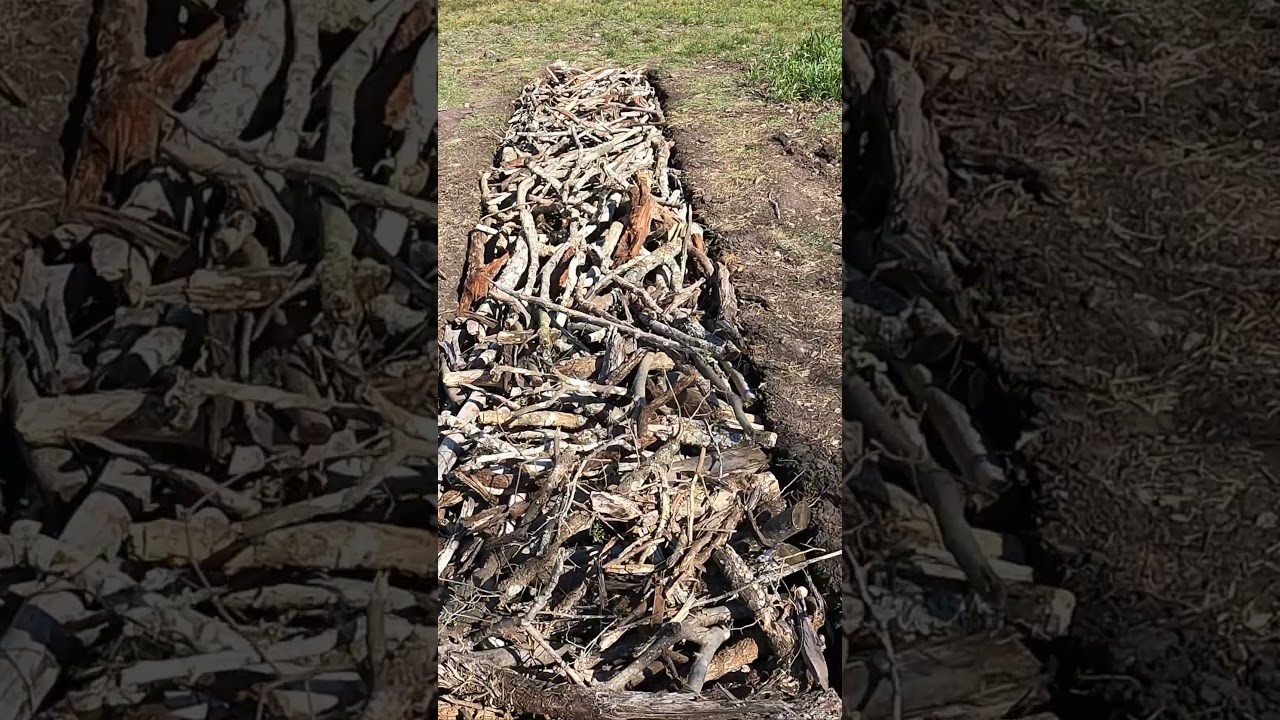
I spent an entire week putting this hugelkultur bed in. It was a tremendous amount of work especially with my rocky and clay packed soil. I dug about 6-8″ deep and layered the wood logs in the bottom then put wood chips and compost over that. Hopefully this was all worth it and I get some really good growing beds for future vegetables. It takes 6 months I hear before the bed will be ready to grow veggies, however I probably will put in some cover crops.
If you wanna see the full video of me installing this, here is that video – https://youtu.be/6xa5dnCn8Ds
49 Comments
Wood breaking down robs soil of nitrogen
You should not burry organic matter in the soil, if it breaks down in an environment deprived of oxygen, it will lead to nitrogen deficiency. You can incorporate organic matter in the top 10cm if you want to speed up decomposition but never burry it.
Thats a clever idea ❤❤
I know the video is over a year old. But i set uo a hugel bed a fairly large hugel bed. Got lucky that a neighbor had MANY logs to use and only dug my bed about 4inches deep. Deepemough for the thickest of logs to become a solid base. And of course did all the needed layering of materials. Im now on my 3rd year growing in the hugel bed and i've still gotten good harvest. The only issue has been my own on fertialising or pla ting my pla ts at the right time. Otherwise i cover cropped it and have kept up on a crop rotation system.
People saying it'll rob nitrogen probably forget that if you'rr amending the bed PRIOR to planting or adding in amendments as you build are useful as well. Or if you're adding compost on top it still becomes a good planting area. And if you're adding the dug up dirt you used to make the oit as a layer on top it already has native nutirents for the plants.
Also raised beds are actually more expensive to make & install regardless of where you're getting the materials from. I'd say i put about 100 dollars into the bed for the first year and that was just to pay for amendments like Compost starter *great addition for a hugel bed amendment*, fertalizer, and bags of compost say about 8 at 5$ a bag from my local seed&feed.
I'll always advocate for cheap ways to garden. And fun fact adding FREE coffee grounds a nitrogen source, also is a beneficial addition. Some of this is trial & erorr other things are a lack of experience & knowledge.
Looks good
I've tried it. Where I live, it turned into one giant fireant mound.
Termite mound.
Don't do that..use only dry and green leaves
Very bad way of doing bed .. this will generate a nitrogen starvation.
Better to put wood ahere there is no roots … on top of the dirt.
Did that in my raised beds. Every veggie i grow loves it minus tomatoes (2 years in a row almost no tomatoes but 7ft tall plants).
I made one of these before. It turned into a rat nest
I tried it and I can only say one thing. This thing takes forever to break down if you don't do some things pre-emptively.
Next time you do this – try to add some mushroom spawn. Blue oyster mushrooms would work the best, but you could also try Stropharia Rugosoannulata. Additional food and your wood will break down quicker.
Been doing this for a few years. Works very well. It’s have a 10×20 Ft cinder block raised bed I did this under and it has produced great results with reduced watering.
Looking good for a bon fire. What you have there is a mess. What are the plants going to do when they reach the wood in a month or less? They're going to die, or you'll have weak sickly plants that won't produce in the manner you were thinking.
I did it last winter with hay I mowed and raked from pasture. Took many loads from the truck and then top with leaves, decomposing wood chips (3 yr old) then some clay and manure on top. I dug holes and planted things with compost last spring. Needed a lot water. Its growing a lot of turnips now after a year..next spring will need less water as it gets better and holds moisture
Hay que esperar años para que eso se desintegre
Love that idea, also such a good way to get rid of the branches if the garden has a few trees. 🥰
You are brilliant ❤
This method offers 5 to 10 years fertilizer. The wood takes few to several years to break down. It holds moisture and creates better environment for growth.
Yeah. I remember when I first learned about permaculture and wanted to do everything.
After some time I grew up and understood that to do hugelkultur you should have a lot of material laying around. If you don't have and need to pay or collect from elsewhere then it is a waste of your energy.
I did that today!
transition from logs to soil is not deep enough and it needs grass clippings and needs to be saturated.
Did you add the grass clippings?..need all the nitrogen you can get in those
Dude I'm right behind you man. I love permaculture self watering systems also you won't even need to feed whatever you grow in there. Be sure to add pockets of foodscraps in there as you grow. Great video
What is this please can somebody explain to me?
Good Work 👍
菌ちゃん農法だね
Good job 👍
I do similar, 1st dig bed, then line with cardboard, then use fell trees decay, add chicken poo, 2x sharks then fill gaps with smaller branches, then add brown leaves, then green leaves then compost layer then add a premium veggie top soil mix, then add layer of mulch.
😮😮😮
Allahumma sholli wa salim wa baarikh ala sayyidina Muhammadin wa'ala ali Sayyidina Muhammadin fil awwalin wal aakhirin wa fil mala'il a'laa ilaa Yaumiddin
En español aprendan español
I can see where this would work. I know I buried a bunch of branches and wood mulch under the god awful clay soil and a few years later when digging I discovered that the soil is amazing!
That soil on the top looks great. A layer of compost under it, yes?
сжечь и не ебаться ….
Вы не представляете, какие хоромы вы построили для мышей, на собственном опыте говорю
Is that what you call it. I do this to all my waste so the worms come .
I thought the idea was to NOT get the wood logs in “as tight as possible”?
It didn't work very well though did it? Air gaps, nitrogen robbing, probably too dry for the first few years.
You didn't mention the nitrogen layer on top of the bed such as grass clippings and greenery followed by compost and then the top soil,
Burn the wood to Ash. Add acid and turmeric. Then your plants could actually use the nutrition
So awesome !!!
Apakah disana ada serangga rayap
And you did it wrong you were supposed to put something in high and nitrate on top of the wood like grass leaves compost something that had high nitrous level to get you through the first year then you put your dirt on top of that
I tried, it absolutely doesn't work… 😂
I’m going to start doing that. It save a lot of water bill from what I heard.
Buen video aslo en español 🫡
เป็นรูปแบบที่ดี
Ci vuole legna morbida come tiglio e pioppo e tagliarli più piccoli possibili poi scoprire e bagnare ogni tanto e una terra già ricca di lombrichi e microorganismi decompositori e quindi è già un' ottima terra quindi…..😊😊😊
菌ちゃん農法ですね