
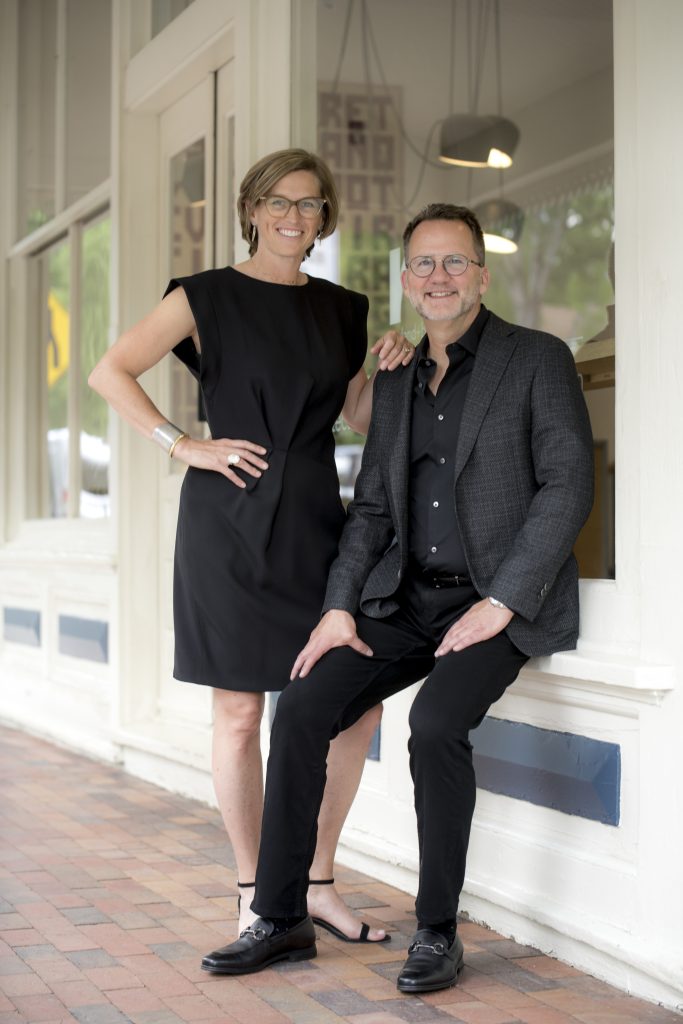
Running a business is like cultivating a garden. It’s a simple analogy, but it explains nearly everything about how John Rowland and Sarah Broughton have built Rowland+Broughton over the past two decades.
They moved to Aspen in 2000 after time in New York City, worked for established firms and, in 2003, launched their own from a one-bedroom condo. What began as two architects working late into the night has grown, carefully and intentionally, into a 45-person firm with studios in Aspen and Denver.
But like any well-tended garden, the growth wasn’t accidental. It required patience. It required discipline. It required knowing when to cultivate and when to cut back. And in a town like Aspen — where expectations are high and the landscape is shared by all — that kind of stewardship isn’t optional. It’s the standard.
Bryan: First question we always ask — how did you guys get to Aspen?
John: We moved to Aspen in 2000 after several years in New York City. Sarah and I met at CU Boulder and graduated in 1996, and while we loved our time in New York, we found ourselves missing the mountains, the outdoors and the lifestyle we had come to value.
Sarah: Part of our draw to Aspen was that our career and profession are deeply important to us. We wanted a community that not only fed our spirit through nature and access to the outdoors, but also offered the cultural depth and patronage that Aspen provides. We felt we could continue building a robust career in a place like this.
Bryan: What did work look like when you first arrived?
Sarah: We initially worked for other firms — John with Dave Gibson and I was with Harry Teague — and in 2003, we started our firm around the kitchen table of our one-bedroom condo.
Bryan: And what was that like?
Sarah: It was like a lot of late nights. John and I were working until one or two o’clock in the morning most of the time.
When you found a company, it’s like starting a garden. It’s a constant process of pruning, watering and weeding.
John: When starting any company, you have to have some understanding of grit. When you’re in production mode, you have to ride that flow state as long as your body will allow.
You can’t be like, “Oh, I’m going to be productive tomorrow,” because you don’t know what curve balls are going to come tomorrow. Starting a business isn’t a 40-hour-a-week job; you can never have that mentality.
Bryan: When you broke off on your own, were you able to solely focus on your own firm, or did you have side jobs to fill the gap?
Sarah: With both of us working, we were able to make a full transition from the start. But it took a lot of hustle, passion, grit and devotion. The Aspen community gave us support from the start, and we’re deeply grateful for that.
Bryan: You compared starting a business to tending a garden. How has your garden grown?
Sarah: Over time, we’ve grown, but we’ve done it very intentionally. It was never growth for the sake of it. We expanded only when necessary — to ensure we had the capacity to deliver every project at the standard we hold ourselves to.
We treat every project like it’s the most important one yet, and every client deserves that attention, and that takes capacity.
When we started, it was just John and me, and today, we’re 45 people.
Bryan: And multiple offices, right?
Sarah: About a year after launching in Aspen, we opened the Denver studio. We purchased a live-work loft there, knowing we would eventually need the additional support, and it has continued to evolve and grow.
Today, we have strong teams in both our Aspen and Denver studios, along with several remote team members. It’s been incredibly rewarding to watch it all come together.
Growing the firm has required a willingness to take calculated risks at the right moments — and a bit of fearlessness when the timing calls for it.
Bryan: I think there also comes a point where saying no is more profitable than saying yes.
Sarah: Exactly.
And there’s the nature of our projects. A lot of them unfold over a few years, which translates into long, deep relationships with clients. You need to make sure you’re on the same page with how you approach projects, how you approach iterating and how you approach problems when they do naturally happen.
Bryan: How do you approach building those long-term relationships?
Sarah: I think you have to be a chameleon to a certain extent. You have to read who you’re working with and how each person responds, and understand what motivates them.
You also have to know when someone is triggered, what created that reaction, and avoid replicating those circumstances.
When you’re a leader, you have to be able to reflect quickly and pivot.
I think since COVID, society has become more transactional, and it’s even more important now to lean into building meaningful relationships. Only through meaningful relationships can truly meaningful work be created.
Bryan: Speaking of COVID, have you seen a shift in the clientele since the pandemic?
Sarah: Unfortunately, a lot of younger people are struggling now since the pandemic, but there are also a lot more wealthy young people in our market. That translates into a clientele who have a different lived experience than what we are used to.
If you grew up in a household that renovated projects, lived with art, lived with finer things — you carry that experience with you. But if you’re new to it, and you’ve never had that experience, it’s our job to educate you on what that’s like and what you can have.
What it’s like to live with beautiful things. What it’s like to support artists and have bespoke items in your house that were created just for you, and how that supports a population that needs support.
Wealth comes with certain obligations.
Bryan: You mentioned the importance of grit when starting out. What’s the most important characteristic you have right now as business owners?
Sarah: Devotion. We’re totally devoted to our firm and to our clients and to what we do. That devotion comes across in many ways.
We work just as hard today as we did at any point in our careers. We want to make sure the years of experience we have gathered are being delivered to all of our clients.
And we always say when people hire us, they’re not hiring one person — they’re hiring all of us, all 45 people.
Bryan: Where do you think that drive comes from — to always keep getting better?
Sarah: I’m a deeply curious person, and that has always driven me.
I’ve always been an athlete, and I recently heard that 94% of women in C-suite positions are athletes. It’s a fascinating statistic because it reflects what sports teach you — teamwork, collaboration, resilience in failure, grace in success and the discipline of hard work.
John’s an athlete too.
And you need growth-focused people around you in business and in life. And growth doesn’t mean money — it’s a mindset.
Bryan: Do you guys see yourselves as yin and yang? How does it work as a husband-and-wife team?
Sarah: One thing I’m really appreciative of about our relationship is that when one of us is really fired up, we know how to calm each other down.
We are open to texting each other things like “take a deep breath. Calm down. This is not the time.”
Bryan: What’s your goal with each project? Is there something bigger you try to leave behind?
Sarah: Our goal is to build something that lasts.
John: There’s a fine line between designing something contemporary or modern and avoiding trends that might not have longevity.
Bryan: You two have a huge responsibility because your work is on the street for all of us to see. How do you deal with that?
John: Oh yeah, it can keep you up at night.
Sarah: But we lean into it.
John and I bought the Mesa Building on Main Street in 2016. We undertook a massive renovation to restore it to its historical beauty.
Today, we have property managers wiping it down regularly because we see ourselves as stewards. It’s one of the obligations we are honored to have in our community.
Bryan: What are your biggest challenges these days?
Sarah: Last year, we had seven babies in our firm. We didn’t anticipate that impact. Colorado now has family leave, which is a great thing, but it can have a big impact on long-term planning. We are now adjusting moving forward.
John: Working with a new generation has also required some adjustment.
When Sarah and I started working, all we wanted was for our superiors to “throw us the ball” and give us as much responsibility as possible. Today, people are more focused on having a work-life balance.
Bryan: How do you accommodate that new paradigm?
Sarah: We get everyone involved in project schedules, because if we set the schedule, it would be completely unattainable.
We coach what it means to deliver excellently across a 40-hour work week, and those standards are non-negotiables.
The younger generation is intensely perfectionistic, but they get paralyzed by it. So we coach efficient iteration.
For the most part, our clients don’t want to wait until the end to see something that is perfect — they want to be shown along the way so that they can impact the process as well.
Bryan: Last question: What advice would you give to someone starting their career in Aspen right now?
John: Build your network. That’s the biggest thing. We will not make a move without consulting with our trusted advisors. There’s probably five or six of them.
Sarah: And get involved in your community. Give back.
Before we even started our company, John was on the Planning and Zoning Commission, and I was on the Historic Preservation Commission. Those things taught us how to contribute to the community and how to be good at public speaking, and they led to countless productive conversations.
Like any enduring garden, what John Rowland and Sarah Broughton have built didn’t happen overnight. It has been cultivated — season by season — through discipline, stewardship and an unwavering standard of care.
In Aspen, where the landscape belongs to everyone, that mindset matters. Tend it well, and it lasts. Neglect it, and it shows. For John and Sarah, the work is never finished — it’s simply the next season.
Bryan Welker lives and breathes business and marketing in the Roaring Fork Valley and beyond. He is president, co-founder and CRO of WDR Aspen, a boutique marketing agency that develops tailored marketing solutions. Who should we interview next? Reach out and let us know bryan@wdraspen.com.
Comments are closed.