
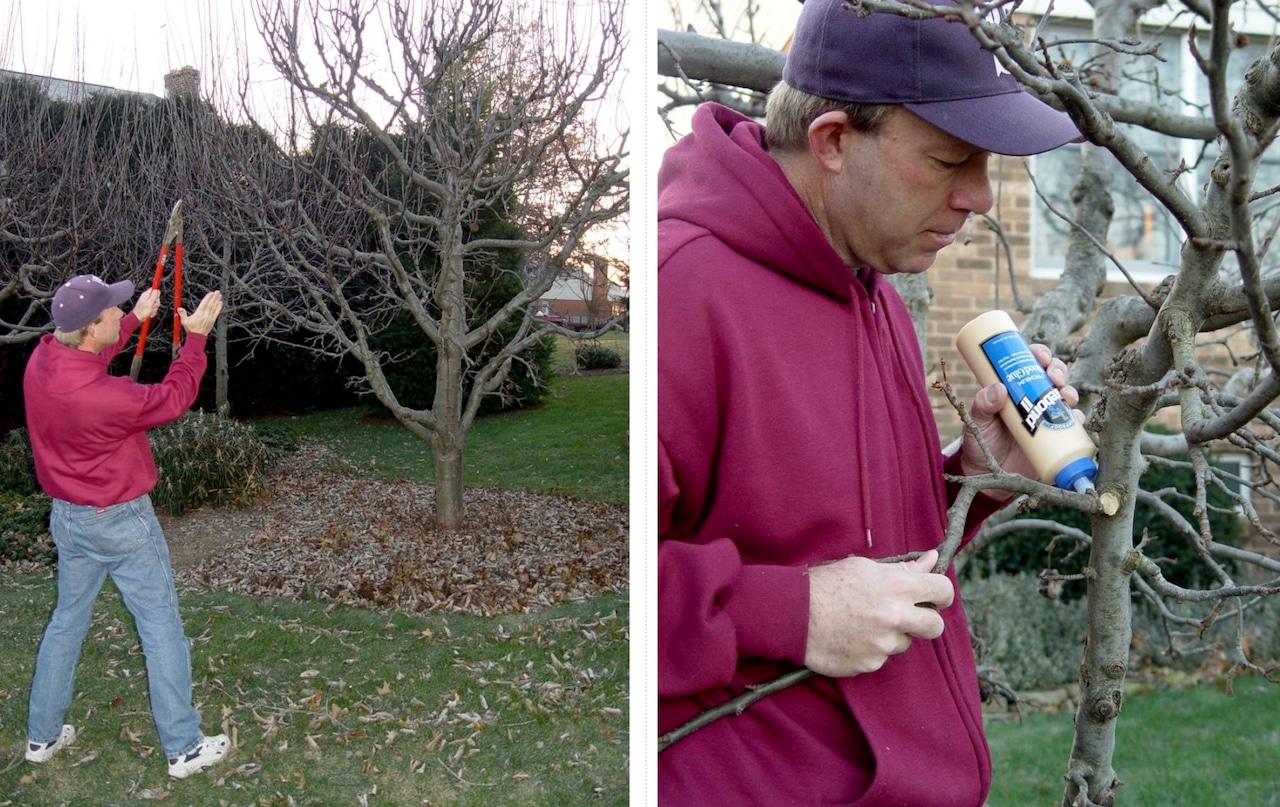
Some trees grow into a nice shape at a measured rate with little help from the tree-planter.
But most young trees benefit from some selected pruning cuts — especially in the first two to five years — to help them develop a solid and healthy beginning framework.
End of winter is an ideal time of year to do that, right before the year’s new growth begins.
“A few minutes of thoughtful pruning on a young tree can eliminate hours of costly future pruning when the tree is mature,” the Penn State Extension says in a post on pruning young trees.
First, forget the old advice that all new trees need to be cut back all around so that the top growth is more “in balance” with the young roots.
Research has found that keeping most of the top growth means more leaves to generate energy that goes into fueling root growth.
So don’t routinely cut a new tree back by a third to a half thinking you’re helping it get started.
When to prune
What cuts should you make then? And when?
First, dead and broken branches can come off at any time. Start by removing those back to healthy live growth or back to where the compromised branch attaches to the trunk or bigger branch. (Make cuts back to the outer edge of the little ring where branches attach, a structure known as the “branch collar.”)
Starting at the beginning of year two, have a good look at the tree’s structure while the tree is leafless in winter.
March is a good month to prune not only because it’s easier to see the structure then, it’s a time right before the tree starts expending energy into new growth. It’s best to channel that energy into the best “keeper” growth rather than letting wayward growth happen and then cut it off.
How to find the right branches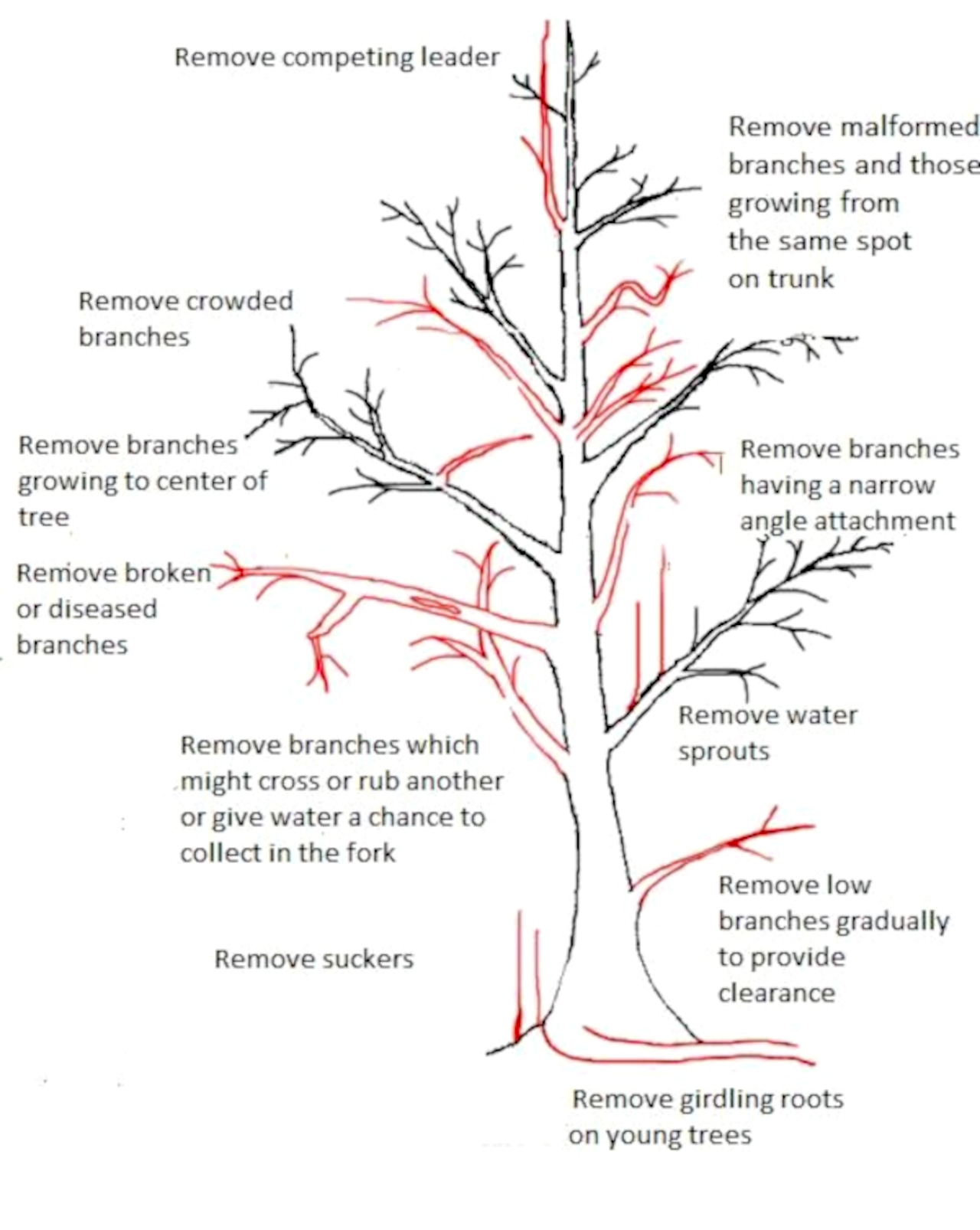 This University of Maryland graphic is a guide to help zero in on which branches to remove from a young tree.University of Maryland Extension Home & Garden Information Center
The University of Maryland Extension has an excellent graphic and rundown on exactly what branches to consider removing.
Penn State Extension also a detailed and illustrated web page on pruning young trees.
And Iowa State University produced a how-to video on pruning young trees if you’d rather watch than read.
In general, the goal of most trees is to encourage one strong central trunk (a “leader”) with horizontal side branches coming out evenly from all around the perimeter.
“Step back to look at the tree from all sides and select the permanent branches and branch structure that the tree will have for its lifetime,” Penn State Extension advises.
If the tree has more than one upright shoot competing to become the main trunk, select the strongest and most upright and remove the other(s).
Also check to see if any horizontal branches are growing up and out faster than the main trunk. Those should be cut back to a side branch or bud that gives the main trunk clear dominance.
How many branches to cut?
Next up is removing excess or unnecessary branches coming off of the main trunk.
Penn State Extension suggests aiming to have branches come out evenly from all around the tree with about 18 to 24 inches between the branch layers.
If multiple branches are growing out of the same general area or too close to one another, pick an ideal one and remove the others.
Best candidates for removal are those that are attached at the sharpest angle, i.e., growing more upright than out. These vertical “branch crotches” are more prone to breaking than the more horizontally attached branches.
If you run into vertical crotches on branches you want/need to keep, University of Maryland Extension says it’s possible to correct that on a young tree by using spacers or spreaders.
“Spreaders can be made of wire or wood and are positioned in a crotch, pushing it wider,” UME says. “Weights also can be tied to branches to widen the crotch angle. The spreaders or weights should be removed after one season.”
Another “defect” to look for is crossing branches. If two branches are rubbing into each another, the weaker, more misdirected of the two should be removed.
Branches growing straight up from the side branches can also be removed (up to one-third of them each year), says Penn State Extension, while branches growing from around the base of the trunk (“suckers”) should be removed as well.
What about lower limbs?
Both Penn State and University of Maryland recommend keeping lower limbs for the first several years to aid in early root development, although these can be shortened if they’re growing up into higher branches that you intend to keep long-term.
Lower limbs can be removed as the tree grows, for example, if you need to mow underneath or if the low branches are growing into shrubs or other low-to-the-ground structures.
A good rule of thumb is never remove so many lower limbs that the trunk will be bare more than one-third of the way up.
Lower limbs ideally should come off while they’re still one inch in diameter or less.
UME says the total branch removal each year should never add up to more than one-quarter of the tree’s wood.
“Remember, it’s better to make several small pruning cuts than one big cut,” UME adds. “Avoid cutting large branches when possible.”
Penn State Extension says young trees can withstand a little more than one-quarter’s worth of pruning.
“Base your total removal of live branches or foliage amount on tree vigor,” Penn State advises. “Young trees, if healthy, can generally withstand wounding more than mature trees.”
While you’re out there pruning the young trees, have a look at older existing trees for any damages incurred over winter or other threats that might make them hazardous “zombie” trees.
More tree-care tips on International Society of Arboriculture’s Trees Are Good website.
Comments are closed.