
Vegetation has always been here. Wildlands outside of urban development demonstrate that no place is or was without it.
Native species lived here before any home gardens did. Whether intentionally or unintentionally, some still do. Some sneak in like weeds. Some arrive by invitation. A few old trees never left as the area around them developed.
Native species perform well locally because they are adapted to local climates and soils. It is all very natural to them. In fact, many dislike major modifications to their climates and soils.
Although most tolerate or even appreciate a bit of supplemental irrigation, some do not. Many rot if irrigation is too generous. Also, many do not want much soil amendment.
Some native species might be a bit too natural, though. Because they are from chaparral climates, they can get somewhat scraggly by summer. It is not because of a lack of water or other environmental deficiency. It is their natural behavior, and how they survive in the wild.
Many wildflowers that bloom so well for spring are completely dormant by summer.
The advantage to this is that almost all native species do not demand much water.
Many want none at all. Once established, they get all they need from natural rainfall.
Therefore, landscapes of mostly or exclusively native species conserve water. Since native species are adapted to endemic soil, they require no fertilizer either. They are quite conservative.
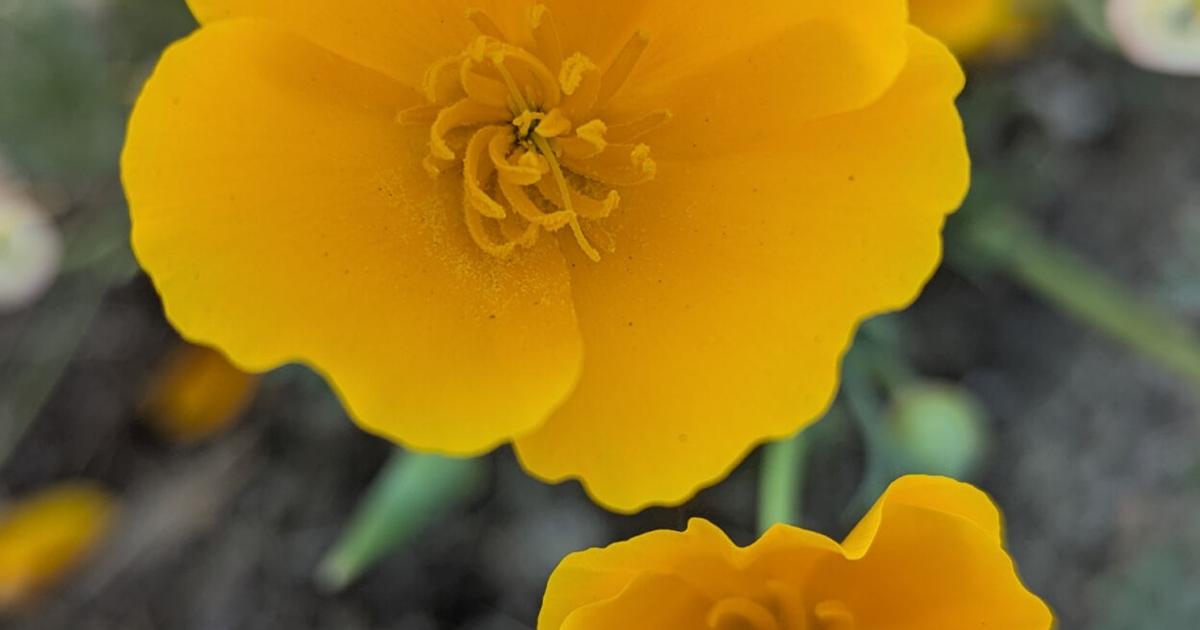
California poppy, which is the state flower of California, is a very familiar native annual.
Unlike other native species, it appreciates supplemental irrigation after the rainy season.
It typically blooms only for spring, but may bloom into summer with occasional irrigation.
Sky lupine is another native annual that blooms for spring, with contrasting blue flowers.
Various salvias, bush lupines, penstemons, irises and grasses are native perennials. So are sticky monkey flower, Oregon grape, tree anemone and tree poppy. Toyon, silk tassel and various California lilacs are native shrubbery.
So are flannel bush, coyote brush and coffeeberry. California sycamore, coast live oak and redwoods are common native trees.
Fernald’s iris
The natural range of Fernald’s iris, Iris fernaldii, is actually rather limited. It is endemic to only the coast ranges from Mendocino County to Santa Cruz County.
Although it grows well beyond its natural range, it is quite rare in cultivation. Within chaparral climates that are warmer than its range, it prefers afternoon shade. Its foliage is greener with irrigation.
In the wild, Fernald’s iris develops sparse colonies, typically mixed with other vegetation. Colonies are more compact with cultivation and exclusion of other species.
Propagation is very easy by division, or simple separation of wayward rhizomes.
Fernald’s iris can be satisfied with shallow soil or soil of inferior quality. Too much fertilizer may inhibit bloom.
Fernald’s iris grows only about a foot tall, with slender, grassy and grayish green leaves.
Floral stalks stand a bit more vertically and slightly above the foliage. The typically white flowers are paired on each floral stalk. Flowers might be pale or buttery yellow, or, rarely, pale lavender.
Roots are thin but tough. Rhizomes, relative to those of other iris, are slim.
Comments are closed.