
 YOU’VE SEEN and heard the list of no-no plants that were showy longtime nursery and garden standards, but have proven invasive and need to go. Yes, we can yank out the barberry and butterfly bush and the rest of the long list—and should. But then what? We need to know what to plant instead.
A new book called “Plant This, Not That” by Elise Howard establishes some basic principles for selecting and using native plants, along with specific examples of substitutions for plants you may be wanting to replace, including her suggestions for gardens in various regions around the country.
In “Plant This, Not That” (affiliate link), Elise offers 200-ish examples of substitutions for plants that have proven troublesome or just don’t do much in the name of supporting biodiversity, grouped helpfully by their landscape purpose for hedging, for groundcovers, for foundation plantings near the house, etc.
Elise began learning about natives more than 15 years ago as a volunteer at Riverside Park in New York City. These days, she lives in gardens in the city and in Western Massachusetts.
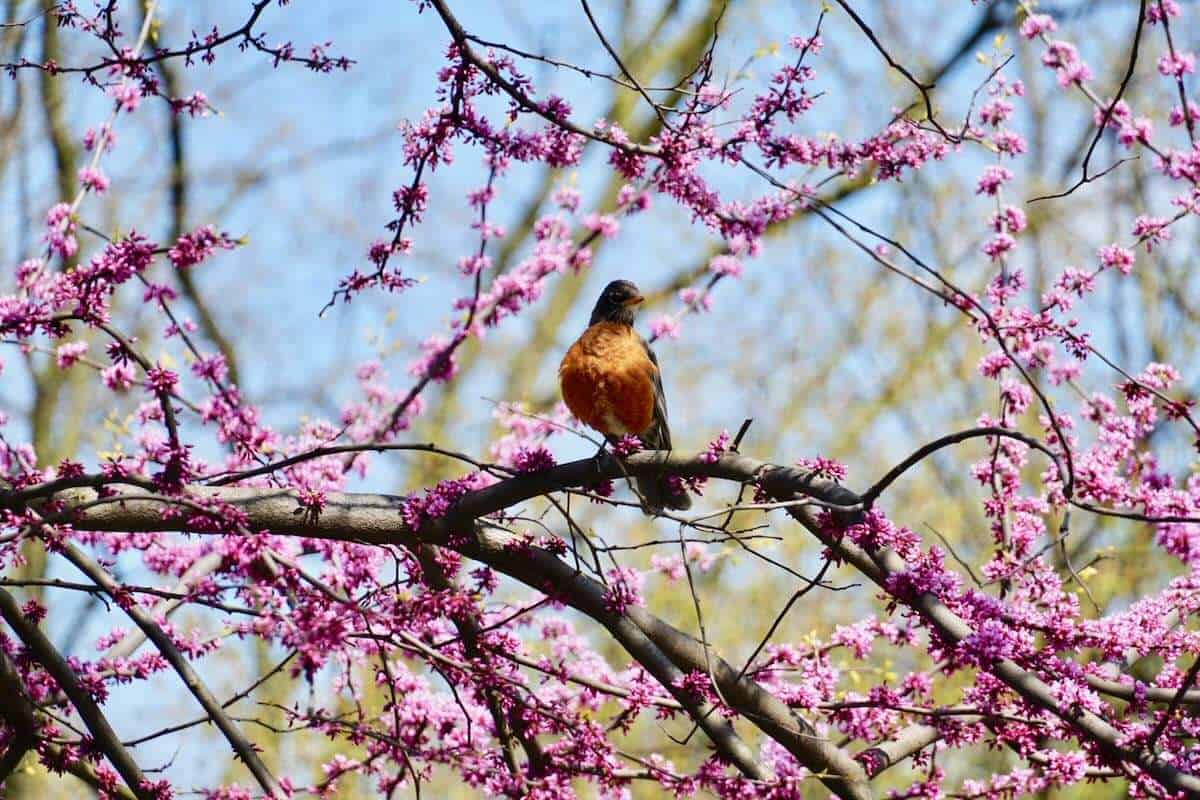
Plus: Comment in the box near the bottom of the page for a chance to win a copy of her new book. (Author photo, below, by Leo Chapman; redbud and robin above by Mackenzie Younger.)
Read along as you listen to the March 16, 2026 edition of my public-radio show and podcast using the player below. You can subscribe to all future editions on Apple Podcasts (iTunes) or Spotify (and browse my archive of podcasts here).

‘plant this, not that,’ with elise howard
Download file | Play in new window | Duration: 00:26:19
Subscribe: Apple Podcasts | Spotify
Margaret Roach: Well, your book is very well titled: “Plant This, Not That.” Because we do need to know not just what not to do, right? [Laughter.] We just can’t be scolded.
Elise Howard: Yeah, exactly.
Margaret: Exactly. And I’ve been enjoying seeing your suggestions and substitutions. What got you started on the book? Was it first-hand challenges that you had for figuring out good substitutions, or what was the impetus?
Elise: The real impetus was when I was gardening in Maine, and the gardening season there is pretty short. Sometimes my first perennials weren’t coming up until late June. And then by September first, Mainers declare it fall. And I had a friend who would help me in the garden, and she started to get into native plants with me, but she told me that when she started to talk about native plants and native-plant gardening with her Maine friends, they were very skeptical that there would be enough color, that there would be enough range of plants.
And I was deeply sympathetic to that because when you’re in a climate where the gardening season is so short, you want to maximize the pleasures of the garden, the blooms and the growth and the scent. And that really got me started. I thought I want to put together something to show people that this is possible, that you can have all the classic beauty of a garden, a wide range of native plants.
Margaret: O.K., so like Doug Tallamy, who’s been an inspiration to so many of us, you don’t write about 100 percent native and get rid of everything else. It isn’t sort of a black-or-white equation, but rather you recommend a 70/30 kind of aim about making room—looking for opportunities in our landscapes to make room for more diversity while of course eliminating invasives. I mean, that’s understood. And in the book, you give us some principles to kind of follow. And I loved those; I think there were like five of them. I wonder if we could talk about those sort of bulleted guidelines to have in mind.
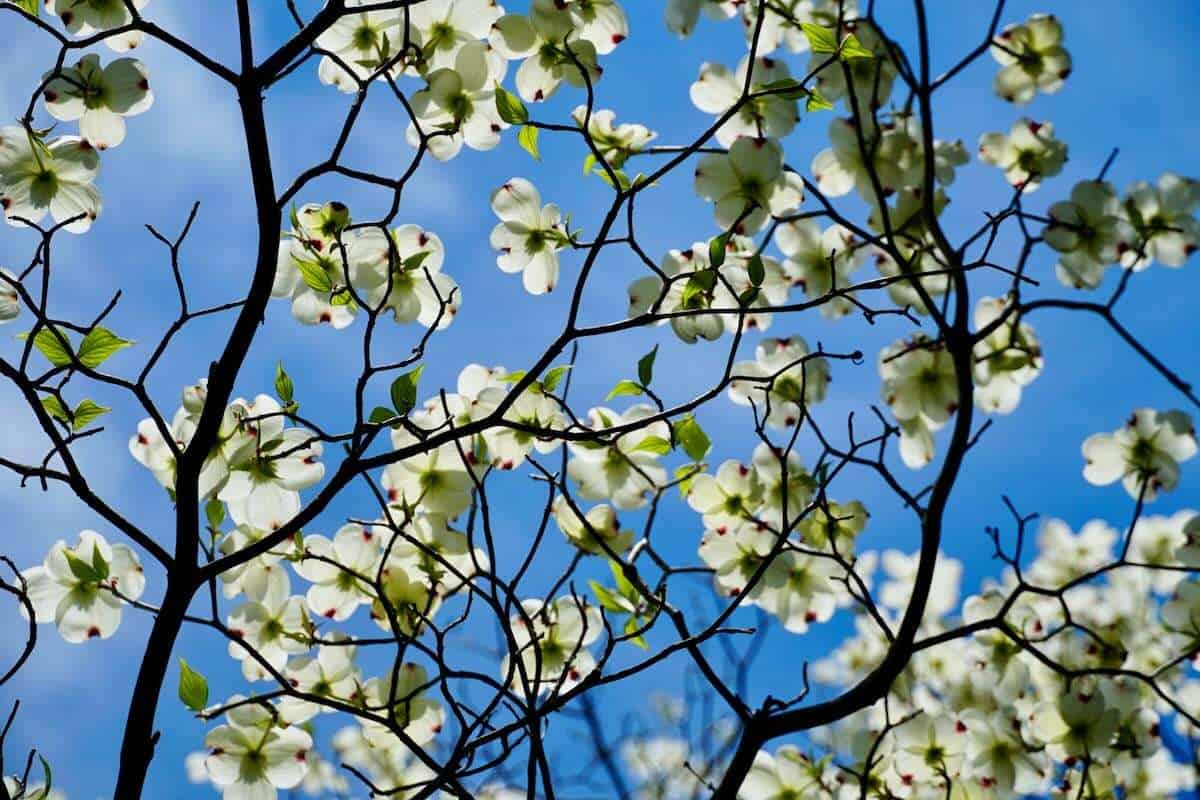 Elise: Yeah. Well, I think the thing is that a lot of people are starting with gardens that have been made in a traditional way. And there are folks who think we need to be 100 percent native right now. And certainly our insects and our birds are in crisis. But it’s not so easy to just redo your entire landscape in one fell swoop. There’s time, there’s knowledge and there’s money. So I wanted to break it down for people. And as you say, I sort of put it into those five basic principles. And Number 1 is “a mainly native garden.” [Above, flowering dogwood (Cornus florida); Mackenzie Younger photo.]
Margaret: Right. To aim for that, to aim for that.
Elise: And spoiler: I would love to go for 100 percent native. I’m hoping to move toward 100 percent native. But for instance, I recently made a move from Maine to Western Massachusetts, and had to start over in one sense because I had to put in a whole new septic system and I had to deal with some regrading issues. So I do have a big blank patch, but alongside that patch, I’ve got some very mature shrubs and garden plants. And whoever owned this house before me seemed to have a tendency, the more invasive, the better. So I’m dealing with goutweed, I’m dealing with lilies of the valley. A lot of that needs to be removed, and it needs to be a gradual process. I’ve got woods, I’ve got bittersweet, I’ve got honeysuckle to deal with. And so it can be daunting. And so one of the things to start with is the idea that every native plant you add is beneficial, and the more the better, right?
Margaret: Yes, yes. And so then sort of your second principle, I think it says to “consider wildlife and beauty,” yes?
Elise: Yes. So I hang out in a lot of native-plant forums, and I’ll see folks saying, “O.K., but now insects are eating my shrubs,” or “I’ve noticed all of these holes on the leaves of my plant.” So I think one of the things we need to keep in mind is that we are doing this and beauty is certainly one of the main things this book is about. But we’re doing it to support not just pollinators, although that’s really important, but also to think about plants as host plants, especially for caterpillars, the caterpillars that are so fundamental to feeding the baby birds, and you can just sort of go up the chain from there. And native plants also provide shelter. There’s the question of overwintering insects and bees and wasps in particular using the hollow stems of plants. So that’s where the planting for wildlife comes in.
At a certain point, you want to have a shift in your thinking. I think one of the examples I use in the book is when you start to recognize the semi-circular signs in your plant leaves that leafcutter bees have been there and getting excited about that.
Margaret: See, I always think that’s exciting because they’re so perfect, and they’re always positioned the same way. And it’s so distinctive. It’s like nothing else.
Elise: It’s so easy to recognize those. And I think that the little, they’re called by a million different names, but the moths that look like hummingbirds. I’m not great at insect recognition and I’m not great at birds yet, although I’m working on it, but there’s certain ones that are just so instantly recognizable and you can learn to celebrate their presence in your garden.
Margaret: So we’re thinking about wildlife and beauty. And then I think you talk about two things that are, I think of them almost like related, although maybe they’re not technically. You talk about thinking about layers, planting, making a garden that has layers and then also about plant communities, about the relationship among the plant choices.
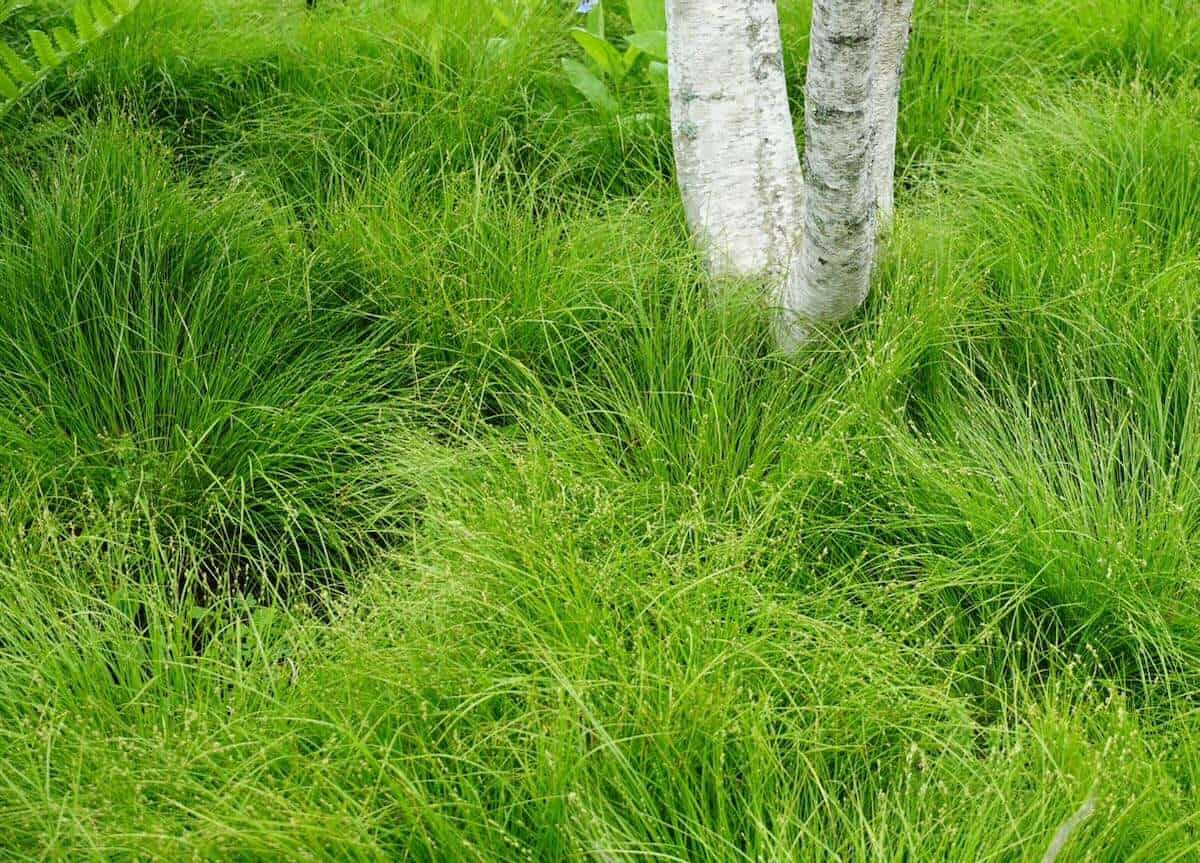 Elise: And I think those are kind of similar in that the layers is all about recognizing that, again, it’s all so interconnected. If you’re going to support wildlife, you have to think about the canopy, you have to think about the shrub layer, and you have to think about the ground layer—forbs, and then the ground layer, literally, what’s the dirt and the leaves that are on the dirt because there are birds that live at each of those levels, for instance. But as we’re now learning, I mean, “leave the leaves” is a huge phrase that you hear in the native-plant community, and there’s so many benefits to that. And then there’s the issue of cleanup. And again, this goes into another of the points I make, but leaving stems at 6 inches or 18 inches because animals are using those stems all year round, right? [Above, sedges as the ground layer beneath a birch.]
Margaret: Right.
Elise: So that’s part of the layering thing. And then plant communities, this can be so beneficial. The gardens we grew up with often had a plant and then a frame of mulch around it. And what we see with native plants … Oh, and also so many supports brought in to keep the taller plants standing up straight.
Margaret: Yes.
Elise: And I think there are a couple things about plant communities. First is the way plants are interconnected above the ground and then also below the ground. And it turns out that if you start to think about what plants grow well with each other at the simplest level—the shy growers versus the assertive growers—and grow plants that go together, they will do that work themselves. The roots will support what’s growing above the ground, what’s growing above the ground will support the plants nearby. And you’ll start to eliminate those little mulch frames. You’ll start to think about plants as green mulch, and the way they can support each other. And then also, of course, there’s just the fundamental issue of making sure that plants have similar light and soil and moisture.
Margaret: So if we move on to some sort of considerations of what should I plant instead of what I have in some cases where I want to remove something, or something’s invasive, or whatever the reason, I wanted to ask about some that are real headliners of problem plants or just plants that don’t really add anything. Like for instance, boxwood, which is ubiquitous in a lot of traditional garden styles that we were talking about, particularly in certain regions of the country, it doesn’t really support a lot of things.
Elise: It doesn’t support a lot of things. And it’s also starting, I guess in some areas, I’m just finding this out recently, to be subject to a kind of a blight so that-
Margaret: Oh no, absolutely, it has widespread multiple pests and diseases and so forth. Absolutely. So what do we do instead of that; let’s talk about some of these sort of much-used plants that we may want to … So what would be some possibilities?
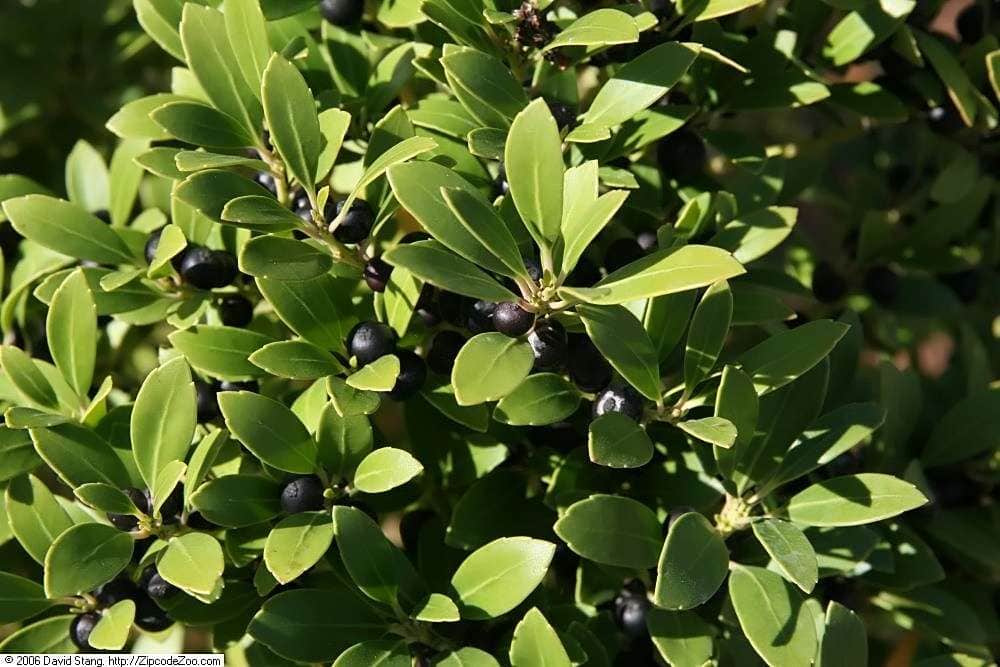 Elise: Well, so it’s great to start with an evergreen one, because that’s one of the tricky things about gardening is we brought in a lot of these plants because they had specific features. And there aren’t that many great evergreens, but there are some evergreens and there are also some plants where, again, you just do a little adjustment of how you think of the way plants are working in the garden. So Ilex glabra in the East and Northeast and Southeast is a great one. [Above, I. glabra; Wikimedia Commons photo.]
Margaret: So the inkberry.
Elise: This is an inkberry holly. It is evergreen. It supports a lot of wildlife and basically functions in a very similar way to boxwood. It’s easily pruned. You can keep it in shape, and it’s almost as close to a one-to-one substitute as you can get when you’re thinking this way. And then there’s in the West Mahonia, which is Oregon grape holly, and also in the West, but a little further inland, there’s Paxistima, which is Oregon boxwood. So again, those are great evergreen substitutes. A more widely native holly is Ilex verticillata, which is the winterberry holly. So this is not an evergreen plant, but what it is is a plant that has beautiful bright red berries throughout the winter.
Margaret: Except when everybody eats them, which they do- [laughter].
Elise: Except whatever eats them. So again, O.K., you have to go out one day and all your beautiful bright red berries are gone and think, hooray, the overwintering birds have had a meal.
Margaret: Yeah. Everybody’s happy.
Elise: Exactly.
Margaret: Yeah, it’s good. It’s good. So that’s the kind of thinking that this book is really trying to encourage in us, is O.K., wait a minute, boxwood, first of all, it wasn’t much of a contributor to biodiversity. Second of all, it’s plagued with a lot of issues now. O.K., if we’re going to yank it, let’s not put more boxwood in. And indeed, they’re working on disease resistant kinds and so forth, but still it’s not a big performer biodiversity-wise. So what could we do instead?
So then there’s a plant like barberry, Japanese barberry, Berberis thunbergii, and this is a terrible invasive plant. And like many of the invasive woody plants that we have found all throughout our forests and so forth, they have fruits and they’re moved by the birds. The birds we were just talking about who like to eat our winterberry holly; that’s one thing, to spread winterberry holy seedlings around a native plant. It’s another thing to be spreading, I think you mentioned bittersweet before, invasives like Japanese barberry. They’re being spread by birds eating the fruit and then pooping the seeds around, and not good. So what about that? What are some possibilities instead of that, do you think?
Elise: So one of the things, or a couple of the things that people like barberry for are the fact that they have great color and also that they are a good sort of hedging shrub. So I love ninebark.
Margaret: Physocarpus is a wonderful plant.
Elise: Exactly. And it’s called ninebark for a great reason, right? It’s got these layers of peeling bark. So it’s not evergreen, but it’s got a lot of winter interest and that bark has a lot of complicated color. And then it’s also got beautiful summer blooms and good fall color.
Margaret: And like the barberry, you can get a sort of purple-leafed, maroon-leafed cultivar.
Elise: Well, yeah, but the-
Margaret: And I know that has limitations, but if you’re stuck, if you have a design and say you have an axial view and it lands at a purple shrub, you know what I mean? And you’re going to pull out that barberry, but you want to keep that quality. O.K., so use ‘Diabolo,’ the ninebark … It’s a lot better than having that barbery there anymore years is what I’m saying. I’m not saying we should all use only purple-leaf shrubs because they have limited herbivory appeal. It is better.
Elise: Right. It does have that limited herbivory appeal and generally speaking, green leaves are better than red leaves. But yeah, I mean, if we’re going to talk about bringing people around gradually, that’s an excellent point. And another thing to think about is we have had this tradition of single species hedges or foundations. So another thing you can do is mix it up a little bit. So I’ll give you your red-leaf Physocarpus if you’ll consider adding in some other shrubs, maybe some Aronia or some shrubby St. John’s wort or some-
Margaret: The Hypericum, right?
Elise: Right, exactly. Or some Swida sericea, which is also called Cornus sericia, the red twig dogwood. Think about mixing it up a little bit.
Margaret: I call those biohedges, and all the fringe of my property is all that way. It’s mixed woody planting, shrubby sort of mixed woody plantings. And it’s great. It creates great ecotone or edge habitat to do that.
Elise: Yeah. And another great thing about it is let’s say something comes in and affects one of those plants.
Margaret: You don’t lose everything.
Elise: You don’t lose everything. You’re not staring at a wall of brown until you can get to the really overwhelming task of pulling out a whole hedge of shrubs.
Margaret: Right. Well, one of the worst hedge situations around here where I live in the Northeast is everybody had privet, and privet is just everywhere in all the woods and along every roadside and whatever. So do you have some specific … Would some of the same things be good substitutes for that or …
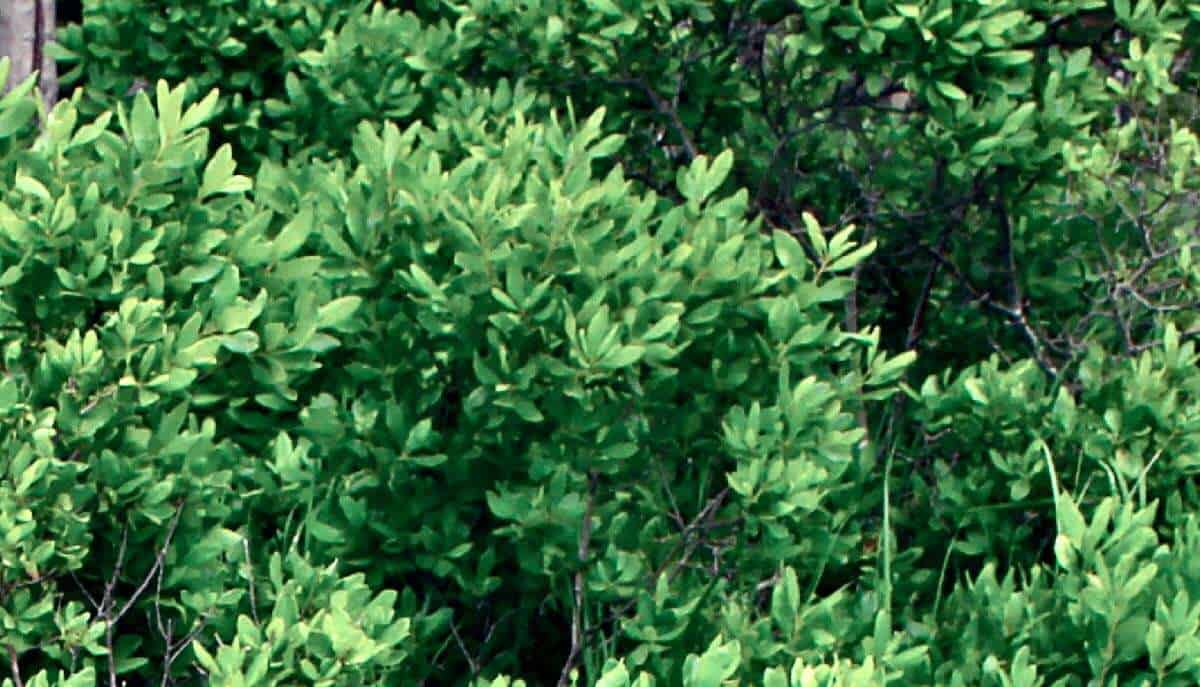 Elise: Some of the same things, but there are a few more things and this allows me to mention one of my favorite plants. So the Morella, the myrtles, are a great substitute for privet. There’s more of Pennsylvania, which is a more northern variety. And then there’s Morella cerifera in the South and Morella californica. Privets are one of those semi-evergreen plants, depending on how north you are. And Morella is similar. One of the things I love about Morella, which is also bayberry, is that the leaves have a scent that for me is like therapy [laughter]. So you go out, you break a leaf, you smell it. This is what bayberry candles are made from. So that’s a great privet substitute. [Above, Morella pensylvanica; photo by Mackenzie Younger.]
Some of the ones we have talked about already also make good substitutes. I think Ilex glabra, if you’re looking for something evergreen or the other hollies or Ilex verticillata, if evergreen is not so important. Also, we can talk about the Amelanchier, which are … So I didn’t get to include them all in the book because of space limitations, but Amelanchier is a big genus that includes a lot of different varieties. This is a plant that has early blooms, it has berries. So it’s helping the early pollinators, it’s helping the birds throughout the season. It’s highly prunable and it has varieties that grow in a roughly similar size and shape as privet. And like privet, it’s a fast grower, some varieties are particularly fast, which is one of the things we’ve loved about privet for decades and decades.
Margaret: So those are just some of the possibilities. I wanted to make sure to ask about one of the ones that everybody doesn’t want to get rid of [laughter], which is Buddleja, their butterfly bush.
Elise: I knew that was coming.
Margaret: You knew that was what I was going to ask. Yes. Yes. And this is a complicated one, because you have it blooming and it’s so full of insects and everybody looks so happy to be enjoying it, but it can’t support the full life cycle of any native insect, I don’t think.
Elise: Right. It can’t support the full life cycle. A lot of people compare it to, “Yeah, insects love it, but it’s like giving them Coca-Cola.” Another important thing about it is if pollinators are flocking to Buddleja, they’re not pollinating the other native plants around, so those plants are maybe having less successful reproduction. So there’s one plant that I think is a brilliant substitute for Buddleja, and there are many varieties. So it’s native in a number of areas. And that’s Eutrochium or what we call generally Joe-pye weed. And that Buddleja does not stay green and it doesn’t even stay necessarily reliably woody over the winter. So Eutrochium is a perennial that dies back to the ground, but it has similarly spectacular blooms and it is covered with pollinators.
I would just say if it’s scent you’re looking for, in terms of shrubs, there’s Clethra, and Itea. They are both magnificently fragrant shrubs, two or three or four, and you walk out your door into your garden and immediately smell that sweet fragrance.
Margaret: So the Itea, as well as the Clethra, both have fragrance. I didn’t realize that. I don’t have Itea in the garden.
Elise: Oh yes, yes.
Margaret: Oh, interesting.
 Elise: And Clethra has good fall color. Itea has spectacular fall color, and there are some cultivars that have been bred particularly for scarlet fall color. So that is a plant that really gives across many seasons.
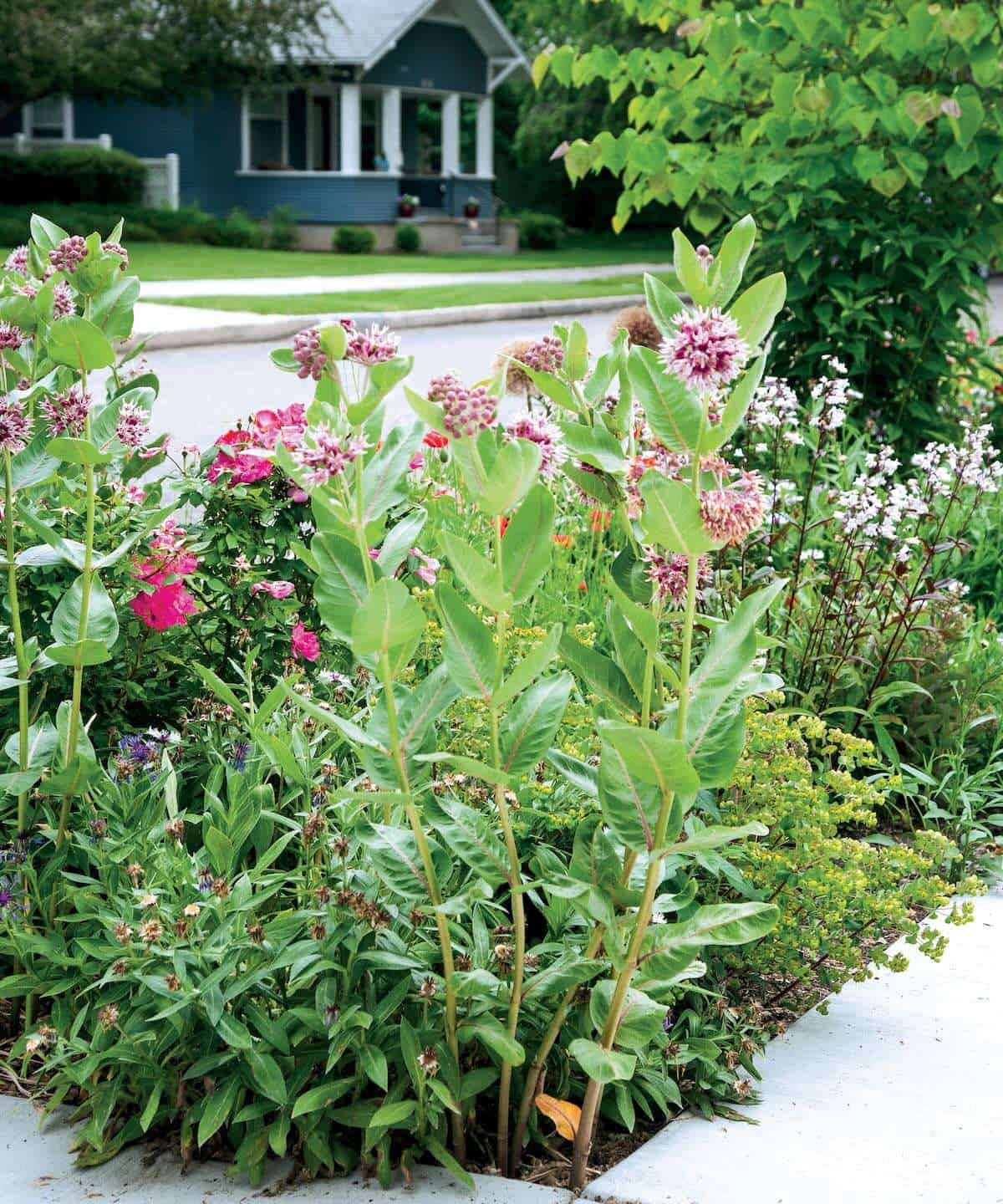
And then I just quickly want to sneak in the fact that Asclepias varieties [above; photo by Mark Turner] are an excellent substitute for Buddleja. And of course, these are the plants that monarch butterflies in particular depend on. So milkweeds are, as they’re commonly known, are a great substitute for Buddleja.
Margaret: And we just highlighted a very, very few of, again, 200-ish plants, more than 200 that are in this book, “Plant This, Not That,” that you’ve just published. And so it’s just some examples, and there’s lots and lots and lots for all different regions in the country. Just in the last minute or so, you talked about some of the projects that are going to go on in your garden, some opportunities, so to speak. Is there anything in particular that you’re really looking to make a space for? Any sort of top of your list of your plant orders [laughter]?
Elise: Well, always redbud [photo, top of page].
Margaret: Oh, interesting, so Cercis.
Elise: Cercis canadensis. Because this is a plant that is one of the harbingers of spring. It blooms before it leafs out. So it has these spectacular scarlet buds that turn into flowers on its branches, and then those heart-shaped leaves that just make it absolutely beautiful.
Margaret: They’re beautiful.
Elise: Yeah. And you can’t mistake it for any other plant. It can be single stemmed or multi-stemmed. So that for me is always a huge favorite.
Margaret: Oh, good. That’s a good one. And that’s a great one, almost like at the woodland edge, you know what I mean? It can be in a lot of different spots in the garden.
Elise: Yeah, it’s an understory plant, so very tolerant.
Margaret: Yeah. Well, Elise Howard, it’s fun that you did this and I love the title, of course, “Plant This, Not That.” And I hope I’ll speak to you again, but congratulations and thanks for these ideas and 200 more that are in the book.
enter to win a copy of ‘plant this, not that’
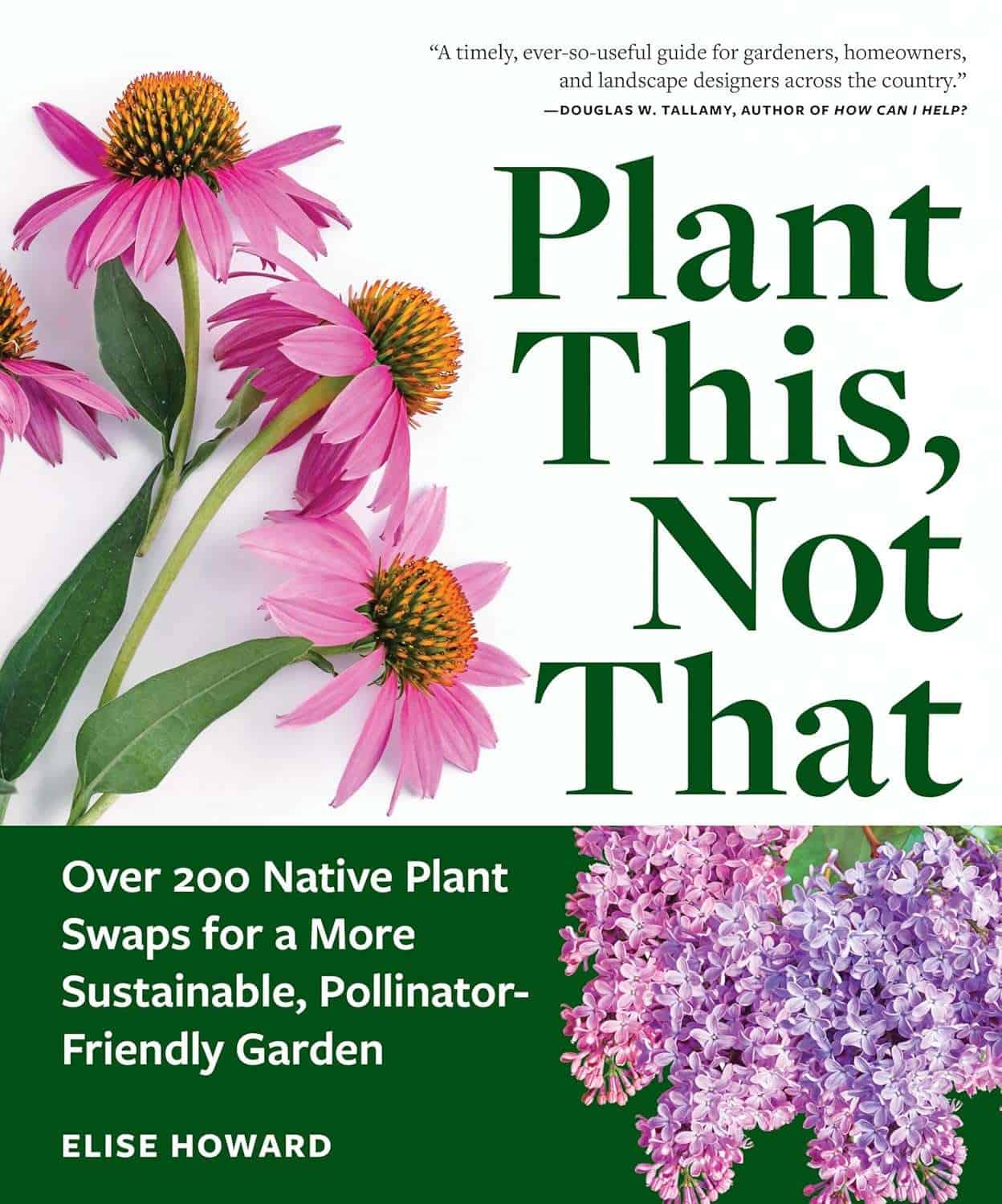 I’LL BUY A COPY of “Plant This, Not That” by Elise Howard for one lucky reader. All you have to do to enter is answer this question in the comments box below:
Is there some troublesome non-native you are looking to swap out this year (or one maybe that you did last season)?
No answer, or feeling shy? Just say something like “count me in” and I will, but a reply is even better. I’ll pick a random winner after entries close at midnight Tuesday, March 23, 2026. Good luck to all.
(Disclosure: As an Amazon Associate I earn from qualifying purchases.)
prefer the podcast version of the show?
 MY WEEKLY public-radio show, rated a “top-5 garden podcast” by “The Guardian” newspaper in the UK, began its 17th year in March 2026. It’s produced at Robin Hood Radio, the smallest NPR station in the nation. Listen locally in the Hudson Valley (NY)-Berkshires (MA)-Litchfield Hills (CT) Mondays at 8:30 AM Eastern, rerun at 8:30 Saturdays. Or play the March 16, 2026 show using the player near the top of this transcript. You can subscribe to all future editions on iTunes/Apple Podcasts or Spotify (and browse my archive of podcasts here).
Comments are closed.