
For most people, the COVID-19 pandemic was the opposite of magical.
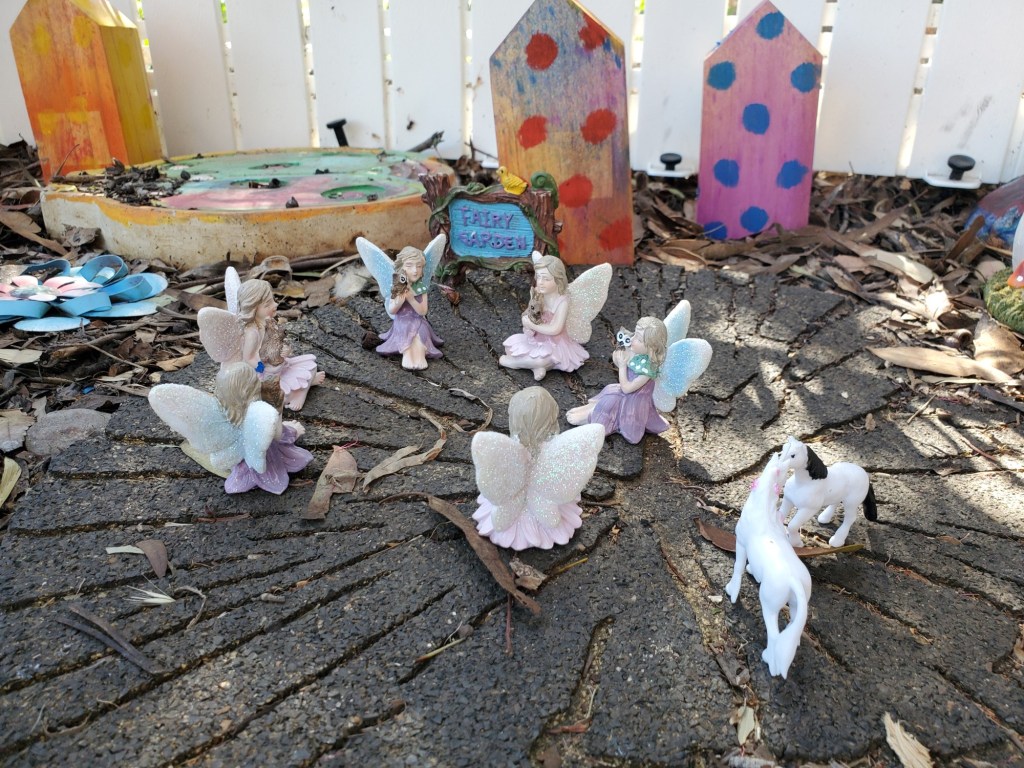
But for one La Jolla family, the isolation of the lockdown mandates led to a whimsical “fairy garden” along the La Jolla Bike Path that is still in place today.
The creation of La Jolla resident Mary Clausen and her family is a ground-level flight of fancy featuring decorated tiles and bricks, painted stones and wood fragments, sculptures and figurines, handmade and donated contributions and more surrounded by a fence less than a foot tall and decorations hanging from the nearby trees. There’s also a little free library of children’s books, along with a makeshift child-size bench.
“In June 2021, we had been in isolation for a while and I had three little kids and we hadn’t really found a community since moving here in 2016,” Clausen said. “We would go on a similar walking path in Point Loma that also had a fairy garden and I thought we needed to have something like it here. So we had this idea, and it started just by installing a little metal door on the base of the tree [to look like a fairy door].”
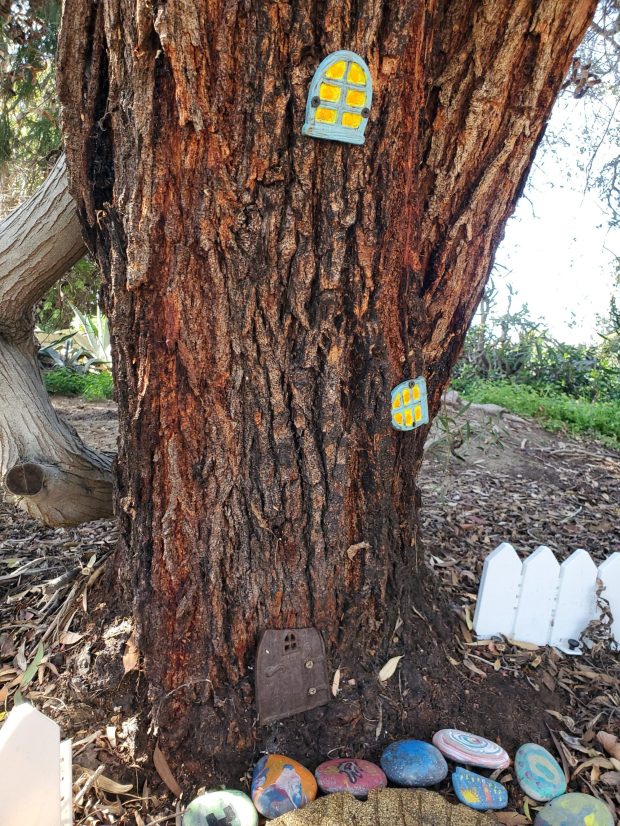 A “fairy door” attached to a tree started what became the La Jolla Bike Path’s “fairy garden.” (Ashley Mackin-Solomon)
She hoped to provide an outdoor space for neighborhood children to gather during the pandemic and add something to it if they chose. In the months that followed, visitors left painted bricks and tiles, toys and other things they donated.
“To me, the beauty of it is kids bringing whatever treasures they want to contribute,” Clausen said. “Someone dropping off a handmade Lego [sculpture] is just as great as someone painting a rock.”
That said, any broken or inappropriate additions are removed.
With the installation of the fence to keep it contained, “it gets a ton of use,” Clausen said. “Classes will walk here on nature walks and this is always a stopping point. It has progressed a lot.”
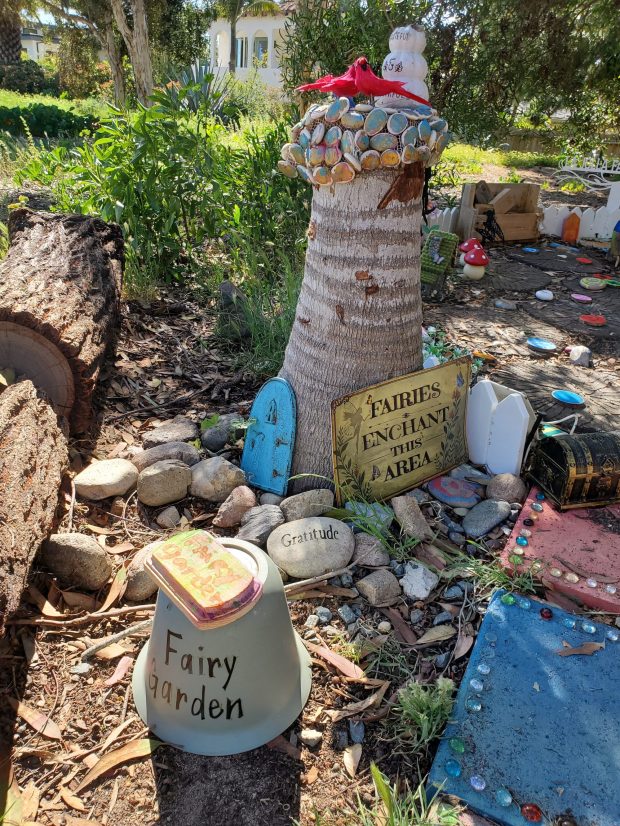 Many features have been added over the years to the “fairy garden” along the La Jolla Bike Path. (Ashley Mackin-Solomon)
As the popularity of the garden grew, students and neighborhood children would write letters to the fairy they believed lives there (who has since been named Coral).
“The kids would write letters and I would answer as Coral, so they believe Coral lives in this tree,” Clausen said. “So now there is this folklore behind it.”
Questions from the children have included “What do you eat?” and “Where do you go all day?”
“I believe play is the work of children, and I see that happening here,” Clausen said. “They believe in this and it means a lot to them. And that’s what this is all about. It’s pure, innocent play.”
Still, Clausen acknowledges there are people who don’t like the fairy garden.
“There are a couple of people who are not happy that these are not natural materials,” she said. “To which I would respond that the bike path is man-made … and the purpose is to provide community gathering. And that’s what this is providing.”
The La Jolla Bike Path runs between Nautilus Street and Mira Monte and is used by cyclists and pedestrians. Clausen said the fairy garden takes up only an 8-by-8-foot section alongside it.
There have been discussions about moving the fairy garden, but the family ultimately decided against it.
“It all means something to the people that use this,” Clausen said. “I’m thrilled with the response. It gets so much love. It’s a lot of fun.”
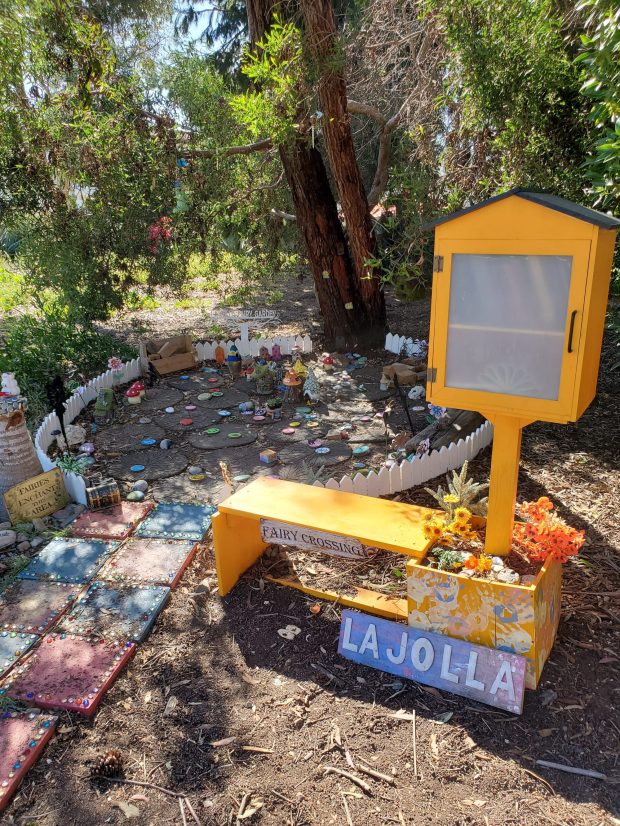 “I believe play is the work of children, and I see that happening here,” says “fairy garden” creator Mary Clausen. (Ashley Mackin-Solomon)
However, the garden does have rules, even if unspoken:
• Donated materials must be contained within the fencing.
• If anything gets broken, it must be removed.
• If anything is dangerous, it must be removed.
Perhaps the foremost rule is: Feel free to bring anything that Coral or her fellow fairies might appreciate (preferably homemade).
“It’s just about contributing to this imaginary world,” Clausen said. “We just wanted to put our creative energy into something that would bring good to the community.” ♦
Comments are closed.