
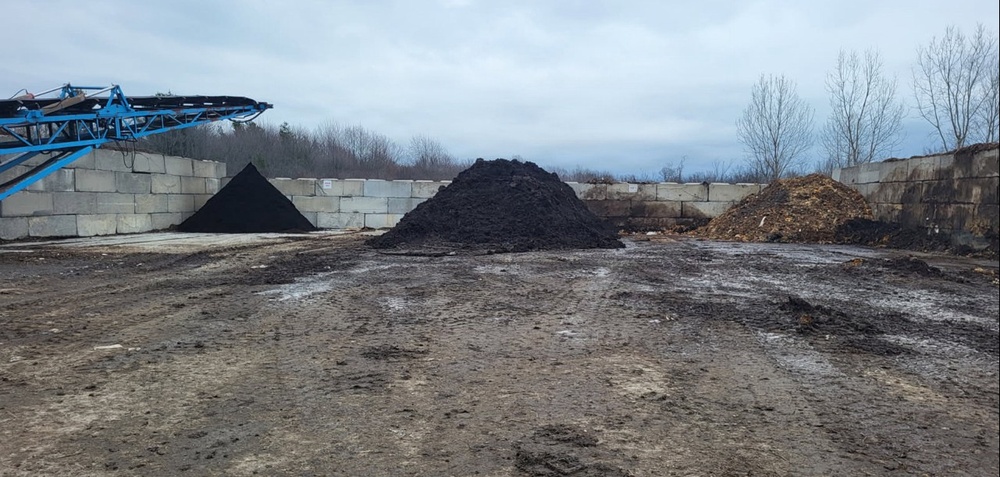
FORT DRUM, N.Y. (March 12, 2026) — The Directorate of Public Works Environmental Division is turning yesterday’s leftovers into a valuable resource that directly supports mission readiness.
Ian Crawford, DPW Environmental Compliance chief, said that tons of nutrient-rich soil is generated annually by composting food scraps and wood waste. It is usedfor various projects, including site stabilization and restoring areas affected by training activities.
“We’re taking a waste product and converting it into a useable product that strengthens the installation from the ground up,” he said. “The food waste that we generate on the installation is recycled, diverting it from the landfill and is used to provide nutrients and enrich soil health after it goes through the composting process.”
While composting isn’t new on post, Fort Drum DPW has refined its process, collaborating with food service personnel to transform food waste from dining facilities into a commodity that supports sustainability goals and strives to conserve vital landscape space.
The composting is overseen by Gordon “Tiger” Phillips, engineering equipment operator, and Steve Smith, operations leader, at the Solid Waste Transfer Station near Cerjan Gate. It begins with a staging pile of “browns” – natural wood chips – and “greens” – organics and food scraps.
“Basically, what they are doing is baking a cake, a compost cake, by layering the browns and greens to a specific size,” Crawford said.
Windrow composting is a method of breaking down largescale organic material by forming them into long, narrow piles that facilitate aerobic decomposition. The material is moved to the ASP (aerated static pile) area where a system of pipes pushes air through the pile, creating a forced aeration process.
“It’s a pretty efficient and cost-effective way to manage large volumes of waste,” Crawford said. “With an ASP system, you don’t typically have to turn or rotate the pile. As it is cooking, Steve will check the temperature, looking for that sweet spot between 131 and 160 degrees. That’s where you get that really good microbial breakdown.”
The high heat kills weed seeds and pathogens, manages odors, and takes several weeks or months to produce consistent, high-quality compost. This happens even in the harshest of winters.
“Winter weather can have an effect, but keeping the pile larger and covering it with wood chips insulates it so it can still maintain appropriate temperatures,” Crawford said. “As the pile matures there will be a gradual cooling of the pile, which is normal.”
Compost matures in a curing area where decomposition slows as the temperature lowers.
“We take an analytical sample and if it comes back clean, then it is staged for future beneficial use,” Crawford said.
Not only does composting improve Fort Drum’s infrastructure, it also provides significant cost savings. Crawford estimates that a half-full dumpster can yield roughly 4,500 pounds of food waste now being diverted from landfills.
“If we weren’t composting, we’d have to pay to dispose of this heavy waste,” he said. “And because it is anaerobic in a landfill, it breaks down slowly and takes up space – and that’s becoming a big issue in some places.”
A key to the program’s success has been the improved collaboration with DFAC personnel. Previously, collecting compostable waste in bags led to high levels of contamination with non-compostable waste.
“What we were seeing was even compostable items, like compost bags, were not efficiently breaking down,” Crawford said. “So now smaller containers containing just food waste are dumped directly into the dumpsters.”
He added that facility representatives received training and are now responsible and accountable for maintaining a pure food waste stream.
“I think overall the staff at the DFACs are doing awesome,” Crawford said. “They really corrected the problem quickly, especially with engagement and oversight by the Army Field Support Battalion food service team and Tiger’s help. We also worked with DECA and AAFES to expand our composting efforts to other food generating facilities on post.”
Prior to streamlining the ASP system and composting operations, Crawford said Fort Drum had averaged approximately 130 tons of compost annually.
“With the efficiency changes and culling out contamination at the generating facilities, we are anticipating maybe doubling that number,” he said.
“It’s been working great,” Phillips added. “This is so much easier on everybody.”
Ultimately, every new load of soil generated at the transfer station connects back to the Soldiers.
“This is actively making sure our troops can train on the ranges,” said Heather Wagner, Fort Drum DPW Environmental Division education and outreach coordinator. “The compost helps restore whatever gets damaged by training activities. And we use this on construction sites to protect Fort Drum’s environment and keep it healthy.”
Comments are closed.