
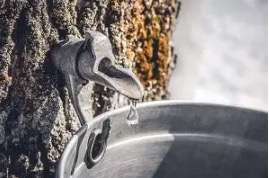
Maple sap running into bucket.
 by Jude Hsiang
We are now about a week away from the Spring Equinox, halfway between the shortest and longest days of the year. And that means it’s time to plan for Maine Maple Syrup Sunday on the weekend of March 21 and 22. This annual event is organized by the Maine Maple Syrup Producers who provide lists of participating sugarhouses on their website.
It is also promoted by the Maine Department of Agriculture, Conservation and Forestry’s REAL MAINE program that also brings us special events around other Maine products including blueberries, oysters and fibers. Both sites have maps and information about the places you can visit to purchase maple products and learn how they are made. Some sugarhouses are open for the entire weekend. Some offer additional activities for the entire family such as sleigh rides and music performances.
After making a quick stop at your local producer’s place for a pint of your favorite sweet treat, or spending a day immersed in the history, science, and taste of maple offerings, you may decide to make your own next year.The University of Maine Extension has compiled bulletins and videos under the title Backyard Sugaring Resources. These cover what you’ll need to know from identifying sugar maples – red maples also provide sweet sap – to the final product. You’ll learn how to select the appropriate trees ahead of the usual mid-February tapping and gather the equipment needed,which is not expensive. Caring for the trees’ health is stressed, as is the food safety of your home-made syrup.
Any trip around Maine at this time of year, in fact a short walk to the car, means muddy boots. Mud Season can be expected to begin in late March and last through April although gardeners know that the weather doesn’t care about our human calendar. We are currently having an early preview of Maine’s fifth season.
The days are warmer, sometimes quite warm, and the ground is still frozen below that mud. Trees and herbaceous plants are still dormant and won’t be taking up moisture until the soil around their roots moves toward 50 degrees. The snow melt just sits and mixes with the surface soil. Soil scientists tell us that because Maine and similar areas were covered by glaciers a mile or more thick until about 12,000 years ago. Although that seems like an enormous amount of time, the soils need millions more years of erosion to allow the water to move deep down enough to minimize the muddy surface layers.
Records kept by farmers and scientists for over 100 years have shown that our mud season is lasting a couple of weeks longer as air temperatures have been rising but the soil is still cold. The changes in typical temperatures from mid February through March that bring us maple syrup, also bring us the mud that causes even some dedicated snow lovers to become snowbirds and flee South for a few weeks.
Some of us just wait it out. Rather than dwelling on our muddy boots, we look up at the sunny skies and swelling buds that tell us that spring will soon be here. Lines from a poem by Polly Chase Boyden may have more appeal to little children than their parents who deal with the mud they track into the house, but they do remind us that even mud has a reason for the season.
Mud is very nice to feel
All squishy-squash between the toes!
I’d rather wade in wiggly mud
Then smell a yellow rose.
© Judith Chute Hsiang
Jude Hsiang is a retired Extension Master Garden Program educator and member of the China Community Garden.
Responsible journalism is hard work!
It is also expensive!
If you enjoy reading The Town Line and the good news we bring you each week, would you consider a donation to help us continue the work we’re doing?
The Town Line is a 501(c)(3) nonprofit private foundation, and all donations are tax deductible under the Internal Revenue Service code.
To help, please visit our online donation page or mail a check payable to The Town Line, PO Box 89, South China, ME 04358. Your contribution is appreciated!
Comments are closed.