
 14 min read
For House Beautiful’s 130th anniversary this year, we’re digging into some of our favorite articles from our archive—from celebrity home tours (including Farrah Fawcett, Bette Midler, and more) to decades-old design inspiration that still holds up today. Stay tuned for more archive deep dives throughout 2026, and sign up for our newsletter to get the very best delivered to your inbox every month.
In 1977, the editors of House Beautiful took a hard stance on houseplants, publishing this 3,200-wordessay by Victoria Erin Townes—a houseplant owner and voracious researcher—denouncing much advice from plant store owners and plant book authors as total bunk. She saw that many shops were more concerned with profitability than plant vitality, and that many writers were not taking into consideration that their home’s conditions might differ meaningfully from plant owners’ homes—and neglecting to discuss why all of those specifics really do matter.
Read Townes’s warnings, most of which still ring true today, or skip directly to her tips for adjusting the temperature, humidity, and even your own watering cycle in order to help your plants better survive. (Townes’s source material? Trusted horticulturists as well as, seemingly, the 1629 tome Paradisi in Sole: Paradisus Terrestris by John Parkinson, an era-defining horticultural text.)
House Beautiful Archives
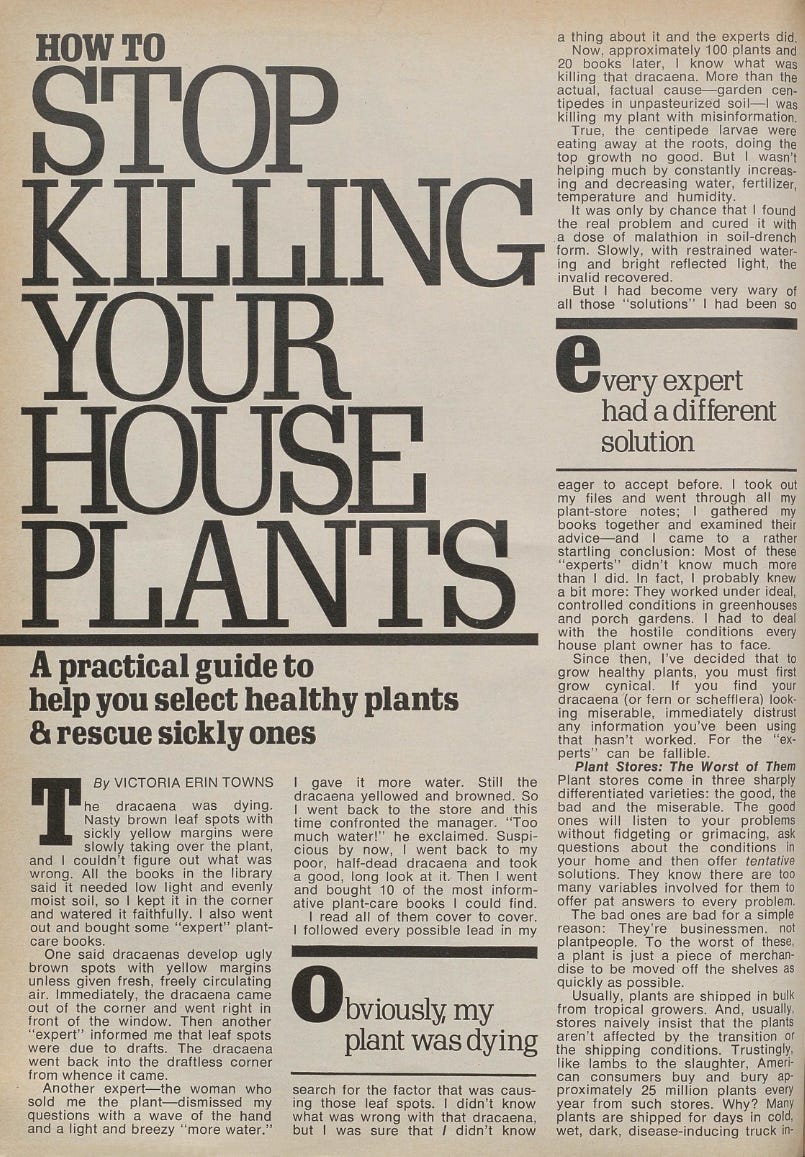
By Victoria Erin Townes
My dracaena was dying. Nasty brown leaf spots with sickly yellow margins were slowly taking over the plant, and I couldn’t figure out what was wrong. All the books in the library said it needed low light and evenly moist soil, so I kept it in the corner and watered it faithfully. I also went out and bought some “expert” plant care books.
One said dracaenas develop ugly brown spots with yellow margins unless given fresh, freely circulating air. Immediately, the dracaena came out of the corner and went right in front of the winder. Then another “expert” informed me that leaf spots were due to drafts. The dracaena went back into the draftees corner from whence it came.
Another expert—the woman who sold me the plant—dismissed my questions with a wave of the hand and a light and breeze “more water.” I gave it more water. Still the dracaena yellowed and browned. So I went back to the store and this time confronted the manager. “Too much water!” he exclaimed. Suspicious by now, I went back to my poor, half-dead dracaena and took a good, long look at it. Then I went and bout 10 of the most informative plant-care books I could find.
I was killing my plant with misinformation.
I read all of them cover to cover. I followed every possible lead in my search for the factor that was causing those leaf spots. I didn’t know what was wrong with that dracaena, but I was sure that I didn’t know a thing about it and the experts did. Now, approximately 100 plants and 20 books later, I know what was killing that dracaena. More than the actual, factual cause—garden centipedes in unpasteurized soil—I was killing my plant with misinformation.
True, the centipede larvae were eating away at the roots, doing the top growth no good. But I wasn’t helping much by constantly increasing and decreasing water, fertilizer, temperature and humidity.
It was only by chance that I found the real problem and cured it with a dose of malathion in soil-drench form. Slowly, with restrained watering and bright reflected light, the invalid recovered.
Every expert had a different solution.
But I have become very wary of all those “solutions” I had been so eager to accept before. I took out my files and went through all my plant-store notes; I gathered my books together and examined their advice—and I came to a rather startling conclusion: Most of these “experts” didn’t know much more than I did. In fact, I probably knew a bit more: They worked under ideal, controlled conditions in greenhouses and porch gardens. I had to deal with the hostile conditions every house plant owner has to face.
Since then, I’ve decided that to grow healthy plants, you must first grow cynical. If you find your dracaena (or fern or schefflera) looking miserable, immediately distrust any information you’ve been using that hasn’t worked. For the “experts” can be fallible.
 Plant Stores: The Worst of Them
Plant stores come in three sharply differentiated varieties: the good, the bad and the miserable. The good ones will listen to your problems without fidgeting or grimacing, ask questions about the conditions in your home and then offer tentative solutions. They know there are too many variables involved for them to offer pat answers to every problem.
The bad ones are bad for a simple reason: They’re businessmen, not plantpeople. To the worst of these, a plant is just a piece of merchandise to be moved off the shelves as quickly as possible.
Usually, plants are shipped in bulk from tropical growers. And, usually, stores naively insist that the plants aren’t affected by the transition or the shipping conditions. Trustingly, like lambs to the slaughter, American consumers buy and bury approximately 25 million plants every year from such stores. Why? Many plants are shipped for days in cold, wet, dark, disease-inducing truck interiors. But they don’t go into shock until they’ve reached the consumer’s home, because most of these “fast food” plant stores don’t have the plants around long enough to observe the results of the harsh shipping treatment.
Then there are the truly miserable plant stores. These are much like the bad ones except that they know they’re selling damaged goods. Like the saleswoman who brushed a fat white grub off the bottom of the pot when I bought my dracaena, they’ll tell you, “That’s nothing. Just a harmless little bug. They’re all over plant stores.”
Such stores give out inadequate cultural information—if they give any—and frequently don’t know the proper names or cultural requirements of the plants they sell. They’ll tell you that a coleus will “do just fine” in a northern exposure or that an Areca palm can be placed 10 feet back from an obstructed eastern exposure. They are trying to sell plants, not give good advice on placing plants properly.
When and if you go back to complain or ask for help, they brush you off with simplistic answers designed not to cure your plant but to get you out of the store fast. And their “solutions” often only make matters worse. Increasing and decreasing the water, fertilizer, temperature or humidity of a sick plant is somewhat like plunging an appendicitis victim into successive baths of icy-cold and scalding-hot water: It won’t cure the problem and it certainly doesn’t make the patient feel any better.
Now I know that to grow healthy plants, you first must grow cynical.
The really miserable plant stores will sell you a partially rooted plant—with the song-and-dance that an immature or “young” plant adapts better to a new environment. This is just plain untrue. These immature plants lack the roots system necessary for absorbing nutrients. They can’t cope with the shock of transition. Result: very dead immature plants, in short order.
These stores will tell you that the extra soil around the unformed root system is good for the young plant because it gives it “room to grow.” This is another untruth. The extra soil is there to camouflage a poorly rooted plant. The store either doesn’t know or doesn’t care that too much soil can cause root burn due to unassimilated fertilizer salts, root rot due to unabsorbed water or excessive root growth at the cost of dwindling foliage growth.
Many plants are susceptible to the Rootless Wonder Treatment, including Agave, Aspidistra (cast-iron plant), Bromeliads of all kinds, Cacti of all kinds, Chlorophytum (spider plant), Crassula (jade plant), Dracaenas of all kinds, Echeveria, Hoya (wax plant), Pothos (scindapsus ivy or ivy arum), Sansevieria, Syngonium (goosefoot plant), all Tradescantias (wandering Jew) and Yuccas.
Your solution to both the Fast-Food Plant and the Rootless Wonder Syndromes is the same: carefully inspect both plant and root ball before purchasing. Examining the store with a slightly jaundiced eye won’t hurt, either. If the store “doth protest too much” at your close examination of plants or facilities, go elsewhere: They have something to hide.
If the plant looks fine, but you’re still worried about what it went through to get to the store and whether it’ll go into shock, put a deposit on it and come back in about a week. By that time the plant will be showing any possible signs of trauma and you’ll know if you should buy it or not.
Once you pick a plant with an adequate root system, you have to care for it. Always ask about cultural requirements, to make sure you are buying a plant suitable to your home environment, but be forewarned that something’s wrong if every plant in sight is recommended for your climatic conditions.
The same applies to fertilizer. Many stores will recommend immediate and frequent feedings as soon as you get the plant home. This is terrible for the plant but makes money for the store.
One new store practice that’s dangerous to not only your plants and your pocketbook but also to your health is the common use of systemic insecticides to produce and sell insect-free plants. Unfortunately, the growers and stores don’t tell the consumer that the plants have been systematized—either because the stores themselves have’t been informed by the growers or because both growers and stores believe the chemicals to be relatively harmless to humans.
Not so, say the Department of Agriculture and the Environmental Protection Agency. Systemic insecticides are among the most toxic chemicals known. Seriously toxic doses can be readily absorbed through the skin, orally or via respiration of foliar sprays. Moreover, systemics are highly insoluble in water, meaning that it takes a strong soap to rinse the chemical off skin—and it takes from five to six weeks for a systemic to degenerate into harmless compounds. While the plants may be pest-free, children or pets can become seriously ill from eating soil, leaves or other plant parts. The plant’s sap, leaves, stems, soil and pot (if clay) can all transmit the systemic to humans or pets—and the poison can have cumulative physiological effects.
The easiest solution is to find out at the start whether a plant you’re buying has been treated with systemics. The store may be reluctant to divulge this information, thinking that it implies their environmental conditions would encourage insects if they don’t use insecticides (a situation that may be true). Persist. It’s well worth the trouble.
If you do find that the plant has been treated, there’s no reason not to buy it—it’s just a slight case of caveat emptor. Get the name of the systemic used, the amount applied and when it was applied. Then make sure you keep pets and children away from the plant for the danger period (again, about five to six weeks), wash your hands thoroughly after handling the plant (including the pot) and contact the Poison Control Center to find out if there are any symptoms to watch for.
As you can see, merely selling house plants does not an expert make. Unfortunately for plant lovers today, first writing mass marketed books about them doesn’t guarantee a great deal of knowledge either.
 Plant Books: The Worst of Them
Plant books, like stores, can be divided into the good, the bad and the miserable. The bad and miserable are those mass-market paperbacks written and published solely to cash in on the current plant craze. The information they print is usually third- or fourth- or even fifth-hand. It’s taken from plant books whose authors took it from other plant books whose authors took it, etc.
These mass books are also carefully edited to save space and money. Unfortunately, the editors often cut potentially vital information, either because they know little about plants or because they fail to see the importance of the information when linked with the over-all whole of culture information.
Yet, each tidbit can be important. For example, if a plant is kept in a temperature range slightly above its normal maximum, it will require more frequent watering and higher humidity than is usually cited in plant guides. But many fail to mention any temperature requirements.
Merely selling plants does not an expert make.
Problems of another sort occur because many books are penned by people who grow plants in near-perfect environments. However, you who are applying their advice may be growing your plants in closer-to-plant-hell conditions. If the author of a book grew his Boston Fern in 50% relative humidity and suggests you need only mist the plant once a day, you of the steam-heated Sahara-style apartments are going to have to take his advice with a grain of salt.
In our own experiments, we’ve found these weaknesses in the kind of cultural information generally given:
Light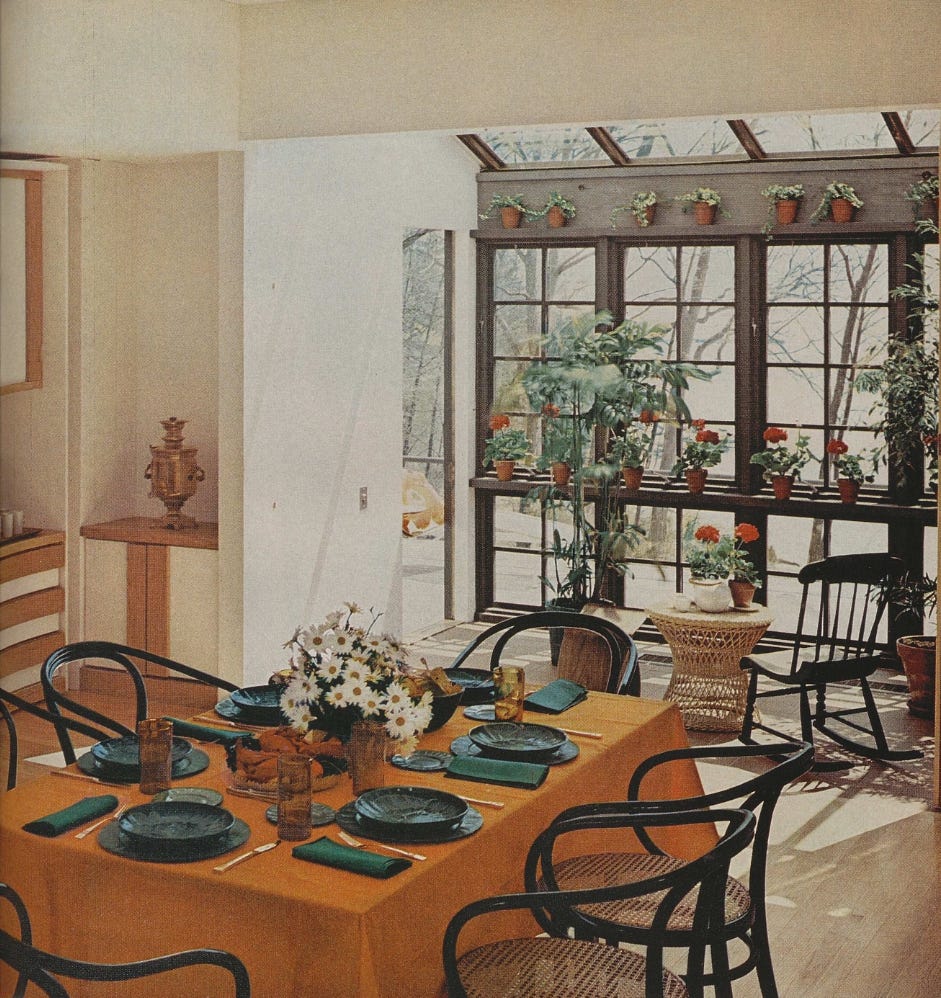 Ezra Stoller
A “plant-decked solarium” defines this New England home by architect Judith Chafee.
Most plant books rarely define such terms as “dim,” “average house,” “medium” or “bright” light. Nor do they mention how far back from windows it’s safe to place a plant. The following chart, adapted from the Terrestris Plant guide, should help.
Good Light Exposures
Two feet back from an obstructed east or west windowThree feet back from an unobstructed east or westFour feet back from an obstructed southFive feet back from, or at the edge of, an unobstructed south
Medium Light Exposures
Four feet back from an unobstructed northFour feet back from an obstructed east or westFive feet back from, or at the edge of, an unobstructed east or westSix feet back from, or at the edge of, an obstructed south
Low Light Exposures
Four feet back from an obstructed northSix feet back from, or at the edge of, an unobstructed northSix feet back from, or at the edge of, an obstructed east or westEight feet back from, or one foot to the side of, an unobstructed east or westEight feet back from, or one foot to the side of, an obstructed southTen feet back from, or two feet to the side of, an unobstructed south
Keep in mind that these are maintenance conditions. Plants grown in such light won’t look plant-show-perfect, but they will survive. Don’t expect them to “thrive,” as the books say. “Thrive” is a word too often used by editors who hate the grim sound of “survive.”
Temperature
This vital factor is rarely, if ever, mentioned by plant stores or books. Most “experts” omit it because they reason that the plants will be living in normal human temperatures, ranging form 65º to 75º. They fail to take into account the microclimates within the average home. Microclimates are the environments immediately surrounding the plants; there may be as many as seven different microclimates within one room.
Lilo Raymond
Lilo Raymond
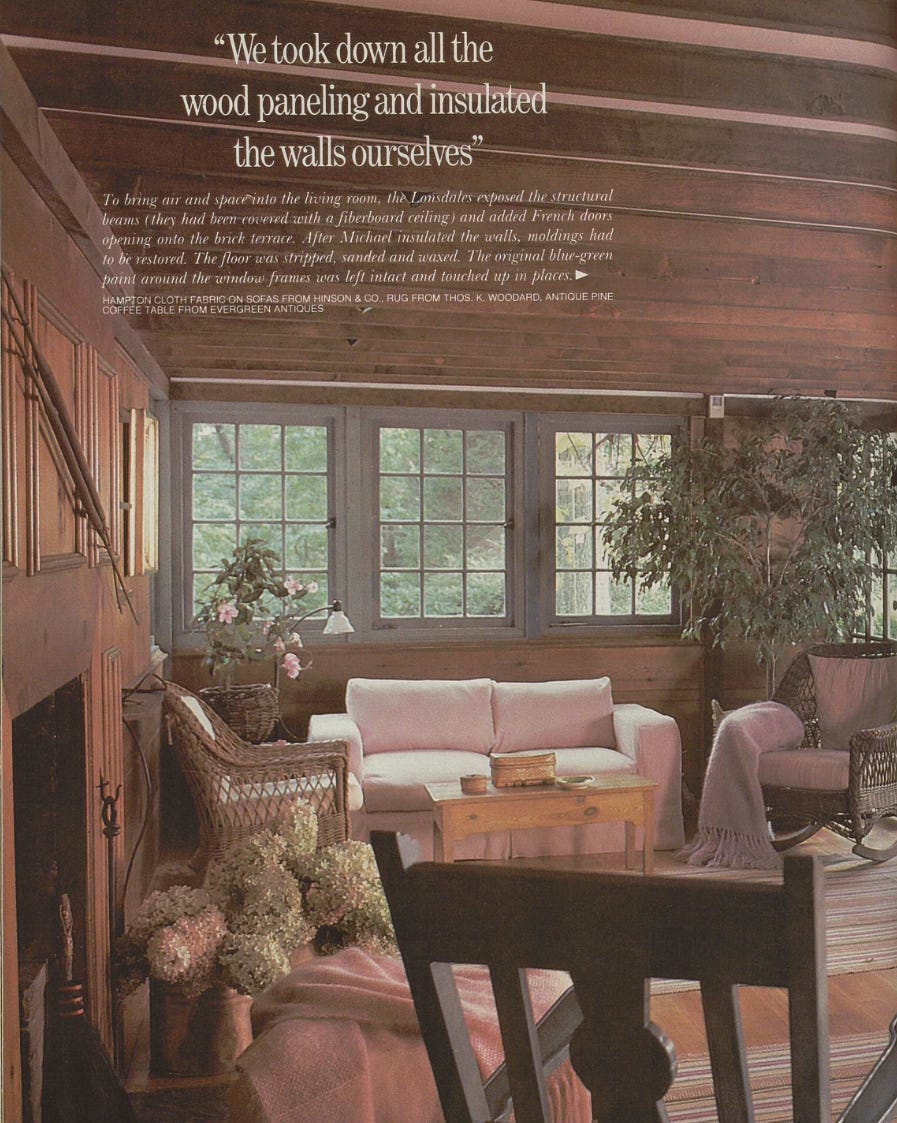
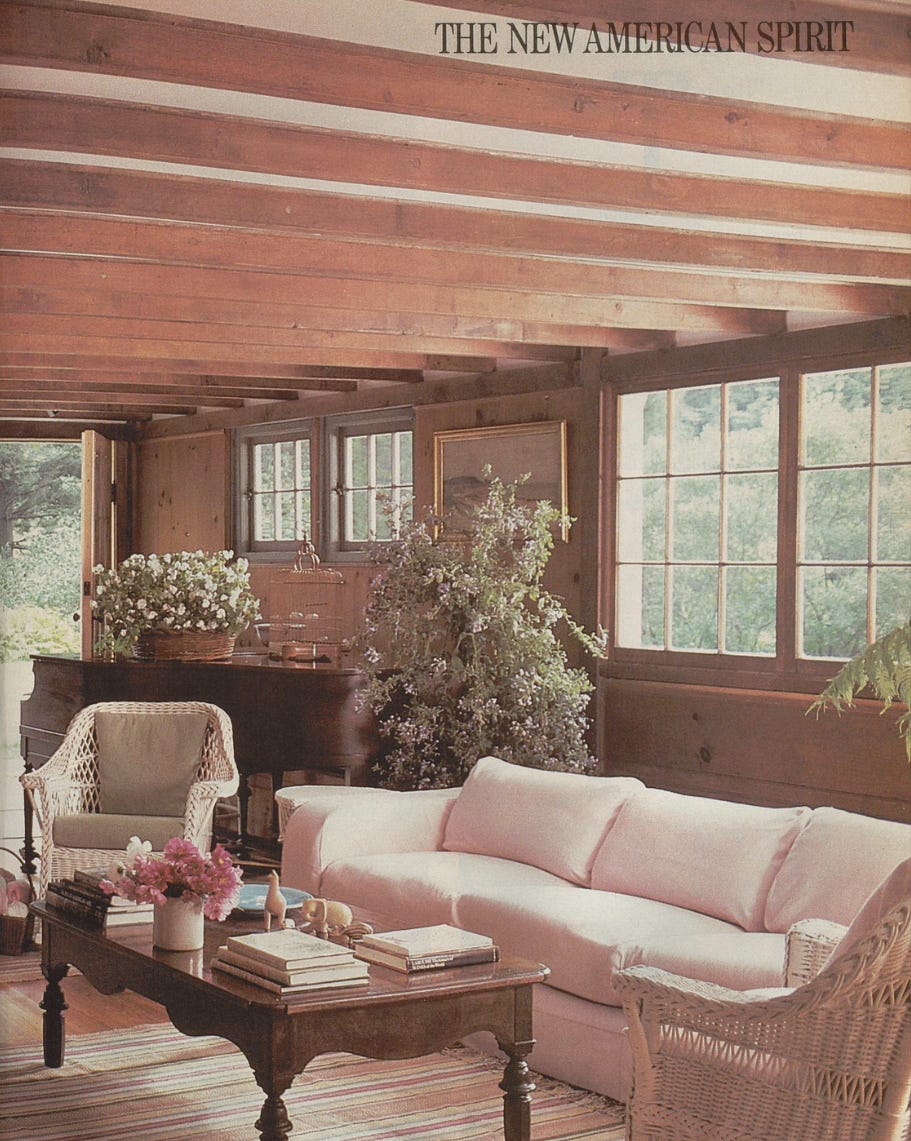
Above: A Connecticut cottage by Michael and Deborah Lonsdale, featured in the February 1984 issue of House Beautiful.
Microclimates can be a matter of life or death to plants. A warmth-loving plant next to a winter windowpane will experience a temperature about 10 to 20º lower than the average room temperature. This could kill certain plants in short order. Though plants can adapt to a slight variation from their ideal temperature range, too much of a difference can send them into shock.
Microclimates that can affect the health of plants are: upper air where hanging plants are kept (average of 5–10º warmer than the room temperature), near radiators (5–15º warmer), near windows in summer (10–15º warmer, depending on exposure) or winter (10–20º coover, depending on exposure and time of day), near floors or in front of open air conditioner vents in winter (10–15º cooler) and near stove or clothes dryer vents (10–15º warmer).
To be sure your plants are suited to their microclimates, buy an indoor thermometer/hygrometer to measure humidity and temperature in each microclimate in your home.
Humidity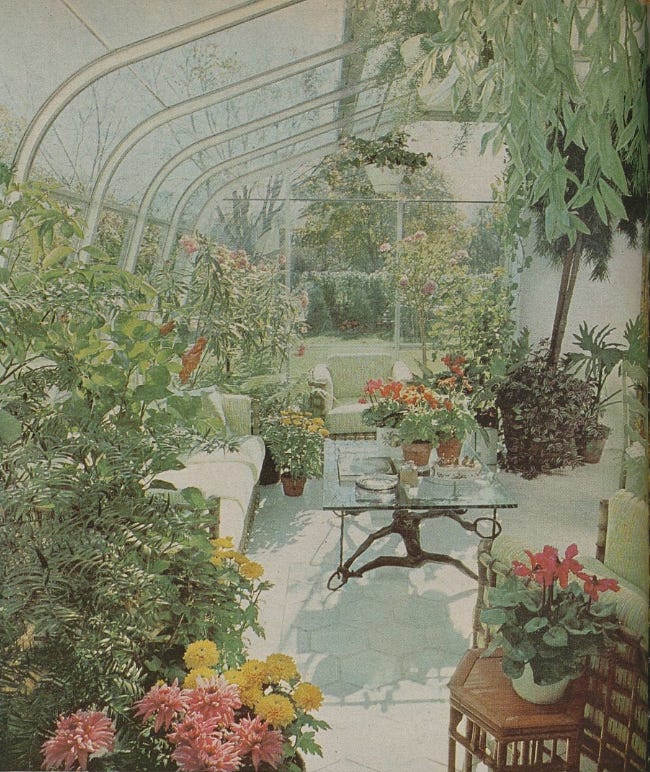 House Beautiful Archives
A Lord and Burnham greenhouse was installed at one end of the dining room in this Clifford H. Stanton–designed home in Southampton, New York, featured in our June 1976 issue.
Many books classify plants as needing either “low,” “medium,” “average house” or “high” humidity levels, but do not explain these obscure terms. Generally speaking, “low” ranges from 0% to 25%, the “average house” ranges from 5% to 35%, “medium” is from 30% to 55% and “high” is from 55% to about 80%.
Microclimates can be a matter of life or death to plants.
If the humidity isn’t high enough for a certain plant, you’ll have to increase it or the plant will literally transpire itself to death, losing so much water through the leaves that its cells collapse. Most plant books frown upon homemade remedies such as groping plants together to increase microclimate humidity and using pebble trays for increased microclimate humidity. But horticulturists we talked to agreed that grouping plants is effective in raising the humidity (through massed transpiration) and that pebble trays can increase microclimate humidity by 30%.
Watering
Most plant books usually advise you to keep plants “evenly moist.” But just what is that?
First, “evenly moist” should not be taken literally: Almost all plants prefer their topsoil a bit dry before dewatering. Plants absorb oxygen through their roots as well as their leaves, and non=stop wet soil doesn’t allow air to reach roots—a situation frequently leading to root rot.
Many plants, depending upon their species and type of pot, will have special watering needs. One example is the chlorophytum, or spider plant. Chlorophytums will tell you they’re being underwater by developing browning leaf tips and/or margins.
Dracaenas, marantas, calatheas, ctenanthes and some other varieties will also exhibit this symptom when underwatered. Browning and yellowing leaf tips or margins might also be a sign of a plant’s sensitivity to fluoride in the water or soil. Check these plants every day and water with room-temperature distilled water when the top soil feels dry/damp. Water can be left standing for about 24 hours in open containers to distill fluorides and chlorine out and warm the water up to room temperature.
And one fact that most books never mention is that perlite, a commonly used soil-mix additive, contains huge amounts of flouride and should be kept away from the above-mentioned plants. Use builder’s sand or kitty litter in your potting mix.
 House Beautiful Archives
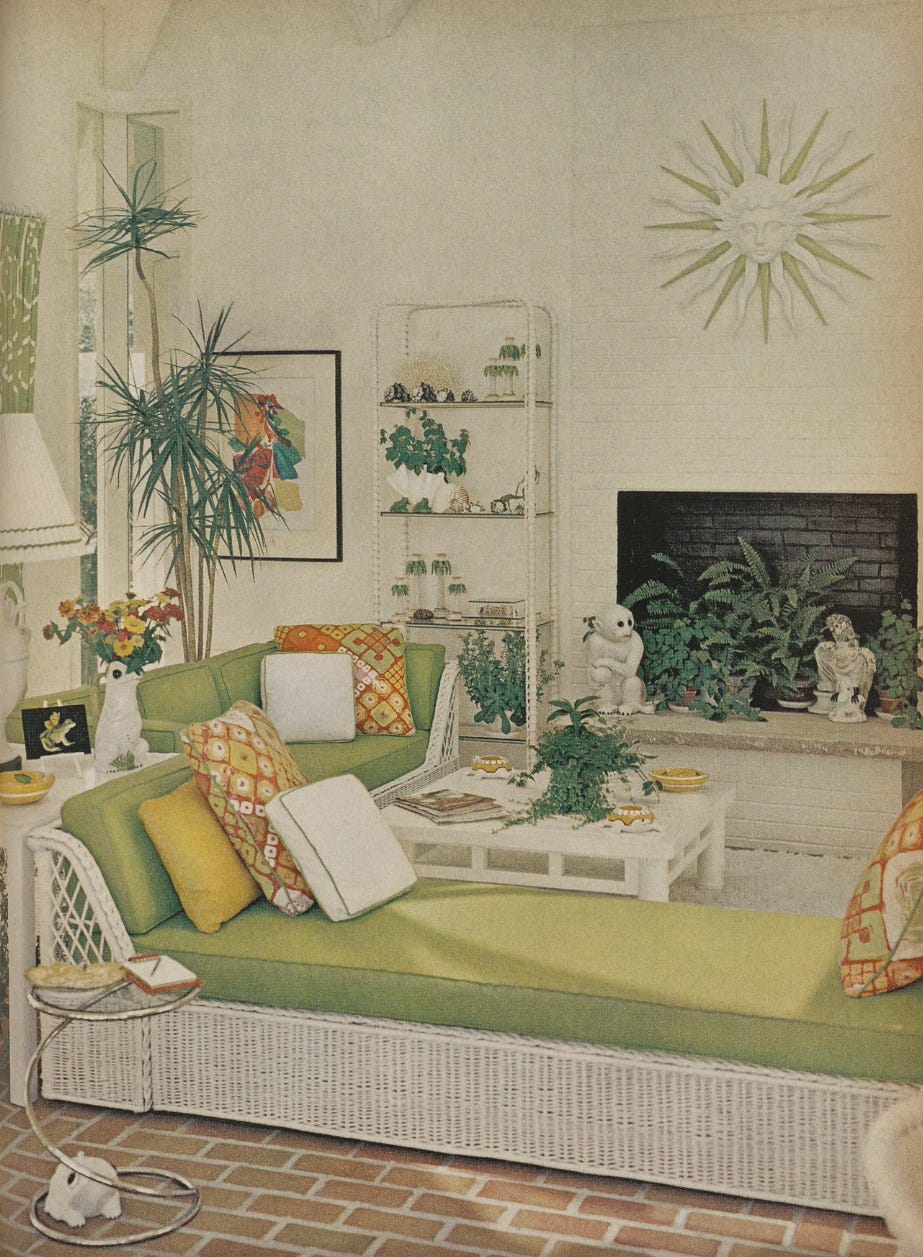
The poolhouse for a family in Marion, Massachusetts, featured in the June 1970 issue of House Beautiful, is anchored by this brick-floor loggia. Architecture by Edward J. Bullerjahn.
Most books will advise checking plants periodically and not relying on a set watering schedule. But they often fail to mention these variables:
When books say you should feel the soil, they usually mean with the finger-tips. However, many growers and hobbyists have found that the human knuckle is more sensitive to moisture than the fingertip. So try using the second knuckle of your index or middle finger when you’re touch-testing soil. Some plants need to dry out more than others. You must let more of the top-soil dry out for plants in larger pots or plants that require more dryness between waterings. Plants in pots with diameters up to seven inches usually require a feel-test about half a knuckle down; from seven to 12 inches, push about one knuckle down; from 12 up to 20 inches, two full knuckles to a finger-length down should do it. Remember to check plants every day so that dryness-sensitive plants won’t suffer. Soil felt in the early morning or late evening or soil in pots close to cold windowpanes will often give the illusion of moisture because the soil is cold.Clay absorbs water faster than most plant roots, so a clay pot may absorb water before the plant can get to it. What this means in practical terms is that pots that have dried out considerably must be either pre- or post-soaked at watering time. Thus the pot will absorb water form a source other than the soil.Some books blunder in asserting that soil color is an accurate gauge of moisture. This isn’t necessarily because the books are poorly informed but usually because they were written before the new soilless and the high-loam-content potting mixes gained wide acceptance. These soils don’t change color as they dry out.
As you can see by now, many so-called experts don’t know all that much about growing plants in the average home environment. So weigh their advice carefully and don’t be afraid to try your own experiments. The harmony and beauty of a roomful of well-grown plants is worth all the skepticism and hard-earned expertise in the world.
Comments are closed.