

 Leaf blower Credit: Thomas Breen / New Haven Independent
HARTFORD, CT — The Committee on Environment is once again considering a bill that would ban gas-powered leaf blowers and help the state and municipalities transition to battery-operated devices.
A similar bill was introduced last year. It made it out of committee and was sent to the House floor, but never called for a vote.
Senate Bill 319 would make it illegal to sell gas-powered handheld or backpack leaf blowers by Jan. 1, 2029, and would make it illegal to use them by Sept. 1, 2030.
Health and environmental advocates say a ban would cut back on air and noise pollution in local neighborhoods. Opponents, however, say the bill creates an unrealistic mandate for landscaping businesses and workers.
 State Rep. Dave Yaccarino
“At the end of the day, this proposal takes away choice,” said state Rep. Dave Yaccarino, R-North Haven. “Residents, contractors, and small businesses should have the freedom to purchase and use the equipment that works best for their needs, not be forced into a single option by government mandate.”
Running a commercial gas-powered leaf blower for one hour produces the equivalent smog-forming emissions as a new sedan driving 1,100 miles, the American Lung Association said in submitted testimony.
“By advancing this legislation, Connecticut has an opportunity to prioritize healthy air and protect public health,” said Ruth Canovi, advocacy director for the association. “This bill will reduce harmful air pollutants, lessen the burden of respiratory diseases and ensure cleaner air and healthier lungs for all Connecticut residents.”
The bill would require several state departments – including the Department of Administrative Services (DAS), the Department of Energy and Environmental Protection and the Department of Transportation – to replace lawn mowers, lawn trimmers and leaf blowers with electric hand-held or push alternatives as the existing equipment expires.
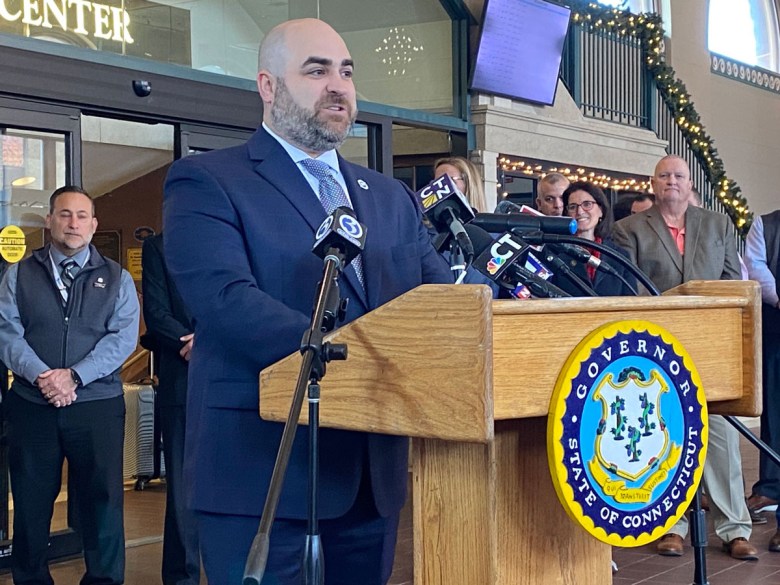 Then-Deputy Transportation Commissioner Garrett Eucalitto in a 2022 file photo. Credit: Christine Stuart photo
This would impose ongoing costs on the state and on electric ratepayers in the public benefits charge during a time when affordability is a paramount concern, said DOT Commissioner Garrett T. Eucalitto in submitted testimony. It would also result in upfront capital costs for the new equipment – both for the state and its contractors, he said.
“Many of our contracted landscapers are small businesses that, like the state, face costs to acquire new equipment,” Eucalitto said. “As a result, they may be hesitant to continue offering certain services, which could lead to a decrease in the number of businesses available to bid on state contracts.”
Storage, maintenance and disposal of electric batteries are also of concern once the switch is made.
“Battery powered equipment can not provide the same performance, productivity, and reliability as gas powered equipment,” said Peter Gorman of the CT Environmental Council. “In order to maintain the same level of productivity and efficiency, operators would have to purchase more units and maintain multiple batteries and charging stations.”
Gorman also noted that battery-powered equipment would not be an option for storm cleanup if there are extensive power outages.
Several Connecticut municipalities have enacted their own ordinances regulating gas-powered leaf blowers, including Stamford, Greenwich, Norwalk and Westport.
Comments are closed.