
Key Points
Manual removal of grass from flower beds is best done after a rain.
Mulching, groundcovers, and edging prevent grass from growing in flower beds.
Treat annual grass weeds with pre-emergent herbicides in late winter or early spring.
Flower beds are a beautiful addition to any yard, but some grasses will creep in and try to take over the space. Without proper grass management, some of them succeed.
Here is what a gardening pro recommends to get rid of those intruders in your flower beds without harming other plants.
Meet the Expert
Justin Ulanoski is the president of Native Creations Landscape Services in Berwick, Pennsylvania.
Identify the Intruders
The grasses that may pop up in your flower beds fall into two categories. If your beds are adjacent to the lawn, chances are the rhizomes of the turfgrass are creeping beyond their designated area. The second category is weeds; these are usually Japanese stiltgrass, crabgrass, and other annual grasses, but there are also perennial weed grasses, such as orchardgrass and quackgrass.
“Misidentification is an issue, especially if you have planted native grasses in your beds,” says landscaping expert Justin Ulanoski. “If you remove them when they are young, you might accidentally pull desirable plants.”
He recommends waiting until late spring or early summer, when you can properly identify the problem warm-season grasses, such as Japanese stiltgrass and crabgrass.
As for the roots of turfgrasses in your beds, those are very easy to identify because their rhizomes are white—unlike the roots of most ornamental plants—so they stand out.
6 Ways to Remove and Control Grass in Flower Beds
Once you’ve identified the kind of grass that has creeped into your flower beds, there are six different ways you can go about removing them.
Manual Removal
Credit: ekaterina savyolova / Getty Images
To remove grass manually, pull it and remove it with all its roots. Ulanoski says this is the easiest when the ground is moist from a good rainfall, and best done before seed heads develop.
If you are using a tool, he suggests using a hoe or any weeding tool that breaks up the soil and is narrow enough to reach between the plants in your bed.
Mulching
Suppressing weeds with mulch also works well for grasses. Ulanoski uses natural bark mulch, which he says weaves together nicely but lets moisture through and feeds the plants as it breaks down.
“Start by applying a 3-inch layer and re-mulch with a 1- to 2-inch layer as the first layer compacts and disintegrates over time,” he says.
Groundcovers as Green Mulch
An excellent way to prevent the popping up of unwanted grass is to plant groundcovers—also referred to as green mulch.
“Perennial groundcovers like black-eyed Susan fill in nicely and give unwanted grass to room to invade your flower beds,” Ulanoski says.
Edging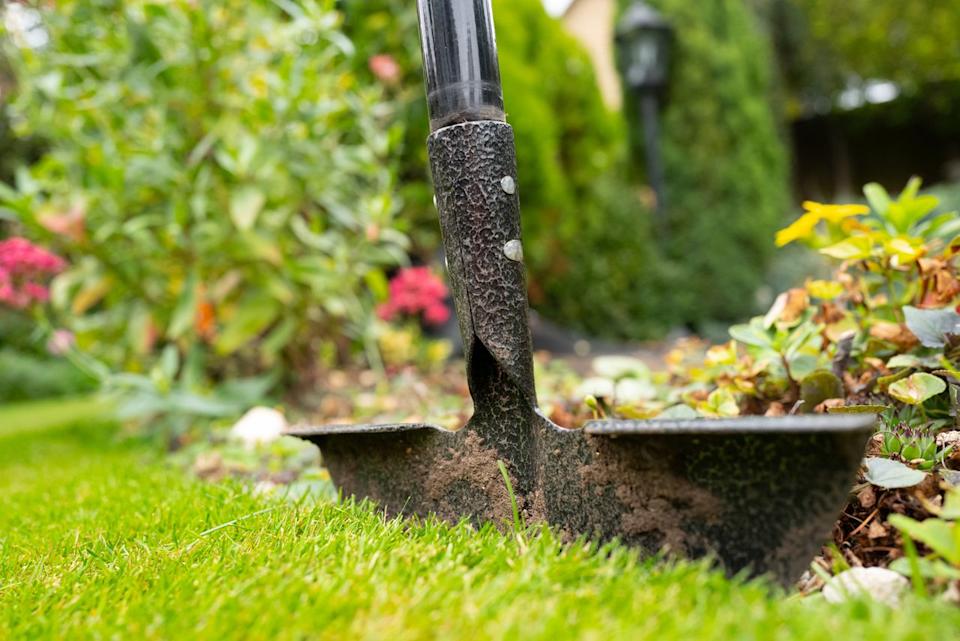
Credit: nickbeer / Getty Images
When lawn grass creeps into flower beds, a deep, crisp edge helps, according to Ulanoski.
“There are edging attachments for trimmers, but a solid, high-quality shovel also works well to cut 3 to 4 inches,” he says.
His recommended method to create a straight line is to lay rope secured landscape pins and follow the rope. You can also use a hose.
Pre-Emergent Herbicides
If you have a lot of annual grasses such as Japanese stiltgrass in your flower beds, Ulanoski suggest applying a pre-emergent herbicide.
“Proper timing is key, as the product has to be applied when the soil is warm enough for the weed seeds to germinate. This varies depending on the climate,” he says, but it would be in early spring.
Post-Emergent Herbicides
Although there are herbicides that are specifically formulated to kill grassy weeds, combating unwanted grass with herbicides should be your last resort. Use it only when a bed is severely overgrown with grasses.
“Make sure to use grass-specific herbicides and always follow the label instructions,” Ulanoski says.
5 Tips for Spot-Treating Weeds and Invasives
Cut a weed at the base. Annual weeds typically won’t regrow, and perennials are weakened.
If you cannot remove a perennial weed, at least cut the top off before the plant flowers and sets seed.
Apply homemade weed killer, such as vinegar or rubbing alcohol, on the weeds.
To spray individual weeds with herbicide, remove the top and bottom of a plastic milk jug. Place it over the weed and spray the herbicide directly into the top opening.
Use cardboard, newspaper, tarp, or plastic sheeting to deprive the weed of sunlight.
Read the original article on The Spruce
Comments are closed.