
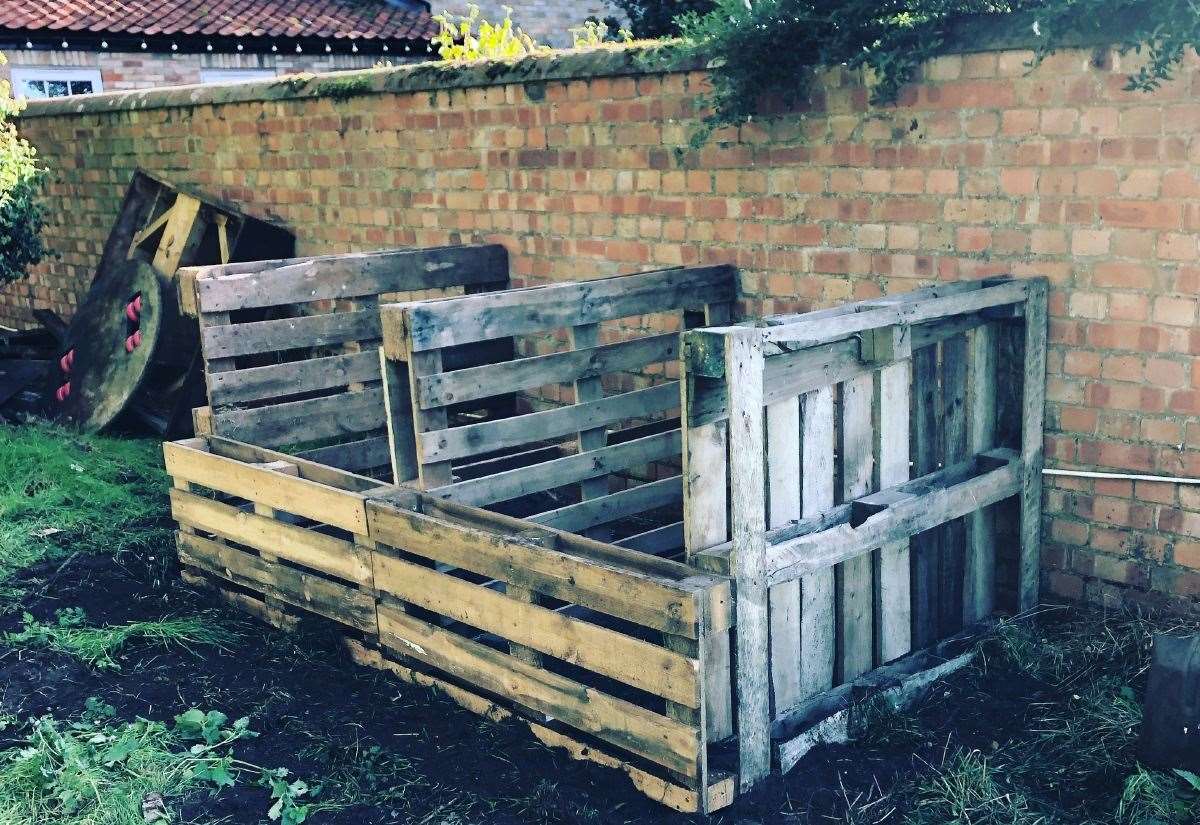
 Jamie has three pallet bays on his allotment -forking the contents from one bay to the next
This week, I want to talk about compost, because for me it’s the single biggest thing that transforms how well vegetables grow.
Composting is simply controlled decay. It’s organic material breaking down with the help of carbon, nitrogen and oxygen, turning everyday waste into something rich and full of life. Carbon gives structure.
Nitrogen gets everything moving. Oxygen keeps the whole process ticking along. Without enough air, things slow right down. Carbon is your dry stuff like straw, dead leaves and woody prunings, with cardboard and paper brilliant additions too. Nitrogen is the fresh material, vegetable peelings, grass clippings and green garden waste.
Pallet bays make an excellent space for compost
A rough guide is about two parts carbon to one part nitrogen. It doesn’t need to be exact, but getting somewhere close keeps things balanced, and once you get your head around that, it’s easier to think in terms of browns and greens.
I like to build my compost heaps in thin layers: a layer of greens, then browns, then greens again. Nothing fancy. If I end up with too much of one thing, I just pile it up beside the heap until I’ve got enough of the other to make a proper layer.
Those layers also help create air pockets, and compost really does need oxygen. If parts of the heap get squashed down, especially grass clippings, they can turn anaerobic, which just means without air. When that happens, it goes slimy, starts to smell, and everything slows to a crawl, which is where turning comes in.
Turning simply means moving and mixing the heap, adding oxygen back in, spreading moisture around and breaking up compacted areas. I usually turn mine after about six months, and it’s also a good chance to have a nosey and see how things are getting on.
Make your own compost – Jamie explains how it works and what to use
Sometimes, on a cold, frosty morning, you’ll notice your compost heap gently steaming when you disturb it. That warmth is just all the natural activity inside, quietly breaking everything down.
There are lots of ways to contain compost, from a simple open heap to plastic bins, pallet bays or insulated hot bins that hold heat and speed things up. They all work if you keep your browns and greens roughly balanced.
At my allotment, I use three pallet bays. One I’m filling, one that’s already been turned and is breaking down, and one ready for the next turn. I just fork from one bay into the next, while enclosed bins usually mean lifting the whole thing off and forking everything back in.
Where you put your compost matters, too. Somewhere convenient is important. If you have to walk miles to add your peelings, it quickly becomes a chore.
I always site mine directly on soil so worms and microbes can move in from below, and a bit of shelter helps too, especially from full blazing sun, which dries heaps out quickly.
Most garden and kitchen waste can go in. Your greens include vegetable peelings, tea bags, coffee grounds, weeds, spent crops and grass clippings, then you’ve got your browns like dried leaves, cardboard, paper and even wood shavings from the rabbit hutch.
I chop hedge trimmings up small before adding them too, just to help everything break down quicker. Perennial weeds like bindweed or couch grass are best dried out fully in the sun first, or soaked in a bucket of water for a few weeks, just to make sure they’re properly dead before adding them.
I avoid composting diseased plants, along with glossy paper, treated wood and pet waste. If space is tight, bokashi is another option. It comes from Japan and uses sealed buckets and special bran to ferment food waste.
After a couple of weeks, it can be buried in soil or added to the compost heap, where it breaks down quickly. Wormeries are handy too, especially in small gardens. They use compost worms, usually tiger worms, which are different from earthworms, although earthworms still help when bins sit on soil.
You can buy a proper wormery, or just tuck peelings under a sheet of plastic on the ground and let nature crack on. All of this matters because compost doesn’t just feed plants. It feeds the soil. Fungi, bacteria, worms and all sorts of tiny life work together to make nutrients available to roots.
That’s why compost improves structure, helps soil hold moisture in dry weather, drains better when it’s wet, and leads to healthier crops.
Think of compost as upgrading your soil rather than replacing it. You’re building something better year by year. Even if your veg beds are still just an idea in your head, start saving peelings, cardboard and garden waste now.
By the time you’re ready to plant, your compost will already be on its way.
Feel free to send me any questions to: Jamieslittleallotment@gmail.com
Comments are closed.