
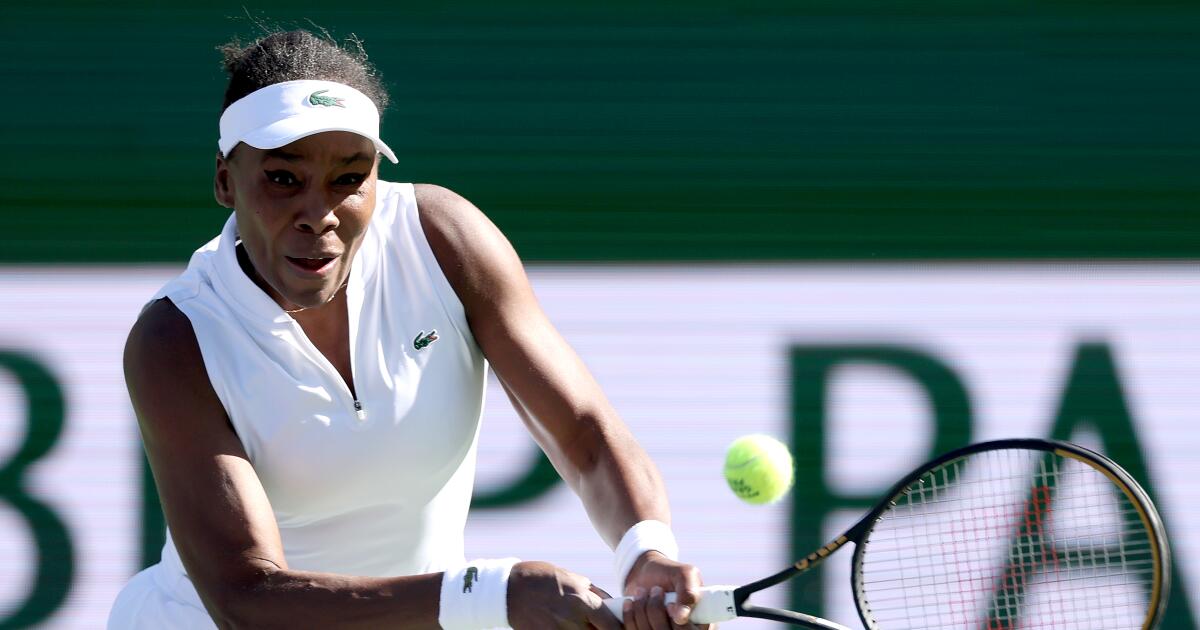
INDIAN WELLS — Tennis Paradise might be a misnomer.
Swirling winds, seesaw temperatures and generally capricious conditions at the BNP Paribas Open often belie one of the tour’s most beloved stops on the tennis calendar — one that is referred to with the sobriquet “tennis paradise.”
The tournament even promotes itself with that slogan, including an imposing overhead sign in the center of the venue grounds.
But as the first few days of the joint men’s and women’s event have demonstrated yet again, there is sometimes a bit of hell in tennis’ Garden of Eden.
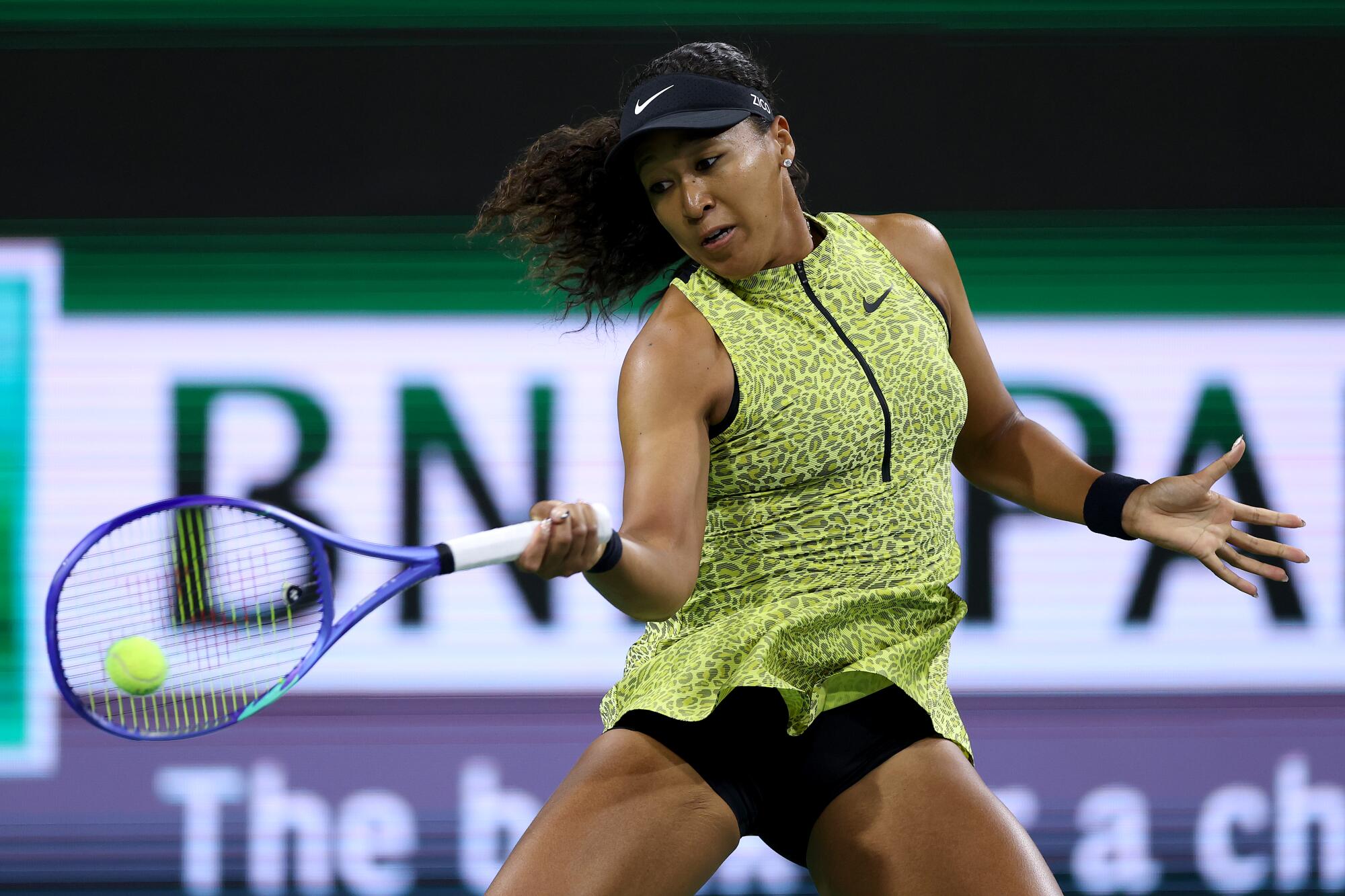
Naomi Osaka returns a shot to Victoria Jimenez Kasintseva during the BNP Paribas Open at the Indian Wells Tennis Garden on Friday.
(Matthew Stockman / Getty Images)
“I think today is not the kind of day that you want to assess,” said Venus Williams following first-round loss to Diane Parry of France on Thursday. “The conditions are impossible.”
The BNP Paribas Open unfolds in a landscape that can feel less like a controlled tennis environment and more like a shifting desert weather system.
Indian Wells sits in the Coachella Valley, roughly 120 miles east of downtown Los Angeles, wedged between the San Jacinto and San Bernardino mountains. That geography turns the valley into a natural wind tunnel. As hot air rises off the desert floor, cooler air pours down from above and funnels between the mountain ranges, sending unpredictable gusts sweeping across the tennis complex.
Those winds are layered on top of dramatic temperature swings typical of the desert.
Daytime sun can bake the courts, sending balls flying faster through thin, dry air, while night sessions can feel almost chilly by comparison as temperatures drop sharply after sunset. Even rain, a rarity in a region that averages fewer than 20 days a year, has a habit of arriving during the tournament’s early-March window, occasionally bringing cold drizzle and delays.
Looks, too, can be deceiving for those not on the grounds.
“You can’t really see it on the TV, I think, when it’s crazy windy or if there is a sandstorm it still looks beautiful,” said sixth-ranked American Amanda Anisimova after coming back to defeat Anna Blinkova 5-7, 6-1, 6-0 in the second round Friday night.
One of the most infamous wind-whipped results was in 2005.
That year, Maria Sharapova, 17 and fresh off upsetting Serena Williams to win Wimbledon a few months before, lost 6-0, 6-0 in the semifinals to American Lindsay Davenport. It was the only double bagel of the Russian’s Hall- of-Fame career.
After the match, the shell-shocked Sharapova explained that the tricky winds made her unsure whether her balls were going to land in, undermining her laser-like groundstokes and confidence.
“I’ve never played such a big-hitting player in these kind of conditions,” the five-time Grand Slam winner said that day. “I guess even when you get a little opportunity, you hesitate a little because you know the conditions are not good.”
Two decades later, that fickle through line carries on.
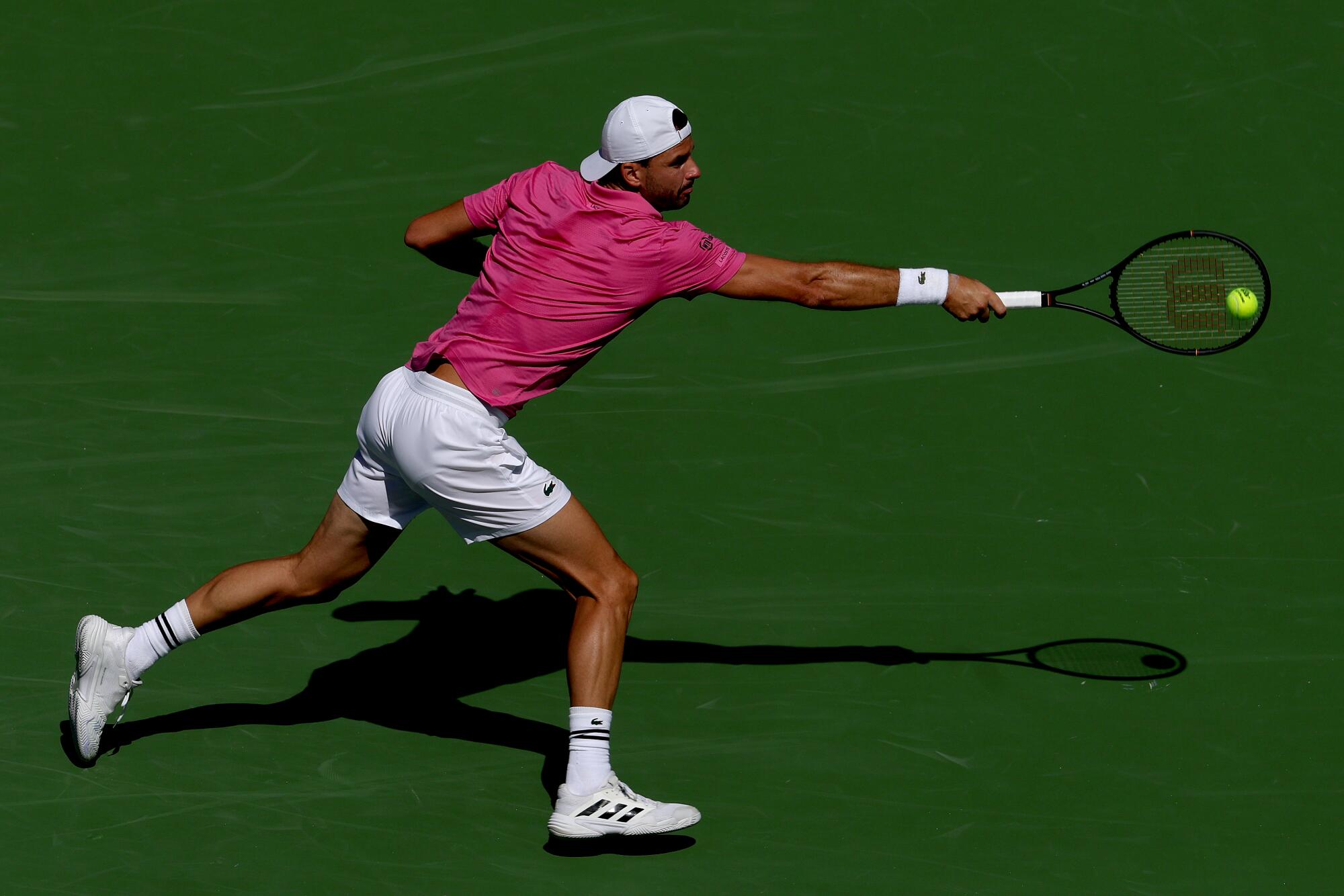
Grigor Dimitrov returns a shot to Terence Atmane during the BNP Paribas Open at the Indian Wells Tennis Garden on Thursday in Indian Wells.
(Matthew Stockman / Getty Images)
Several players, from 19-year-old Indian Wells debutante Victoria Mboko of Canada to 45-year-old Williams, who first competed here 30 years ago in 1996, have already gotten a taste during the tournament’s opening days.
Sometimes the blustery weather can distract play, as a takeaway food bag blowing onto the main stadium court during Grigor Dimitrov’s first-round victory against Terence Atmane did on Thursday.
“The playing conditions here are terrible,” the Bulgarian said in his postmatch on-court comments after notching a win.
The upshot is a tournament defined by contradictions.
Circumstances can shift not just from day to night but hour to hour: hot afternoons with lively balls, cooler evenings when the pace slows and swirling winds that can make a serve toss veer sideways or a groundstroke wobble off course.
For players, Indian Wells can feel less like one event than several rolled into one. It’s a reminder that even in a place marketed as “tennis paradise,” the desert ultimately sets the terms.
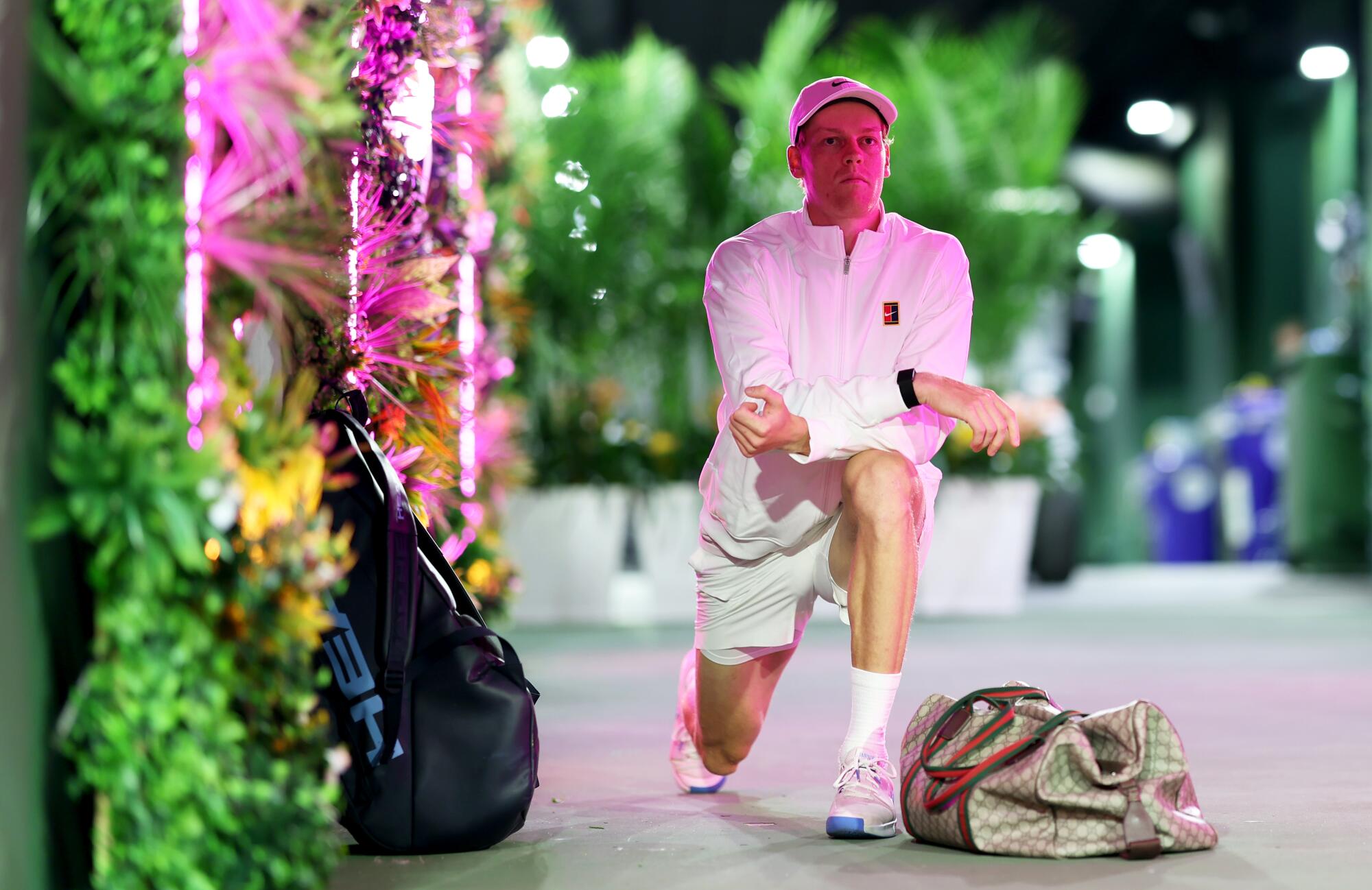
Jannik Sinner prepares to leave the player tunnel ahead of a match against Dalibor Svrcina at the BNP Paribas Open on Friday in Indian Wells.
(Clive Brunskill / Getty Images)
Not everyone dislikes the variability.
American Tommy Paul breezed through his opening match Friday on the venue’s largest show court, Stadium 1. With its more expansive layout, open entrances, and large concourses, it can pose particular problems by forcing players to adjust on the fly.
“I like the conditions a lot, especially on that court too,” said No. 23-seed Paul after beating Zizou Bergs of Belgium 6-1, 6-2.
Part of traveling the globe as a pro player, of course, means navigating different surfaces, balls, winds, temperatures, time zones, and local environments. It’s a reality of tour life.
Most take it in stride, or consider the situation at Indian Wells a fair tradeoff for the otherwise gorgeous backdrop of mountains, picturesque sunsets and lavish facilities.
“I mean, at the end of the day, like, you can’t control the weather, and I think it’s kind of fun, because it brings a challenge for all the players,” said Anisimova, last year’s Wimbledon and U.S. Open runner-up. “It’s still paradise because of the scenery and how beautiful it is here,” she adds.
Anisimova isn’t one to complain, even if she has yet to tame the tournament’s unpredictability. In her last two appearances here, she lost her opening match.
She admits: “I don’t think it’s fun for everybody.”
Comments are closed.