

For The Union-Tribune
We’re at the end of winter, yet it seems like there’s barely been any winter at all. This has been one of the warmest winters on record, though fortunately not the driest. Winter rains have been a bit above average, arriving in big storms with long dry periods and Santa Ana winds in between. This is what the climate change modelers said would happen.
In our gardens, irrigation systems have been on, then off, then on, then off again, following the wet/dry periods. The desert has been experiencing good blooms for several months already. Let’s see if that continues this month as we head into spring gardening!
Edibles: vegetable, herb and flower gardens
March is the time to start your summer vegetable, herb, and flower seeds. Started now, your seedlings will be ready to transplant by mid-April, just as the weather warms.
Want to learn how to start seeds and grow vegetables? Or polish your vegetable gardening skills? Sign up for my online course, “Strong Starts: Spend Less, Grow More.” Even better, add on an in-person workshop and you’ll become a seed starting, vegetable growing superstar! Whether in person or online, I guide you through the summer, from seed through harvest. Workshops are held this month, across San Diego and in Los Angeles, too.
A sampling of seeds to start now in containers:
• Summer edibles: tomatoes, peppers, squash, eggplant, basil.
• Annual flowers: marigolds, zinnia, cosmos, Mexican sunflower
A sampling of seeds to plant directly into the soil:
• Herbs: cilantro and parsley
• Root crops: carrots, turnips, beets
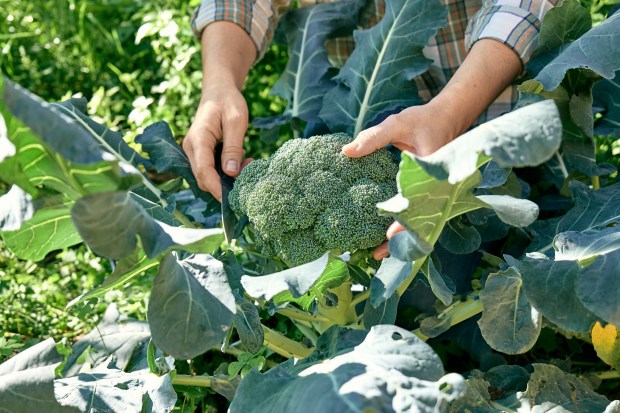 Harvesting the last of the broccoli is needed before working on your spring planting. (Adobe Stock)
Get your garden beds ready for spring planting:
• Harvest the last of the cool season crops like cabbage, cauliflower, lettuce and broccoli.
• Cut cover crop plants at the base so roots decompose in place. Layer the leaves and stems over the soil. They’ll soon decompose, too.
• Install a grid of inline drip irrigation into each garden bed. For vegetable garden beds, the best irrigation is Netafim Techline EZ with emitters spaced every six inches.
• If you’ve already installed inline drip irrigation, test now for any needed repairs.
• Top off garden beds with fresh compost (NOT planting mix, NOT potting mix), plus worm castings and organic vegetable fertilizer. Water well.
• Install sturdy trellises, wire mesh cages, etc. to support rangy plants like tomatoes, and vining plants like cucumbers, climbing squashes, luffa, watermelon, pumpkins, etc.
• Build some of my favorite tomato cages. Find my how-to video at nanstermangardenschool.com/tomato-cage.
Fruiting trees and shrubs
As the weather warms, restart watering deciduous fruit trees: pomegranate, apricot, peach, apple, etc. Always water for the same number of minutes year-round — gradually water more often into spring and then summer, less often as the weather cools and through winter.
• Apply granular organic fruit tree fertilizer to stone fruit, apple, persimmon and pear trees.
• Apply granular organic citrus and avocado food to citrus and avocado trees, following label directions.
Fertilizer how-to:
• Pull back all the mulch under the entire canopy to expose the soil.
• Sprinkle fertilizer over all the bare soil, to the edges of each tree’s canopy.
• Top the fertilizer with a fine layer of worm castings (optional).
• Water the soil/fertilizer/worm castings well.
• Put back the mulch. Add more if needed, to ensure there’s a 3- to 4-inch-thick layer.
As you harvest citrus, monitor plants for ants as well as for aphids (green, white or black specks on leaves and stems), mealy bugs (tiny, fuzzy white spots on leaves and stems) and scale (tiny, hard-bodied brown or black ovals along stems and leaf petioles).
Leaves covered in powdery black sooty mold are your first clue to these pests. Stop the ants using Terro or Advion bait stations, then hose off or scrape away the aphids, mealy bugs and scale.
If scale builds up on citrus, spray the branches and other infected areas with light horticultural oil, NOT Neem. Do not spray the trees while in bloom. Wait until after “fruit set,” when the flowers become tiny fruits. Even scale-infected fruits can be sprayed.
Don’t fertilize fig trees, pomegranate, pineapple guava, tropical guava and loquat, Instead, mulch them with a 3-inch-thick layer of coarse wood mulch. Water deeply but only occasionally as the rains end. After that, water only occasionally through summer (or not at all if you are close to the coast).
Harvest loquat fruits to eat fresh, can, dry, etc.
Ornamental perennials, shrubs, vines, and trees
“Right plant, right place” is more than a cliche; it is a guiding principle of a successful, low maintenance garden.
• Choose the right size plants: Know the height and width of the spaces you are filling. Match the plants’ mature sizes to the size of the spaces so you rarely need to prune.
• Know your garden’s typical rainfall: Select plants native to your community or to areas with similar amounts of rain. Those are the plants that grow with little to no need for irrigation in your garden.
• Winter cold and summer heat: Plants that tolerate the highs and lows in your garden are more likely to live long, healthy lives.
• Discover your soil: Does the soil drain fast or slow? Dig a hole 2 feet wide and deep (or as close to that as you can). Fill it with water and let it drain. Fill with water again and time how long it takes to drain. If water drains within a day, that’s fast draining. If not, it’s heavy soil. Choose plants that match your soil.
• Group plants according to their need for sun and water. Avoid mixing thirsty plants with drought resilient plants, shade plants with sun plants.
• Flowers attract pollinators to your garden. As bees, butterflies, flies (yes, flies are pollinators!), and other pollinators visit flower after flower in search of nectar and pollen, they unintentionally fertilize each bloom, which then morphs into a fruit. Flat, wide, open flowers (like daisies) attract bees. Tube-shaped flowers (like sage) attract butterflies. Add both to your garden for good pollination!
Take a hike
Head out to a mountain or grassland and follow the trails to see native plants in bloom now. Identify the plants, bugs and animals you see using your smart phone and iNaturalist app.
Our native lilac (Ceanothus) starts blooming this month. They turn the tapestries of chaparral-covered hillsides shades of blue to purple to white. California poppies bloom now too, in addition to bright-orange native California poppies (Eschscholzia californica), and pink flowering western redbud (Cercis occidentalis), to name just a few.
Love native bulbs? Watch for pink blooming Calochortus splendens, bright yellow with gold speckled Calochortus weedii, and white blooming Calochortus dunnii. Enjoy these bulbs in habitat. They are very challenging garden plants.
Enjoy looking at wild plants and flowers but NEVER pick them. DO NOT collect cuttings or dig up plants, and NEVER collect seed pods. Those flowers make the seeds that ensure a new generation of plants next year and for years to come. When you remove flowers and/or seeds, you diminish next year’s generation and the next and the next and so on until the population dies out. Collecting on public or private property is illegal as well.
Maintenance
Wait until midmonth to cut away cold-damaged leaves, stems and branches. By then, plants will be in their spring growth spurts. If you live in the mountains, wait until April.
Do you love angel trumpet plants (Brugmansia sp.)? These giant, South American perennials take on a tree shape and are festooned in long, hanging, trumpet-shape blooms that release a wonderful perfume in late afternoon. The plants can really suffer damage from winter cold, so once we get to midmonth, give yours a well-deserved haircut. It will bounce right back!
If you notice collapsed Agave plants, check the roots for agave root weevil. The weevil’s young (grubs) eat the roots, turning them into a stinky, liquid mash. Dig out the entire plants including the roots. Seal it all in a bag, and trash (not greenwaste) the whole thing.
We are still seeing Canary Island palms with flattened tops caused by the deadly South American palm weevil. Sadly, the first indication is the final indication. By time you see the collapsed fronds, the palm is too far gone to save.
Flush out the centers of bromeliad plants growing in the ground. Turn potted bromeliads over to pour out their water, then refill with fresh water. Sprinkle Mosquito Bits granules into the water that collects in the center of the leafy rosette to prevent Aedes mosquitoes from breeding there.
Start watering plumeria when leaves appear towards the end of the month.
Start fertilizing roses with slow-release granular fertilizer.
Refresh your garden’s mulch. The goal is a 3-to-4-inch layer over the entire garden except to leave a patch of bare soil, 5 or 10 feet square for native, ground-dwelling bees to nest. Native bees are excellent pollinators and very rarely sting humans.
Weed, weed, weed, weed, weed. Pull weeds out by the roots or cut off the top growth with a hoe. Do it as soon as you notice the leaves. DO NOT:
• Let weeds flower. Those flowers make the seeds for next year’s crop of weeds.
• Cover the soil with weed cloth or landscape fabric, both of which turn your garden soil to cement and neither of which stops weeds.
• Rototill: Rototilling destroys the soil structure, causes compaction and brings more weed seeds to the surface, multiplying the problem. If you have Bermuda grass, tilling cuts the grass up into a million pieces, each of which becomes a new plant.
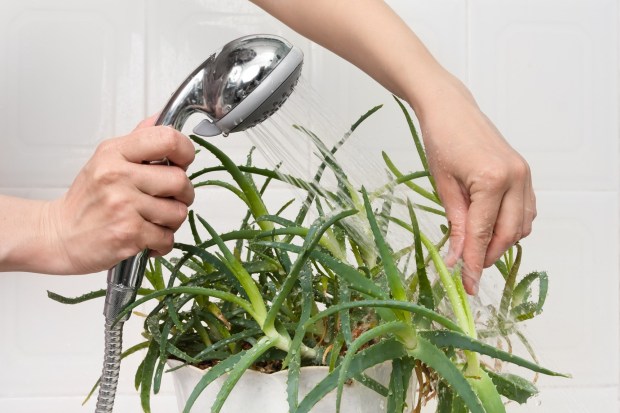 Rinse off houseplant leaves to remove dust from the winter and leach out salts that have built up from hard water. (Adobe Stock)
Houseplants
• Rinse houseplant leaves to remove the dust settled over winter.
• Leach the soil to rinse through the salts that accumulates in the soil from our hard water. Sit the plant in a sink and let water drip through the soil for a few hours.
• Trim back too-long vines.
• Shop for new plants to add to your collection.
Get involved
This month kicks off garden event season in Southern California.
March 29: San Diego Horticultural Society tour, featuring gardens in Coronado and Point Loma, all designed by members of the Association for Professional Landscape Designers who co-sponsor the tour. Find tickets at sdhort.org/event-6517792/Registration.
March 21: UC Master Gardeners Spring Garden Event, seminar and plant sale; mastergardenersd.org.
March 12-15: Japanese Friendship Garden Cherry Blossom Festival, niwa.org.
March 1 to July 31: “Strong Starts: Spend Less, Grow More” vegetable gardening course online with in-person workshops across San Diego; nanstermangardenschool.com/easy-seed-starting.
Sterman is a garden designer, journalist and the host of “A Growing Passion” on public television. She runs Nan Sterman’s Garden School at waterwisegardener.com.
Comments are closed.