
Happy month of Adar.
Adar is the month of joy, and as Purim arrived with the full moon, we were invited to celebrate in ways our ancestors understood as expansive and embodied: to feast, to disguise ourselves, to drink wine, to loosen the grip of ordinary consciousness. The Sages teach that one should drink “until one cannot distinguish between “cursed is Haman” and “blessed is Mordechai” (Babylonian Talmud, Megillah 7b). It is a startling instruction for a holiday whose villains and heroes seem so clearly defined.
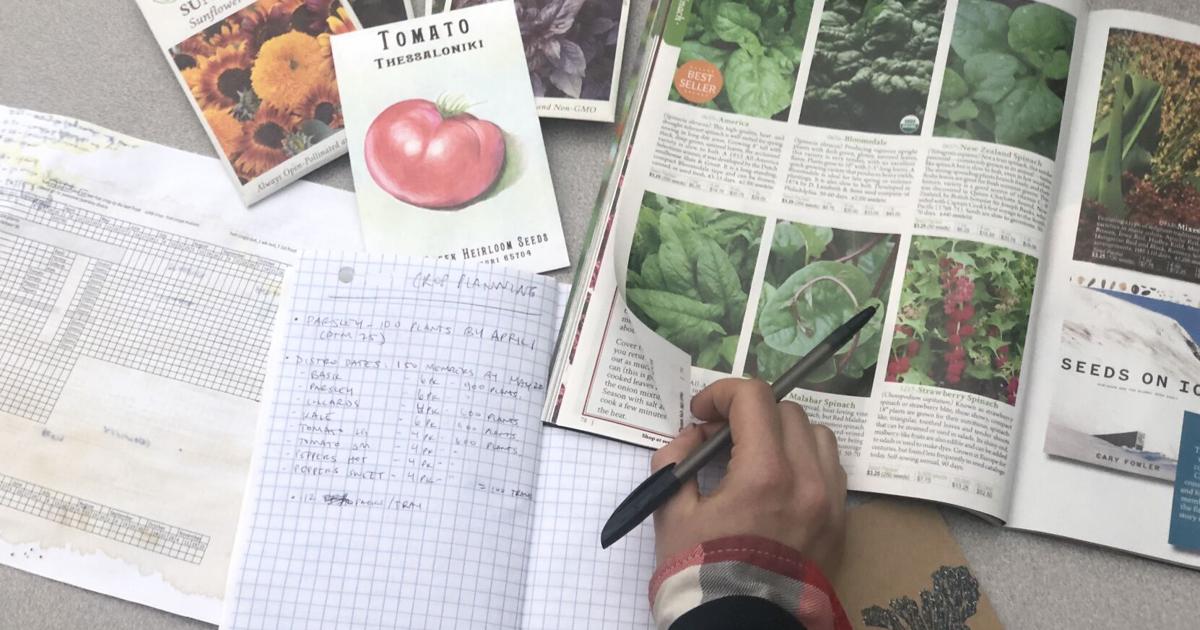
For gardeners, this is also the season when anticipation tips toward delight. Seed-ordering season is its own kind of Purim. It’s the moment to experiment with new varieties, to try to grow something you previously decided was too hard or uninteresting, to experiment and play. Across my kitchen table are scattered colorful catalogs and my stores of seeds saved from previous years. I leaf through packets, taking inventory of what’s still viable, remembering which varieties thrived and which challenges I’d rather not repeat.
On my table, you’ll find “Detroit Dark Red” beets from High Mowing Organic Seeds, “Cherokee Purple” tomatoes from Baker Creek Heirloom Seeds and “Sugar Ann” snap peas from Johnny’s Selected Seeds.
After a long winter, the joys of the coming season are already palpable. Each packet carries memory: sowing trays in the greenhouse, the first true leaves, a monarch sighting, a surprise blossom, the sweetness of an early harvest.
Like the Jewish calendar, the garden runs on cycles. The same moments return, but we are not the same. Each year, we meet them with a little more experience, a little more humility and ideally with a little more joy.
So, why does the Talmud invite us to blur the line between villain and hero? On Purim, we boo at the mere mention of Haman and cheer for Mordechai. Evil seems to have a name, a face, a clear category. And yet, for one day, we are asked to soften that certainty.
The binary of good and evil is ancient — and so are the problems it creates. Purim nudges us to hold even our most confident judgments with curiosity. In the garden, we can become so intent on eradicating “pests” and “weeds” that we reach for broad solutions — herbicides, pesticides, quick fixes — that harm far more than their intended targets. (Put. The RoundUp bottle. Down.) In our rush to protect what we love, we may poison the soil, the pollinators, even ourselves.
And. anyway, aren’t those “pests” just bugs doing their bug thing?
The more we learn about ecology, the less stable our categories become. Dandelions are the bane of lawn perfectionists, yet among the earliest food sources for pollinators each spring. Every part of the plant is edible and medicinal. From another angle, what we called a nuisance becomes a gift.
Purim’s costumes and cups of wine are not merely about excess. They are about perspective. What happens when we loosen our grip on who we think we are? When we soften our certainty about who or what is good or bad? Is there more room for forgiveness, for complexity, for seeing the humanity in one another? What hidden connections might reveal themselves? What small miracles might become visible? What new joy is possible?
Whether or not we partake in the libations of the day, the invitation stands: Turn things upside down. Play. Increase joy. Approach the world, and the garden, with a little more spaciousness and wonder.
Wishing you a joyful seed-ordering season, and Chag Purim Sameach.
As owner-operator of Chamomile Gardens, Carly brings garden visions to life throughout Metro Detroit for individuals, families, businesses, and organizations seeking to grow food and flowers in their space. Learn more at chamomilegardens.com. Gardening questions you want to see answered here? Send them to Carly at growchamomile@gmail.com.
The Detroit Jewish News has been supported by readers like you since 1942. Support independent, local, Jewish journalism with a donation today.
DONATE
Comments are closed.