
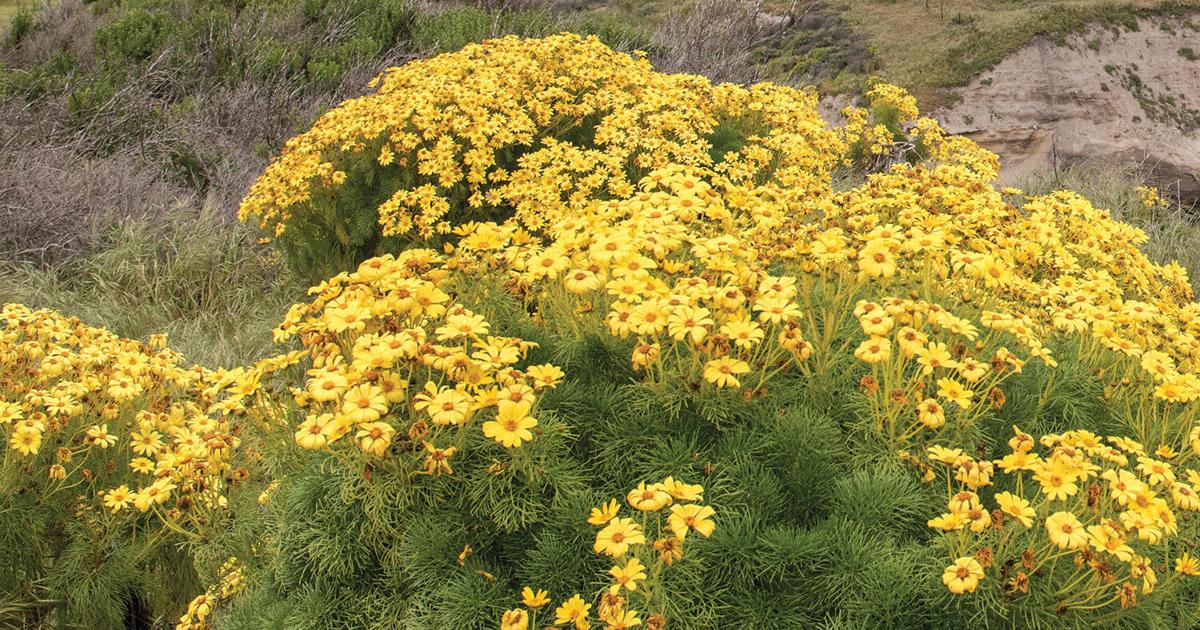
This past January, I spent a Saturday morning logged in from home, not just as an observer but as a student of a growing and urgent movement. I was attending the Santa Barbara Botanic Garden’s 13th Annual Conservation Symposium virtually. The shared sense of purpose was clear as a diverse array of scientists, land managers and home gardeners presented their work. A powerful, unifying narrative unfolded: our local ecosystems are under profound stress, and the single most effective tool we possess for healing them begins right in our own backyards. The solution, echoed in every session, is the conscious and deliberate act of planting native plants.
It was there that I learned about the garden’s “Native Plant Pledge,” a powerful initiative that transforms this idea into concrete action. This isn’t just a symbolic gesture, but a key part of a much larger, science-driven mission. Citing the work of renowned ecologists, the garden has set a regional goal to achieve 30% native plant coverage in the spaces where we live, work and play. This is the critical tipping point, the threshold at which local ecosystems can begin to rebound and support healthy, self-sustaining populations of wildlife. To reach this goal, the Garden has an ambitious target for 2026: to have 10,000 people join the movement. I took the pledge that day, and I encourage you also to join this vital effort.
For decades, we’ve been conditioned to see a very specific, and deeply flawed, image of the ideal yard: the manicured green lawn, a holdover from a wetter, cooler European climate. When treated as the default for our private landscapes, it becomes an ecological desert — a biologically silent carpet demanding immense quantities of water while relying on a constant cycle of chemical fertilizers that ultimately wash into our creeks and ocean. Most critically, it is a food desert for the pollinators and insects that form the very foundation of a healthy environment.
This isn’t a declaration of war on all turf. Lawns absolutely have their place, providing durable, wonderful surfaces for our community parks and sports fields where children can play, and teams can compete. The problem is its default status in our yards, where a more vibrant, living landscape could thrive instead.
To choose native plants is to consciously reject this default. When we choose natives, we evolve from being just gardeners into becoming restoration gardeners. We shift our mindset from being caretakers of a sterile plot of land to becoming true nature allies, actively participating in the ecological healing of our community.
The importance of this role cannot be overstated. Think of the rugged, beautiful landscape of the Carpinteria Bluffs, with the scent of coastal sagebrush on a warm afternoon. That is the authentic look and feel of our region. As restoration gardeners, we have the power to weave our own yards into this larger natural fabric. Our local wildlife has co-evolved over millennia with these specific plants. The monarch butterfly cannot complete its life cycle without native milkweed. A single native oak tree can provide food and shelter for over 500 species of caterpillars, which in turn become the primary, irreplaceable food source for baby songbirds. By planting these species, we create a continuous thread of habitat that stretches from our doorsteps to precious wild spaces like the Bluffs and the foothills, directly combating the habitat fragmentation that threatens so many species.
Taking the pledge is the first step. The next is often asking, “But which plants are right for my yard?” Thankfully, this question has never been easier to answer. The California Native Plant Society (cnps.org) offers a free, powerful online database at Calscape.org. The site can generate custom, localized planting guides and lists based on your specific location. This incredible tool allows you to further filter the results by sun exposure, soil type and water needs, truly taking the guesswork out of planting locally.
But knowing which plants belong is only half the battle. What about design? For this, the Bloom! California initiative provides a wealth of inspiration on its website, bloomcalifornia.org, with professionally designed, ready-to-use garden plans. For an even more comprehensive set of local resources, visit the Santa Barbara Botanic Garden’s website and explore “The Native Plant Tool Kit” (sbbotanicgarden.org/insight/native-plant-toolkit). This fantastic resource is a one-stop-shop that includes guides on everything from “Easy-to-Grow Native Plants” to a “Plant This, Not That” guide.
Native gardening is about creating a landscape that matches where we are, provides the greenery, flowers, shade and beauty you want in your yard, requires less maintenance and water usage than traditional landscaping, and also happens to be habitat that helps heal nature.
I urge you to visit sbbotanicgarden.org/grow/join-the-movement to take the Native Plant Pledge, and let’s get growing.
Mike Wondolowski is president of the Carpinteria Valley Association (www.facebook.com/carpinteriavalleyassociation), a local organization dedicated to maintaining the small beach town nature of our community. In over 35 years of involvement in planning issues, he has witnessed visionary successes, as well as decisions that were later widely regretted. When not stuck indoors, he can often be found enjoying Carpinteria’s treasures including kayaking and snorkeling along the coast, running or hiking on the bluffs or the Franklin Trail, or “vacationing” as a tent camper at the State Beach.
Comments are closed.