
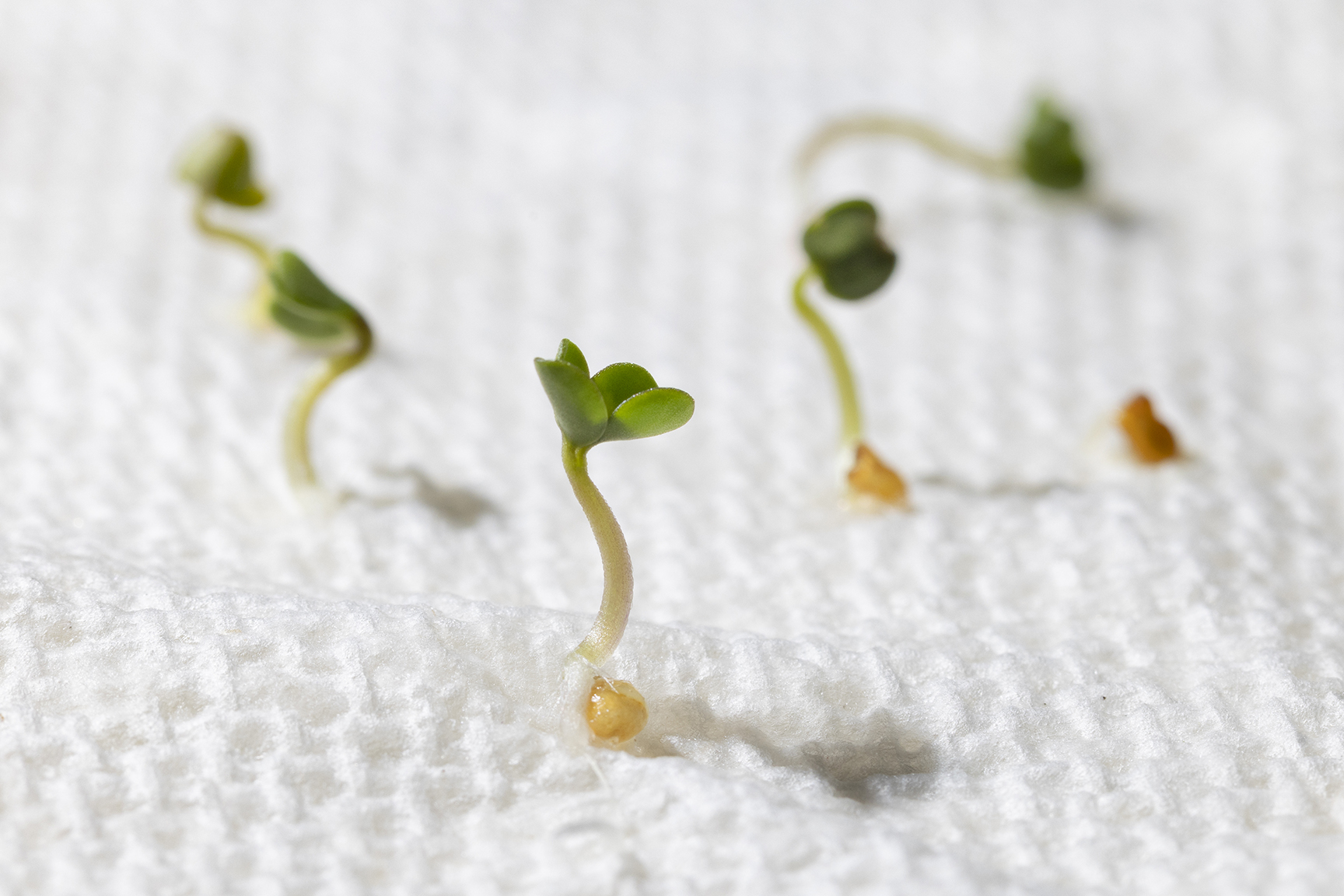
Now that we have two and a half more hours of sunlight and the garden catalogues are pouring in, I declare the garden season…open! Where to start? With seeds! Although everyone recommends March as the time to start seeds indoors, I had to get into the dirt. I just transplanted my late January tomato starts into their own pots; we’ll see if they grow straight and strong for planting in May.
If you’re not ready to start seeds, how about testing the viability of your seed stash older than three years? Drop 10 seeds onto wet paper towels and gently fold them into a plastic baggy (you want damp, not soaked). My gold winner is arugula with 10 of 10 seeds sprouted. The silver medal goes to spinach and Merlot lettuce. I’ve rewarded them with their own pots of soil.

Check out a tasting experience unlike any other – featuring nine Milwaukee chefs from the best restaurants in the city.
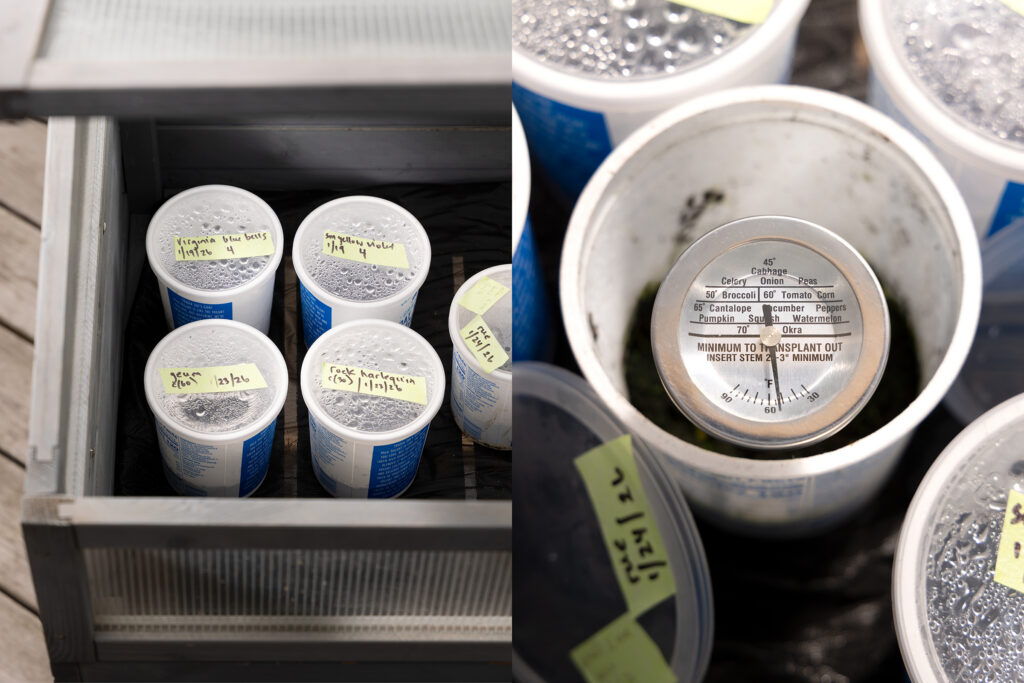 Native seeds in a cold frame; soil thermometer at 53 degrees. Photo by Kevin J. Miyazaki
I am also “cold stratifying” native plant seeds. Cold stratification means imitating the conditions that seeds would experience if left outside. Typically, this means making room in the fridge by shoving aside eggs and jars of food. But beware: seeds have different cold stratification needs and timelines. Should they go into the fridge dry or on wet paper towels? When can they be moved outside, when planted? One of my seeds needs cold-hot-then-cold again – yikes, isn’t it easier to toss seeds outside and let Nature take her course?
My fridge cold stratification wasn’t successful last year so I am activating the homemade cold frame my partner Kevin bought last summer. Cold frames are small “greenhouses” that use the sun’s heat to jump start the season. Inside my cleaned and stabilized cold frame, I have sown spring ephemerals Virginia bluebells and smooth yellow violets along with rock harlequin and rue (others will join them in March). On a recent 45-degree day the soil temp in the cold frame was 55 – hmmm, time to consider cool crops outside? Just kidding – it’s only March, let’s not get cocky. There will be more snow.
My cold frame holds 20 containers, but given how many seeds I have, it’s clear my gardener’s eyes are bigger than my cold frame! No matter – I am living my motto of “Always Be Planting”.
While I dream of my little black dots of life waking up, I want to follow up on last month’s discussion about dirt (pardon me, soil) with a related topic: grass. As you may know from my last January and February columns, I have strong opinions about how we steward the land. Grass is a great landing pad and bathroom for kids and pets, but it doesn’t have much ecological function.
America’s obsession with grass can be traced to Thomas Jefferson’s time as Ambassador to France. Jefferson brought the labor-intensive green carpet back, part of America’s scraping the soil of nutrients, plants, animals and peoples. Grass is political in a different way today. It is inert and sucks down water, chemicals and your precious time. Its short roots don’t slurp and store water in the ground and requires chemicals which spill into our waterways. No creatures use it for food or shelter. Grass is a moat to protect us from our neighbors – another reason we have a crisis of social isolation? Wildflowers, on the other hand, support 100 times more wildlife and use 75% less water. By removing your grass – even half of it! – you will restore our glorious native tapestry.
Think I am on the fringe of the “great grass debate”? If even the New York Times say the era of grass is over, it must be.
Never fear, there is support as you consider removing your lawn. Try the “Less Lawn, More Life” challenge from Plan It Wild to be part of a rational, national movement. I just discovered Earth X Media’s “Kill Your Lawn” series with two goofy buddies who travel across the country to carry out a “turficidal killing spree.” These are just two examples of how Americans are transitioning to vital, vibrant properties.
But wait, don’t leave the soil bare and exposed to compaction and erosion! Put in a giant schmear of native plants (splurge at a native nursery, list below under Buying Plants and Sustainable Garden Information) and start rebuilding your soil and our natural world.
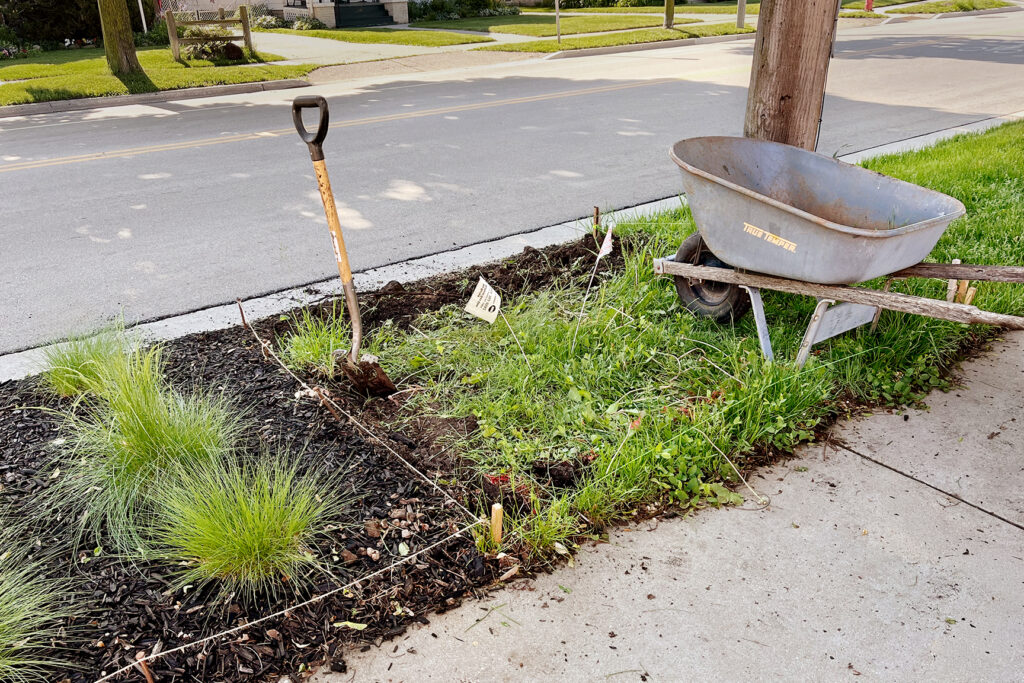 Pulling out the second half of the park strip, with Digger’s Hotline flags permission visible. Photo by Marilu Knode.
Taking grass out sounds daunting, but if I can do it, you can too.
First you must call Digger’s Hotline for the “all clear” to avoid rupturing sewage, gas or other infrastructure lines (no-one needs their street to go kablooie).
In my first call to Digger’s Hotline (the grass came out in two phases), I gave the nice woman my address. She asked me a few questions, including: was I going to use dynamite?
I said I didn’t know that was an option! I had a good laugh. She must have been thinking Wauwatosa is a rural town.
Digger’s Hotline checked the infrastructure and left flags to okay grass removal. I planted my low-growing prairie dropseed into lines as “cues to care” for neighbors skeptical of the bold move. The plants are charming and well-behaved and thus don’t lower anyone’s property value, which is often cited as the biggest obstacle to native plants. I don’t have to mow my park strip; the prairie dropseed survives the street schmutz and snow piles; and their brown wands wave the birds over to feed. Everybody wins.
44 million acres of turf are under homeowner control. If we could reduce that number by even half, imagine how much more alive our landscapes could be! Think about it: removing your grass gives you a chance to customize your home outside too. Here’s the truth: If we don’t have native pollinators, birds and other native creatures that can only live on native plants and in native habitats, it means we won’t have food either. If you’re like me, once you learn this, you will start expanding your garden’s support for the whole community. This is why gardeners are the best: they make change one shovelful of soil at a time.
I left the best for last: the start of spring is March 20 – time to dream about planting but also about the good that you will do for our community.
A Few Gardening Resources
Events
1. Tosa Wildlife Habitat Spring Kick-off Event, Wauwatosa Library Firefly Room
March 7, 1:00 p.m to 4:30 p.m., free to all, with hand-outs, stickers and giveaways | 7635 W North Ave, Wauwatosa
Guest speakers include a welcome by Tosa Mayor Dennis McBride, whose garden is a certified Wildlife Habitat yard; landscape designers Danielle Bell and Marian French of Native Roots, a landscape design and installation firm; and Coe Douglas. I confess my self-interest here: this is my volunteer group that is trying to get Wauwatosa to be the first city in Milwaukee County to be a certified Wildlife Habitat city. We only need 91 more points out of 250 to cross the finish line.
Here’s a challenge: with all the great organizations and gardeners in town, shouldn’t Milwaukee be working towards certification? Gauntlet thrown!
2. Elizabeth Adelman in conversation with Martha Bergland, Boswell Books
March 13, 6:30 p.m. | 2559 Downer Ave., Milwaukee
Elizabeth Adelman will talk about her book Chasing Lewis’s Monkeyflower: The Amazing Afterlife of the Lewis and Clark Expedition’s Wild Plants.
3. “Neonicotinoids and Their Effect on Our World” by Dr. James Crall, Elm Grove Library, O’Neill Room
March 18, 6:30 pm | 13600 Juneau Blvd.
4. Family Veggie Gardening Workshop, Urban Ecology Center, Riverside Park
March 28, 1:00-2:30 pm | 1500 E. Park Place
Learn how to grow veggies with your family at the Urban Ecology Center’s class!
Buying Plants
The Wisconsin Department of Natural Resources has planting basics for different creatures; lists of native plant nurseries and the plant sales listings I have relying on for myself – with the Milwaukee-area sales added below for a quick-draw order frenzy.
Friends of Wehr Nature Center’s Native Plant Sale fundraiser: Order form is available, plant pick-up will be May 30-31, 10:00 am – 3:30 pm. Wehr Nature Center, 9701 W College Ave, Franklin
Milwaukee Metropolitan Sewerage District 2026 Rain Garden Plant Sale: Online ordering runs to April 2 or until limited supplies run out, whichever comes first. 260 W. Seeboth Street, Milwaukee
Friends of Horicon Marsh Wildflowers for Wildlife Native Plant Sale: Pre-order to March 31, plant pick-up May 17, 9:30 am-1:30 pm. Horicon Marsh Education and Visitor Center, N7725 Hwy 28, Horicon
Urban Ecology Center Native Plant Sale: May 23, 9:00 am – 1:00 pm. Advance registration not required. Riverside Park, 1500 E. Park Place, Milwaukee
Friends of the Monarch Trail Native Plant Sale: Pre-order online begins March 1, or go in person May 9 & 10. Pick-up May 9, 11:00 am – 4:00 pm; May 10, 11:00 am – 2:00 pm. Greenfield Park Pavilion, 2028 S 124th St, West Allis
I just found some new nurseries to diversify my support for farmers:
Education
For more information on how to make your own cold frame, try Mother Earth News (with free plans).
Schlitz Audubon’s Barred Owl Nest Box cam starts up again in March. Keep an eye out for these glorious creatures in your neighborhood.
I am slowly getting more addicted to watching the birds in my back yard. (Is bird watching far behind?) WUWM’s Xcaret Nuñez hosts Chirp Chat. Listen to episodes and sign up for the app.
Want to support biodiversity and your local ecosystem? Check out Sarah F. Jayne’s Nature’s Action Guide.
See Vitamin Nature’s most important ambassadors strutting their fuzzy stuff in The Extraordinary Caterpillar from The Caterpillar Lab.
I attended a garden session for Seedtime where they shared their Gantt chart seed planting software to help us quadruple yields by managing three seasons of crops. I will play around with a free account to see if my rudimentary tech skills make this a better solution than graph paper and lists – who knows, I may double my tomato take this year.
Love free online garden books? Try Indigenous Landscapes, particularly Native Meadowscaping: Designing, Installing & Maintaining Native Meadows with plans application to us in the Midwest. They also sell native seed mixes.
If you are interested in densifying and diversifying your food and flower beds, try the Gardenary website. I just listened to a talk by founder Nicole Burke, and despite her being in Texas—a climactic zone very different than ours—she has some great and pretty lessons for us all.
Check out Prairie Up’s website for inexpensive Pocket Guides to Green Mulch, Principles of Natural Garden Design, Garden Design Planners, or sign up for their newsletter so you don’t miss classes or webinars.
Do you, like me, miss your garden community? Hold a winer seed sowing party! You can share your bounty by following instructions from Homegrown National Park.
A recent Wild Ones newsletter reprinted seed sowing guidelines with a free download for kids to understand how seeds work and what creatures (including humans!) help them propagate.
Sustainable Garden Information
Comments are closed.