
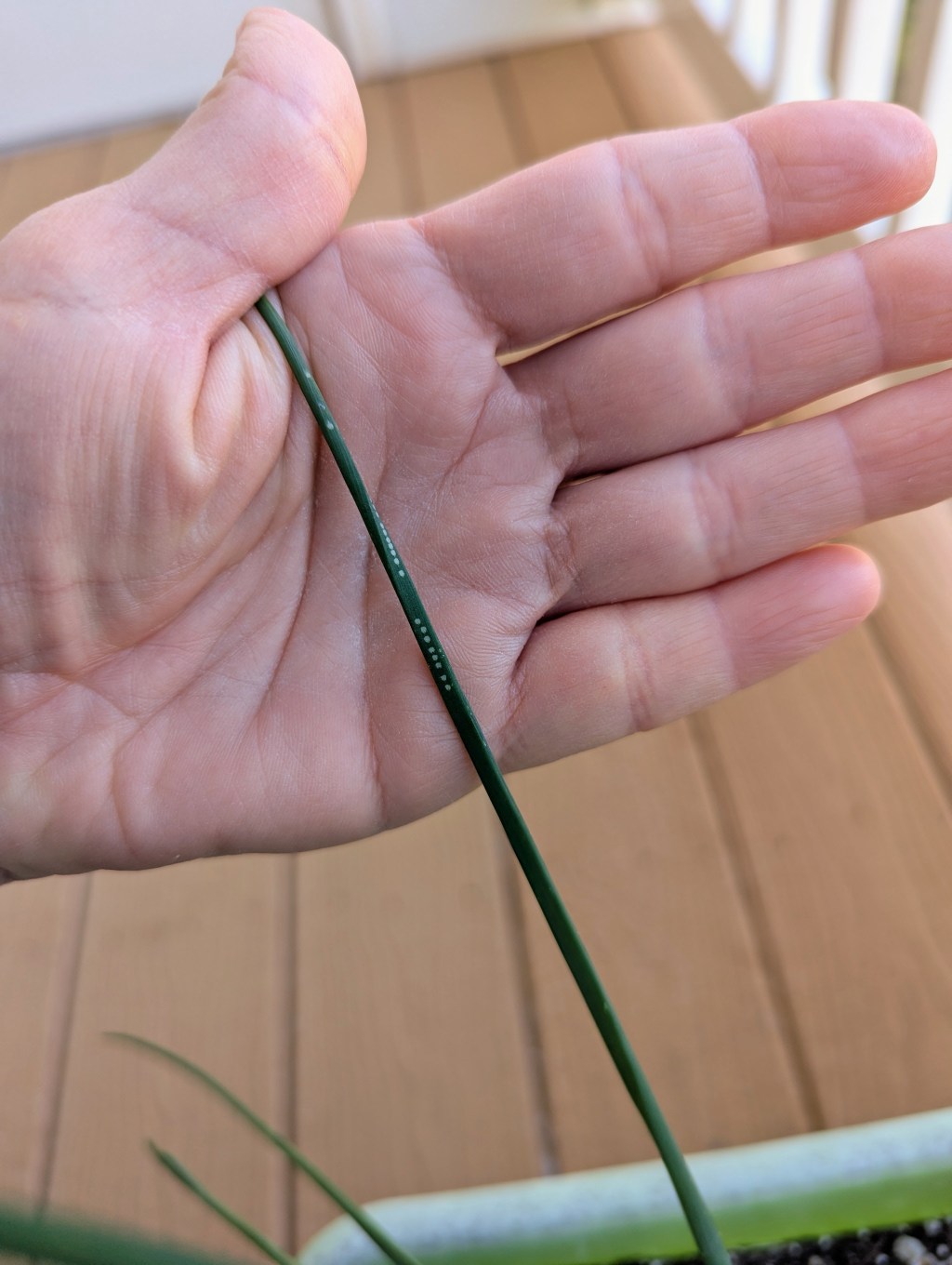
Last year, something damaged my chives and garlic, starting with odd rows of white dots on the leaves. The garlic damage was extensive enough later in the season that I couldn’t use the whole crop, though the chives seemed less impacted. How do I keep it from happening again this year?
Rows of pale dots on the leaves of chives and their Allium relatives (onions, leeks, garlic, shallots, and scallions) indicate that you’re dealing with Allium Leafminer (ALM). This pest fly originated in Europe and was first recorded in our region in 2015.
The best prevention approach is exclusion: covering vulnerable crops as soon as they are planted with a mesh net that blocks insect access. With two ALM generations per year, plant protections need to be maintained for two long periods: March-April and September-October.
Adult female ALM inserts eggs into leaf tissue, scarring the leaf with pale rows of dots. Upon hatching, the larvae bore into the foliage – eating a “mine” into the leaf tissue – before moving down the stem into the bulb, feeding as they go. Feeding on the bulbs by older larvae is the more damaging aspect of ALM behavior, at least among the bulb-forming Alliums.
It may seem early, but late February to early March is the time to get overwintered Allium crops protected in central MD. Row cover or fine insect mesh/netting should effectively exclude the adults. Since the first generation of adult flies emerges in March/April, having a crop covering already in place should prevent egg-laying and the resulting damage to your plants later in spring.
These spring adults arise from pupae that overwintered in plant debris or in soil. Use caution if you’re covering a bed that you know had problems with ALM last autumn: you don’t want to trap the pest inside with a host plant buffet and protection from predators. In that case, try to knock the population down by lightly cultivating the soil a couple inches deep around the plants. This buries pupae so they won’t hatch, or exposes them to predators and harsh weather. If ALM remains a problem despite these measures, try to rotate to another crop after the harvest so this pest doesn’t have a steady food supply.
Once the first spring generation pupates, the pupae wait out the summer heat, maturing into adults that emerge in early autumn. Since each of the two adult generations per year can be flying for a window of time almost two months long, keep those plant covers in place as a first line of defense against infestation. As a last resort, you can try an insecticide: visit our Leafminers on Vegetables page for more life cycle details and a couple of organic pesticide options and their timing of use.
Will all the salt applied to roads and sidewalks this winter damage plants? Can I treat the soil with something to remove salt?
Different plant species have different tolerances to soil salt levels and leaf exposures to salt spray, but overall – yes, too much salt can damage plants, and it will also leach into runoff that contaminates streams and the Chesapeake Bay. Aquatic plants, invertebrates, fish, amphibians, and other wildlife are harmed by water quality degradation from road salt treatments, which have further impacts on the local ecosystem (and human health, when our water supply gets saltier).
Salt damage symptoms in terrestrial plants include poor or stunted growth in spring, dieback of new growth on evergreens, and leaf scorch or browning along the leaf edges in
deciduous trees and shrubs. If you suspect salt damage, you can have your soil analyzed by a soil testing laboratory.
Ice-melting salts do tend to leach out of the soil over time. (They might alter soil pH in the meantime, however.) It’s hard to predict how long it will take for conditions to return to baseline on their own, because leaching rates may vary with weather and soil type. (Sand will leach faster than clay.) How long leaching takes to remove excess salt also depends on how salt-laden the soil became to begin with. Keep in mind that, in this situation, “salts” also refers to mineral residues that remain in the soil from over-applied or unused fertilizer, such as from lawn runoff.
Manually soaking an affected area with one-inch applications of water three to four times during the spring can reduce the risk of plant injury if damage hasn’t already taken place. Although adding gypsum to the soil might reduce high sodium levels, it won’t necessarily bind and pull enough sodium out of the root zone to be worth the effort and expense in most cases. Otherwise, rainwater should eventually leach the excess below the root zone (once we get out of the ongoing drought, anyway). Any salt removal success with gypsum or natural leaching doesn’t solve the problem of aquifer or surface water salt contamination, but it at least improves conditions for your plants.
You’ll need to wait until spring to see if plants exposed to salt spray or contaminated runoff will survive, since a deciduous plant might not develop any obvious symptoms while dormant. Branches may die back or buds may be killed, either due to direct above-ground salt exposure or as a result of dying roots. Affected evergreen foliage may turn dry and brown due to “salt burn,” especially for hedges planted close to a road or walkway. Prune off any branch tips that remain bare after the rest of the shrub has fully leafed out. You can also remove evergreen branches that discolor while the rest of the plant looks normal, as that usually indicates branch death.
University of Maryland Extension’s Home and Garden Information Center offers free gardening and pest information at extension.umd.edu/hgic. Click “Ask Extension” to send questions and photos.
Comments are closed.