

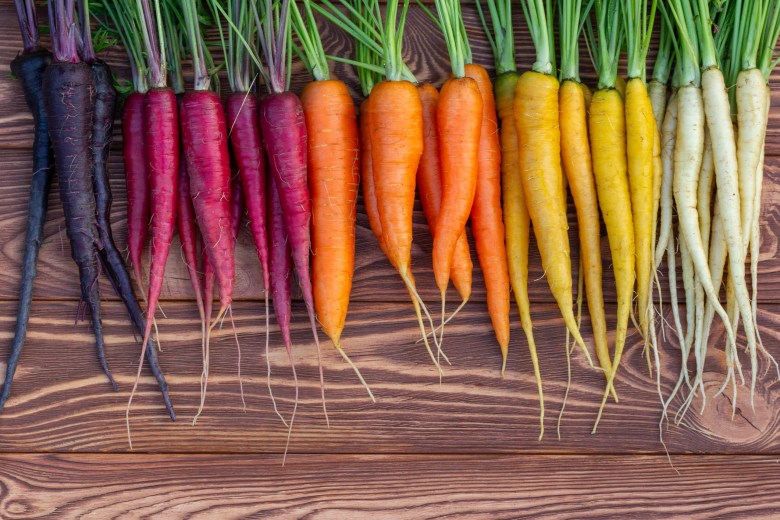
 Colorful carrots are shown lined up on a table . Courtesy Getty Images.
Do you have a gardening question? The UC Master Gardeners of Santa Clara County can help. Our volunteers are part of the University of California’s Cooperative Extension program, and we are trained to use research-based information to educate our fellow residents on home horticulture, pest management, and sustainable landscape practices specific to our area.
Our monthly “Ask a Master Gardener” column will answer your questions and offer tips. Have a question? Email lifestyle@embarcaderopublishing.com
March gardening tips
Now is a good time to plant carrots
Carrots thrive in cool weather and can be planted before the final frost of spring. Early spring planting leads to sweeter, crisper harvests.
If you have a light, fluffy soil, perhaps in a raised bed, you can grow those long beautiful carrots you see in the grocery store. Most of us on the Peninsula, however, have heavy clay soil, so it is best to grow the shorter varieties if you plant them in the ground.
Adding organic material, such as compost rather than manure, is beneficial. The seeds are very tiny, and mixing them with sand will help you avoid over-seeding. Plant no more than 1/2 inch deep. Carrots are slow to germinate and can take up to three weeks. Keep the soil moist until they emerge. Thin the carrots so they are 2 to 3 inches apart. Plant every few weeks for a continuous crop.
UPCOMING GARDENING EVENTS
UC Master Gardener gardening events are taking place throughout the county this month. Here are some of them, with more listed on our events page.
If you have limited space, try growing them among your ornamentals; their feathery tops can look quite pretty. They can also be grown in containers. Some common problems are twisted roots from planting too close together, forked or deformed roots from clods and rocks in the soil, hairy root from too much nitrogen and splitting from too much water.
More information: How to Grow Beautiful Carrots
Preparing for summer planting: Should you turn the soil?
It’s tempting to grab a shovel and turn over all the soil in your garden as you prepare for summer planting. But should you? Increasingly, science is saying “no.”
Every time you dig into the soil, you’re disturbing a very intricate, living web of organisms, bacteria and fungi that your plants need to thrive. In contrast, a “no-till” approach minimizes soil disturbance and keeps organic material like leaves, compost and coarsely chopped plants on the ground’s surface to slowly decompose.
Have a sick plant? Need expert advice? The UC Master Gardeners’ plant clinic is back live and online
The UC Master Gardeners’ monthly Plant Clinic Online starts up again on Tuesday, March 10. The Plant Clinic Online lets home gardeners chat with Master Gardeners via Zoom to diagnose plant problems. Participants can listen and learn while people ask questions. Sessions take place on the second Tuesday of the month, March–October, from 7 to 8:30 pm. Everyone is welcome. Register for Plant Clinic Online via Zoom.
By keeping it moist and protected from the beating sun and pounding rain, this organic material allows the soil to stay crumbly and ideal for planting.
More information: No-Till for Home Gardeners
Spring is almost here — should you prune frost damage now?
When there is still a danger of frost, we recommend leaving frost damage on plants so it provides protection to undamaged parts. Once the cold winter weather is behind us, it’s time to prune frost-damaged plants. Pruning it off too early would stimulate tender growth that is susceptible to frost. Although the typical last frost date will vary depending on your location within the county and its microclimate, it’s time to start the spring cleanup soon.
More information: Treating Cold-damaged Plants
Thyme: A versatile herb for your garden and kitchen
Thyme is much more than an herb to season food. In ancient times, it was brewed by Egyptians for mummification, bathed in by Greek soldiers for courage in battle, and used by the Sumerians as an antiseptic and antifungal. And if you want a real surprise, check out the active ingredient list on a bottle of Listerine mouthwash.
In your own garden, it can be used for culinary purposes or as a purely ornamental landscape feature. It grows best in well-drained soil and sunshine, although it will tolerate some shade. It is quite drought tolerant once established. Common/garden thyme (Thymus vulgaris) is an excellent all-purpose thyme, growing to a foot tall and up to 2 feet wide. Lemon thyme (Thymus citriodorus), with its lemon scent, makes a nice evergreen border.
Creeping thyme (Thymus serpyllum) stays short and can be used as a ground cover or between stepping stones. Thyme is attractive to butterflies and bees.
More Information: Growing and Using Thyme
Would you like to ask a UC Master Gardener about a plant problem? Submit questions to our Help Desk online.
You can also subscribe to our monthly Tips and Events newsletter. San Mateo residents can also find gardening advice on the UC Master Gardeners of San Mateo and San Francisco website.Follow us on Facebook, Instagramand TikTok
Most Popular
Comments are closed.