
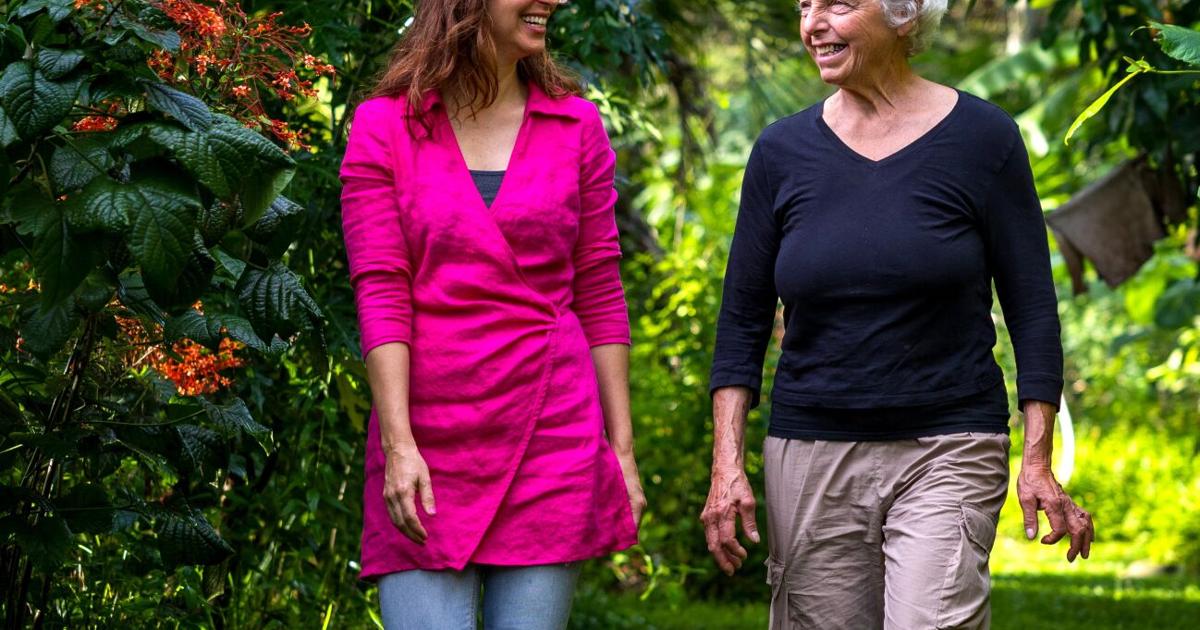
WATERTOWN — For nearly a decade, Dani F. Baker has been growing, sharing and advising others about the “edible forest” method of gardening.
Four years ago, her award-winning book, “The Home-Scale Forest Garden: How to Plan, Plant, and Tend a Resilient Edible Landscape,” was released; published by Chelsea Green Publishing, the leading publisher of books about organic farming and gardening. The roots of the book developed after a senior editor at Chelsea Green Publishing saw Baker speak on the topic at a sustainable farming conference in 2020 in Pennsylvania.
“She spoke with confidence, keeping the attention of the audience, which filled the room and even the doorway, and asked her lots of questions,” Chelsea Green’s Fern Marshall Bradley told the Watertown Daily Times on the eve of the publication of Baker’s book. “That level of audience response is a signal that the topic is something people want to know about, and that’s an important consideration in looking for authors, too.”
But even then, Baker was interested in expanding the scope of spreading the word about edible forest gardens.
“I wrote into the contract for the book that my publisher would not have control over any future video project,” Baker said last week from her home on Wellesley Island, where she and partner David Belding tend Cross Island Farm and Enchanted Edible Forest.
Also helping an idea to take root was a visitor to her farm/forest during the summer of her book’s release. “I had a volunteer here who had some marketing background,” Baker said. “She helped me put together a pitch for a TV show.”
At 7:30 p.m. Monday March 9, Baker’s audience for spreading the word about forest gardens will branch out further when Watertown-based WPBS launches the eight-episode, “The Home-Scale Forest Garden Show: How to Plan, Plant and Tend a resilient Edible Landscape for Any Size Plot.”
The series of half-hour episodes inspires viewers to create their own “beautiful, bountiful and edible” landscape at any scale as Baker shares seasonal tasks, plant selection, ways to attract beneficial creatures along with gardening tips and tricks.

A tree sparrow feeds her chick at Dani Baker’s Enchanted Edible Forest on Wellesley Island. Courtesy of Dani Baker
A summer scene at Dani Baker’s edible forest on Wellesley Island. Provided photo
On the same page at WPBS
An edible forest garden has seven permaculture layers: overstory, understory, shrub, herbaceous, ground cover, roots and vines.
“The whole idea is modeling planting after nature, where all the needs of the plants are incorporated into the design,” Baker explained. For example, one key to the concept is nitrogen-fixing plants and others that invite beneficial insects.
The concept, and much more, is explained in Baker’s book, which she dropped at the WPBS studio a couple of years ago, addressed to Mark Prasuhn, president and general manager of the public television station affiliated with PBS and serving Northern New York and Eastern Ontario, Canada.
“I was quite taken with it right away,” Prasuhn said. “We were on the same page right from the start about this being a great opportunity to create a television series.”
A gardening show is not new to WPBS. But it has been nearly 25 years since it has produced one, as Prasuhn recalled the popular “From a Country Garden” and “The Gardener With Ed Lawrence” shows.
Prasuhn, who began his job at WPBS seven years ago, said local viewers have occasionally brought up those shows to him in conversation. He also has experience with gardening shows from previous jobs.
“I’m pretty exposed to it in my home life also,” Prasuhn said. “My wife is a super-avid gardener. It’s always been an interest. So, when Dani told me what she was doing, showed me the book, and essentially the system and approach she developed, I was struck by it. There’s nothing quite like this out there on television and I thought this would be a great opportunity for us to create a program that would be made here but also travel across the country.”
The series is being delivered to top syndicating organizations that make shows like “The Home-Scale Forest Garden Show” available to PBS stations across the country.
“We’re just delivering everything to them now,” Prasuhn said. “They will make it available to stations, probably starting in April. We expect it to be on the air in different parts of the country in May, June and from then on.”
Care was taken to make “The Home-Scale Forest Garden Show” attractive to an audience around the country, Pasuhn said.
“We don’t want people in the south, or out west, say, ‘That’s interesting, but Northern New York has nothing to do with us. It has totally different climate.’”
To help counter that, Prasuhn said that Baker found a “compatriot” in Florida: Amanda Pike of Pike Food Forest in Jupiter. Pike wrote the book, “Transforming Florida Yards: A Regional Food Service Guide.”
“We had the crew go down there for a few days with Dani for filming,” Prasuhn said. “It shows the universality of the technique; that even in different climates and settings, you can take the same approach that Dani has got of doing it on whatever scale, big or small, to make a go of it.“
Most of the show was shot in Baker’s garden, but some segments were filmed at WPBS studios. The co-host is Loraine O’Donnell, executive director of Constable Hall, Constableville.
“We learned that Loraine had some TV hosting background,” Prasuhn said. “It was nice to find someone nearby who could do that. In order to make it easier to follow for the audience, we built little bridges, or short segments in the studio where Loraine and Dani talk about the particular plant or technique. And then, we cut to Dani in the garden showing you on location.”
The Northern New York Community Foundation provided a $10,000 matching grant to WPBS in support of the project. “That got us started,” Baker said.
“One of the striking things about the show is the amount of information that director and producer Tracy Duflo and Dani have stuffed into each half hour,” Prasuhn said. “It’s super informative. There’s no shortage of material to consider for a second season.”
Local buzz is building for the show. Tug Hill Tomorrow Land Trust will host a Zoom watch party for the first episode on March 9. In a Facebook post, THTLT Interim Executive Director Heidi Sourwine wrote, “Dani is an inspiration to environmentalists across New York State and beyond. This is what following your passion looks like.”
Perennial favorites
The series was shot in Baker’s garden over a growing season. “We started in March once the snow was gone, and there were things blooming already, which we talked about and showed.”
All of the plants in the garden are perennials: plants that persist for several years.
“You do have to take care of it until it’s established,” Baker said of the plant variety. “You have to make sure that it has enough water, it’s well mulched, and to keep competing plants away while the roots are trying to establish themselves. There might be some maintenance. If it’s a berry bush, you might need to prune it in the spring.”
Baker has over 300 types of plants in her edible forest garden.
“You can incorporate traditional perennials like rhubarb and asparagus in a garden like this, and I have, but there are many others that I wasn’t even aware of until I started researching.”
Baker gave a few examples: Good King Henry, a low-maintenance spinach relative, and Turkish Rocket. In describing the latter, Baker said, “It’s like a perennial spicy mustard that comes up every year, and you can eat the flowers. Before the flowers open, it’s like a broccoli rabe and the leaves are edible.”
Baker said that creating a large-scale forest garden like hers is not the main goal of the series.
“You can do this at any scale,” she explained. “People can just do a foundation planting. They can replace their ornamental plants with edible plants on a side of a house. You can do an edible hedge to screen the view of a neighbor. You can just do a small bed in your backyard with maybe one fruit tree and a few berry bushes, some ground cover and maybe some perennial vegetables and edible flowers to cover the ground.”
Baker realizes that gardening can be time-consuming. “But just about anybody can start small and do a little planting. And then, once it’s established, people will be so reinforced by their success that they’ll want to do more.”
Building a farm dream
Baker is an accidental gardener/farmer. She is a former psychologist and a native of Westchester County who spent her formative summers in the foothills of the Adirondack Mountains. She and David didn’t initially plan to be farmers when they bought their 102-acre property, a former farmstead, near Wellesley Island State Park in 2005. But they became intrigued by the idea of making the land productive again. That year, they attended a local Cornell Cooperative Extension class, “Building Your Small Farm Dream.” She retired from her psychologist position at the New York State Department of Corrections and Community Supervision in 2007 to devote her time to Cross Island Farms.
They started their farm in 2006, and Dani started her forest garden about a decade ago. When not gardening, Baker works with the Northern New York Community Foundation on several philanthropic endeavors, supporting a wide range of local causes and organizations.
She believes that the forest gardening technique is having a moment.
“Many people are interested in growing their own food these days, so they know where it comes from,” she said. “If you have done annual vegetables, you know how much work is involved. Growing plants this way will allow you to perhaps cut back on the annual vegetables and harvest more perennials, which require less labor.”
The technique is also good for the environment, Baker noted. “You invite pollinators and beneficial insects that kill other bugs that you don’t want and invite a lot of birds that eat bugs and you invite all kinds of other creatures ‒ frogs, snakes, turtles ‒ to help take care of pest management.”
Baker said she has incorporated over 25 “nitrogen-fixing” plants into her garden as a sustainable way of enhancing soil fertility.
“Dandelions are an example. They pull up a lot of nutrients from the subsoil. When they die down in the fall, those nutrients are taken up by the soil, and they become available to the surrounding plants.”
Prasuhn is impressed by the way Baker covers such ground.
“The neat thing about Dani, beyond her knowledge base and zeal for the subject, is that she is astute on the business and marketing aspects of it.”
On April 16, Baker will speak at Colgate University, Hamilton, on “What is a Food Forest and What Can You Plant in It.“ ”I’m available to give talks to anyone who is interested.“ On Tuesday, she spoke at Clayton Rotary.
For Baker, there is lots to talk about.
“We had to cut so much material just to make these episodes. A garden like this is always evolving, so there’s always something new to see and to talk about.”
Comments are closed.