
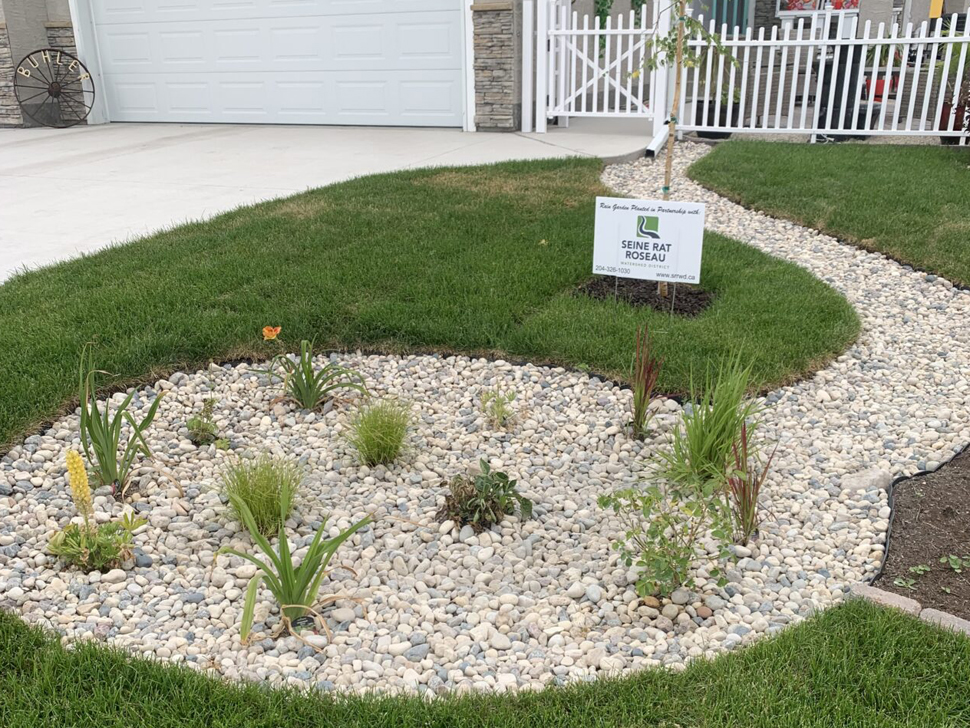
The City of Steinbach is encouraging residents to consider rain gardens as one way to help manage excess water following heavy rainfall, after a recent presentation from the Seine Rat Roseau Watershed District.
Office manager Joey Pankiw presented to city council about watershed initiatives and practical steps homeowners can take to improve drainage and reduce localized flooding concerns.
Mayor Earl Funk says the discussion offered practical solutions that residents can implement on their own properties.
“We really enjoyed having them over, listening to what they’re all doing, and the projects they are doing in our community and around us.”
Rain gardens offer practical solution for homeowners
One of the key ideas discussed was the creation of rain gardens, landscaped areas designed to absorb runoff water from rooftops, downspouts, and sump pumps.
Funk says the watershed district has seen strong results with the approach and even offers financial support to encourage participation.
“They offer $750 for the creation of a rain garden. And essentially what a rain garden is, it’s somewhat of an attractive hole [on your property] where you would have plantings in it where you could lead your downspouts or your sump pump pipe into it and it would absorb that water.”
Related Stories:
According to Funk, rain gardens do not require deep excavation.
“He was saying 6 to 12 inches is as deep as you have to go. It’s more about the root system and how that absorbs the water that gets put in there.”
Funk adds the gardens could help address some drainage issues.
“I think this is a win-win for Steinbach and for homeowners that have standing water on their yards after a rain event.”
Beyond their function, Funk notes rain gardens can also enhance residential landscapes.
“There’s a place to put that water into a rain garden and it’s attractive, and then you’ve got the plantings that are there for the entire year and you can enjoy as a very aesthetic area in your yard.”
Managing water coming from outside the city
The presentation also addressed broader watershed challenges, including runoff entering Steinbach from surrounding rural areas.
Funk says the city has limited power over water flowing in from neighbouring municipalities and agricultural land.
“We have no control over how much water is coming.”
One potential solution that was discussed involves temporarily holding water upstream during heavy rain events so drainage systems have time to catch up.
“They talked about projects could be done to retain water for a few hours.”
However, he noted those efforts depend heavily on cooperation from surrounding landowners.
“The challenge there is willing landowners that will hold water for a few hours after a rain event.”
Development increases runoff pressures
Funk says urban development increases runoff because buildings and paved surfaces prevent water from soaking naturally into the ground, placing added pressure on Steinbach’s drainage system during heavy rain events.
During intense rainfall, that runoff moves quickly through Steinbach’s drainage network, increasing pressure on infrastructure.
Related Stories:
“So during a heavy rain event it compounds the amount of water that we have to maintain and take care of in our community.”
Manning Canal maintenance part of long-term solution
Discussion also touched on the Manning Canal and the importance of long-term maintenance rather than short-term fixes.
Funk says clearing the canal alone will not solve drainage concerns without ongoing upkeep and cooperation from nearby landowners.
“Not just to take a Band-Aid approach and clean out the drain, but to actually also maintain the drain so that the restrictions of not farming only so close to the drain and all those things are also kept up.”
He adds both provincial action and continued maintenance are necessary to ensure the system functions effectively for years to come.
“Yes, the province needs to clean the drain but then yes, those things also need to be maintained.”
Shared responsibility for flood resilience
While municipal infrastructure improvements remain important, Funk says individual property owners also play a role in reducing flood risks.
“I think it’s one of the answers. It’s not the only one, but it’s one of those answers.”
He encourages residents to take steps on their own properties where possible.
Related Stories:
“I think it’s very important that we do what we can on our properties to flood proof ourselves.”
Funk says combining homeowner action, insurance coverage, and municipal projects can help the community better handle extreme rainfall events.
“At the end of the day, we can all do our part, and we can make ourselves so much more resilient when it comes to heavy duty rain events like that.”
Comments are closed.