
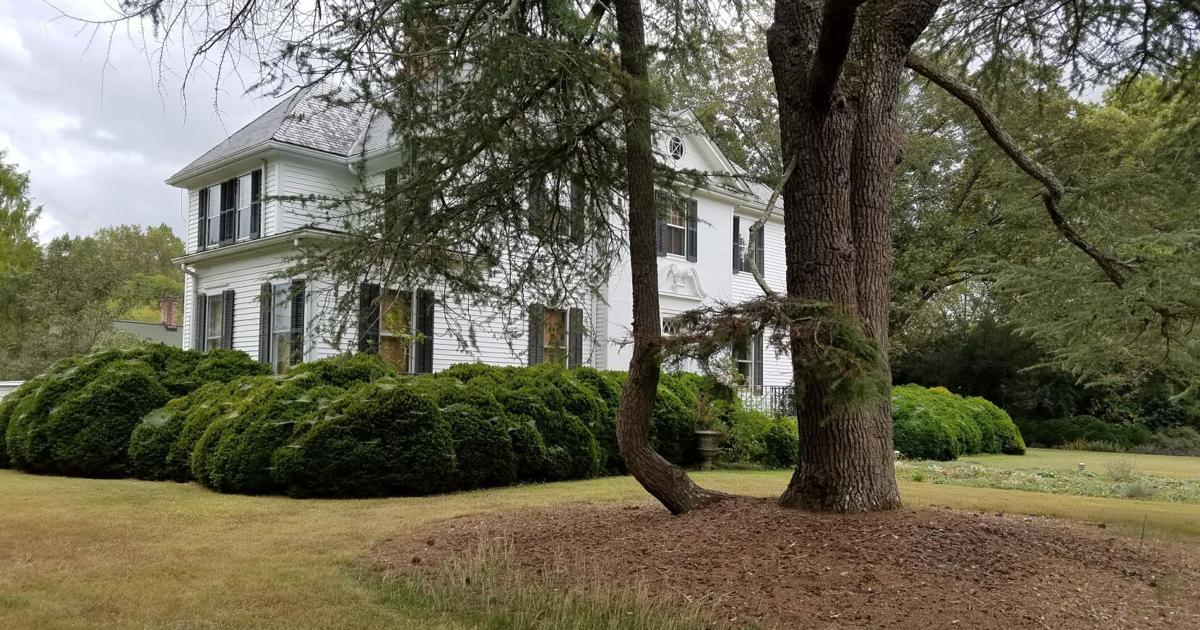
I hate to admit it, but I fell for the gardening clickbait. There is so much stuff about gardening on the Internet these days and it is usually junk, so I just tune it out. Yet, when Southern Living teases me with a headlike like “The Landscaping Trend We Hope Never Comes Back- And the Pros Agree”, I have to see what it is. Professionals are involved, right, so it has to be good?
Well, the one person who is quoted in the article has no professional citations in the article (turns out he is a landscape designer in Alabama), but I was inspired by the thought experiment of the article: overcrowded foundation plantings and overgrown shrub borders causing issues down the road.
The Problem: Landscapes with too many plants from the beginning
Whether you are in a new-build home or are wrestling with a landscape that is maturing, you know.
We have a historical problem in the green industry with planting too many plants to “fill space”. Somehow along the way the perception of a full landscape right after installation became the standard; yet any landscape designer, gardening book, local friendly Extension agent will tell you to plant with the mature size of a plant in mind. The downside of using this logic is the initial installation can look “empty”. The upside is it will save you time and money down the road.
Overplanted foundation plantings can cause algal growth on siding because of lack of airflow and scratching from branches brushing against the house, and even damage homes’ foundations when aggressive roots undermine the footings. These trees and shrubs can make it hard to service your home and can be a hassle during home renovation and maintenance projects. Overly-mature plants can also negatively impact the view out of your home.
Some trees and shrubs, evergreens especially, look cute in their small pots and may even purport to be “dwarf”. Many of these dwarf varieties can still get 10-20 feet tall and 10-20 feet wide; because when your usual mature size is 150-200 feet tall, 10-20 feet is dwarf!
Once these plants get “too big” for the space they are a lot of work to remove or prune. Some folks just give up, making the problem even worse and more expensive in the future. The overall look of your landscape will also be impacted if you do decide to act if you go from a “full” look to an “empty” one, making many regret their choice.
The Solution: Research and
give your plants time and space
This overplanting habit is a human problem that we can solve for ourselves, but it will take patience to unlearn our expectations of landscapes. Stop to ask yourself: “What are my expectations for my landscape? What functions does it need to fulfill? How much work do I want to do?”
There is a plant for every space (just check out the NCSU Plant Toolbox, which contains 4,678 plants, as of February 2026), you just need to spend a little time with a book or your phone to do a little more research. Make sure you fully understand the mature size of the plants you are choosing, or work with your designer or builder so they understand your expectations to leave space!
Only put plants where you want them to be and only put the amount you can reasonably care for. Remind yourself that plants are like puppies: they can be cute and cuddly in the beginning, but they eventually grow up and get bigger and they will need care throughout their lives! Plan with the end in mind!
The Truth: Gardening is never done (this includes ‘landscaping’)
Whether you consider yourself a gardener or not, your landscape is alive and will need care throughout the time you are responsible for it. Just like you would not neglect sweeping the floor or cleaning the windows of your home or space, you have to do seasonal and annual maintenance to your landscape or it will eventually look overgrown or drab (think the outdoor equivalent to dust bunnies in the corner!).
So, don’t set yourself up for more work by overplanting trees and shrubs when you are planting or renovating your landscape! You can make informed decisions about it from the beginning that help you balance your expectations of how it looks with how much time you have to maintain it.
For NCCE-Lee County website
Resources
Spafford, A., M. Wallace, C. Lauderdale, L.K. Bradley, and K.A. Moore. 2022. Landscape Design, Chapter 19. In: K.A. Moore, and L.K. Bradley (eds). North Carolina Extension Gardener Handbook, 2nd ed. NC State Extension, Raleigh, NC. <http://content.ces.ncsu.edu/19-landscape-design>
Amanda Bratcher is the horticulture agent with N.C. Cooperative Extension- Lee County Center. You can reach out to the office at 919-775-5624 for more information or questions regarding this article, but also any other questions about your garden, farm, land or plants! We’re here to help! You can check out our website’s events page (for print: https://lee.ces.ncsu.edu/events/) for more information and to register for upcoming programs.
Comments are closed.