


Yew Dell Botanical Gardens $5M castle improvement project
Kentucky’s tiniest castle gets a $5 million royal facelift at Yew Dell Botanical Gardens. Take a peek.
Witchhazels are fragrant, easy-to-grow shrubs that bloom from fall through winter.Native to North America and Asia, they thrive in full sun despite being shade-tolerant.Many popular varieties are grafted, requiring the removal of suckers from the rootstock.Witchhazels are not more popular because they bloom when few people visit garden centers.
It’s the middle of February. I just returned from 10 days of sun and palm trees to the gray of winter in the Ohio River Valley.
Re-entry can be tough.
But this morning on my walk from the car to my office, my brain completely occupied with the tasks of the coming day, I was stopped dead in my tracks. At first I didn’t know exactly why I stopped. It was a bit like when someone shakes you awake in the middle of the night. It took me a minute but the fog finally cleared. It was fragrance that roused me out of auto-pilot. A quick glance around solved the mystery: witchhazel.
I have written about witchhazels many times. Creating greater appreciation and demand for this sublime group of garden plants is what I refer to as one of my self-assigned bits of quixotic horticulture.
Witchhazels belong to a rather small and unique group of plants in the genus Hamamelis. There are witchhazel species native to much of the eastern half of North America and much of Asia as well. They are generally large shrubs that are widely adaptable and easy to grow. They are best known for their unique flowers that flower according to a rather different drummer.
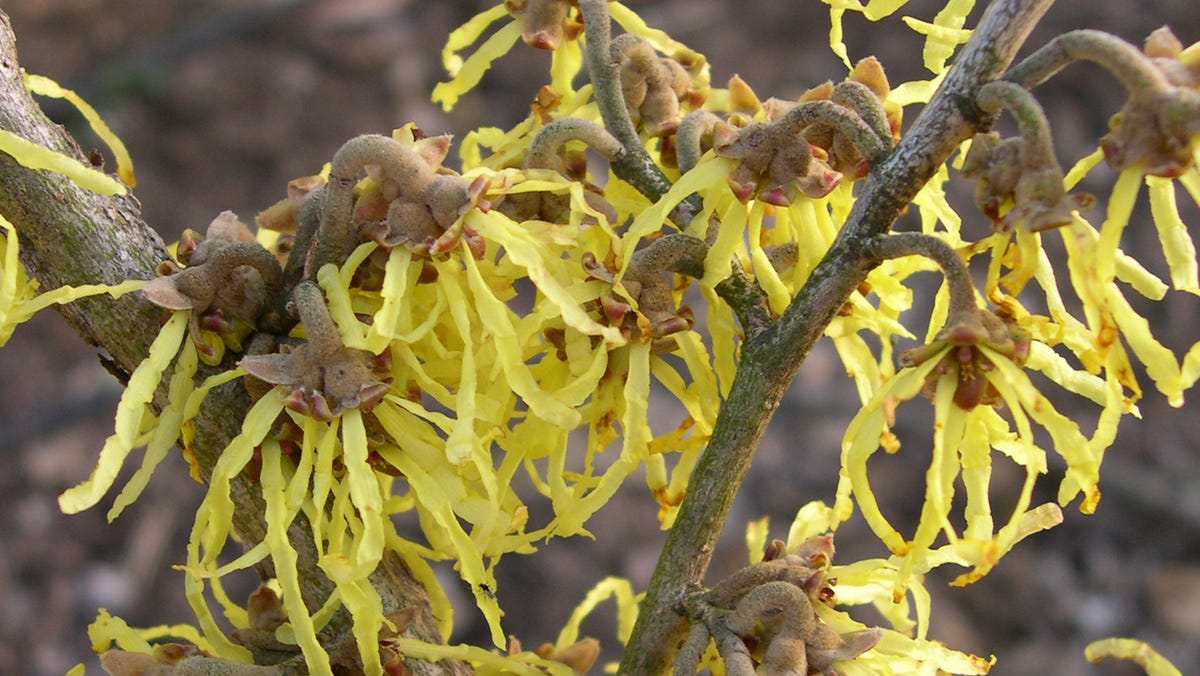
Witchhazel flowers are about an inch across, with thread-like petals. Some are bright and showy while others are more subtle in coloration. All are fragrant. But it is their flowering time that makes them stand out. Depending on which species you are looking at, they can bloom from the middle of fall, straight through winter. Most witchhazel flowing is fading away just as the rest of the garden begins waking up for spring’s main event.
In North America there are two primary witchhazel species. The Common Witchhazel (Hamamelis virginiana) blooms at the height of fall, bearing clear yellow blooms with a lightly sweet and somewhat astringent fragrance. Its cousin, the Vernal Witchhazel (H. vernalis), is a somewhat less showy, winter bloomer. Its flower color typically ranges from a gray/bronze to a deep orangy red or amber color and its flower petals are about half the length of its fall-blooming cousin. But fragrance is where Vernal Witchhazel excels.
Taking advantage of any hint of a mid-winter warm-up, Vernal Witchhazel will pop out massive flower crops — a single mature plant providing enough fragrance to fill several residential yards. And they provide nourishment for a surprisingly large contingent of early foraging bees. A single cut stem brought inside and forced into bloom is enough tonic to get just about any gardener through the depths of whatever winter can throw your way.
And as is so often the case, our North American witchhazel species have a handful of Asian counterparts, as well. The Chinese Witchhazel (H. mollis) and Japanese Witchhazel (H. japonica) are winter bloomers that combine winter flowering with a wide range of diverse colors (yellow, orange, red) and typically wonderful fragrance. Most commercially available, named witchhazel cultivars are hybrids of all three winter blooming species sold under the botanical label, Hamamelis x intermedia. Their colors are stunning, especially contrasted with all the gray of the winter landscape.
Here’s a few things about gardening with witchhazels:
How to grow and care for witchhazel
All members of this garden clan are often listed in garden references as shade plants. And while they can certainly grow in a moderate amount of shade, they are much happier and are definitely much showier in flower and fall foliage when grown in full sun.
What many books and websites get wrong is the difference between shade tolerant and shade requiring. We all know of plants that get cranky if they see a single photon of direct sunlight. Witchhazels are not in that category. In shade they develop a rather open (some would say, straggly!) architecture as they exploit a few brighter spots in the understory. But in full sun, they are much more vigorous, set more flower buds and produce more brightly colored fall foliage.
Witchhazels are tolerant of a fairly wide range of soils. As long as you avoid swamps and deserts and a soil pH that would dissolve a shovel blade, they usually thrive with very little attention.
How to prune witchhazel
There is one major issue to watch on witchhazels in the garden. Many of the best and showiest varieties are grafted onto a wild rootstock. This ensures that if you buy an ‘Orange Peel’ variety witchhazel, you’ll get the exact, bright orange and tremendously fragrant flowers you want in your garden. The problem is that the rootstock can send up suckers from the roots below the graft union. If you don’t keep those suckers pruned out, they’ll eventually take over your whole plant, leaving you with, who knows what.
Bit it certainly won’t be ‘Orange Peel.’
Can you propagate witchhazel?
So, why not simply propagate witchhazels from seed or rooted stem cutting rather than risk problems with grafting? The answer is simple. Seed-grown witchhazels, while they will most likely grow into perfectly nice witchhazel plants, won’t necessarily look just like the parent that produced the seed. Seedling variation, the stuff that makes natural selection and evolution possible, is anything but predictable.
And as for propagation by stem cuttings, I can show you a line up of research and nursery industry colleagues who have run themselves into ragged abandon trying to get rooted cuttings to survive. They root just fine but rarely make it through their first winter alive. A gentle reminder that when it comes to gardens, any notion that we’re in control is a pretty good illusion.
Finally, if these witchhazel things are the greatest garden bits since sliced bread, why aren’t they more popular? The simplest answer is, they’re their own worst enemies. There aren’t many of us in garden centers in the middle of winter when most witchhazels are doing their flowering thing. By the time Mother’s Day rolls around and the garden center check-out line is out the door, witchhazels look like so many big green blobs in pots. Nobody ever said life as a garden plant is fair.
It was about a 6-foot-tall specimen of Vernal Witchhazel that woke me out of my auto-pilot stupor a few days ago. It reminded me of my self-appointed task. And if this column doesn’t do the trick, I might just try to convince my friend Sancho Panza to stand on the side of the road with one of those twirly signs …
Paul Cappiello is the executive director at Yew Dell Botanical Gardens, 6220 Old Lagrange Road, yewdellgardens.org.
Comments are closed.