
In our austere tan, white, black, and gray landscape, if we could see what is happening under the snowpack, it would make us happy. Early spring growth — the skunk cabbage, croci, snowdrops, narcissi — is pushing up and budding.
While it is warm and insulated down there at ground level, above ground, the colors of the twiggy growth, slowly swelling, also brighten in the drizzle and wintry mix. The season turns and proceeds, all things in their time.
Citrus In winter
The ‘Kishu’ mandarins, the smallest of the satsumas, were ripe by the end of January. These delicious, bite-size winter citrus are a type of mandarin that is closely associated with the Lunar New Year.
Winter is citrus season. In Japan, where they are known as mikan, the satsumas are esteemed; their ripening is celebrated with festivals. The satsuma that fruited here is ‘Kishu Seedless,’ Citrus x reticulata. It was like celebrating the Lunar New Year in this miniature orangery.
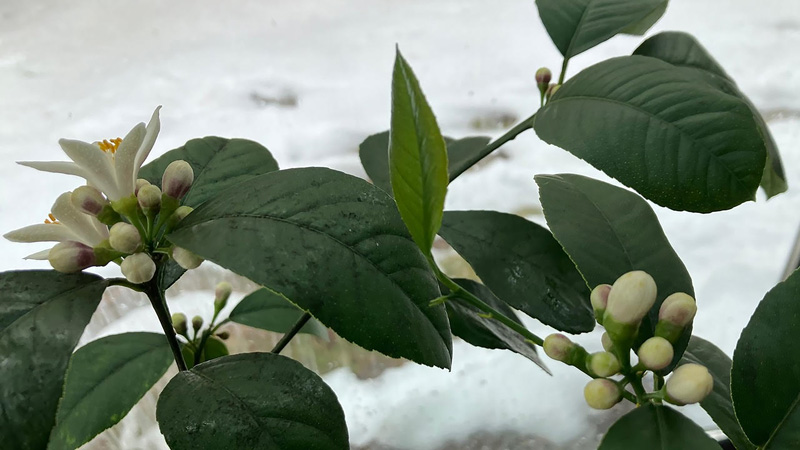
With their vitamin C content, citrus fruits, usually from Florida, Texas, and California, boost winter diets. Your spirits might be boosted too, if you are able to keep a potted citrus plant. Their charms — dark green foliage, frills of fragrant flowers, the colorful fruits — are antidotes to winter.
The ‘Kishu Seedless’ here lives with five other potted citrus that make up a small collection. An ordinary house or sunroom could house it for those who, like me, are captivated and slightly addicted to citrus charms.
What is the purpose of such a collection? Fruit, ultimately, although in all phases citrus are attractive. However, frustrations are common.
The Island obviously is not in the citrus belt. For many who grow potted citrus here, fruiting is undependable. Plants must come indoors for winter, housed in containers that may become quite large over time. Flowers bloom, but drop off without forming fruit. Pests such as scale or ants materialize out of thin air.
Starter citrus plants might be calamondins, now Citrus x microcarpa, a decorative, cold-tolerant species. With judicious pruning, they will remain small. Orange fruits are similarly sized to kumquats, but round, good for spritzing drinks or seafood. As calamansi, they are a staple seasoning in Filipino cuisine. My plant has been with me about 55 years.
Meyer lemon (Citrus x meyeri) is another winner. When they fruit, these hybrids are a culinary bonus. With thin skin, Meyer lemons do not ship well, but when homegrown, they may be a prolific source of fruit. (Deer are fond of the lemons, even when green, as I learned a couple of years ago.)
A smaller potted citrus here is Key lime, Citrus x aurantiifolia. It is a fine-textured plant with petite green fruit, an essential for bartenders and Key lime pies. The collection is rounded out with ‘Cara Cara,’ a Citrus x sinensis blood orange hybrid of Venezuelan origin, and another Citrus reticulata mandarin, ‘Gold Nugget,’ neither in bud at the moment.
The source for these plants was Logee’s, except for the calamondin. They are grafted plants, to enhance earlier fruiting. Logee’s is also a source for the liquid iron and citrus fertilizer blend that supply needed nutritional elements.
Prune citrus after fruiting. Repotting and root pruning become necessary over time, a real workout. They require potting in good soil, with good drainage. Water citrus regularly, but do not leave them standing in water, as they are prone to root rot. Mist foliage, and groom for scale. Hort oil and insecticidal soap should be sufficient to manage infestations.
I spent hours poring over the Citrus Pages website, and was fascinated by the wealth of information I found there (bit.ly/CP_CitrusIntro). The site helped me organize my knowledge and information about these legendary fruits, emerging from the mists of time in ancient China and throughout Asia. Citrus discovery, breeding, and introduction remain an astonishing field of endeavor.
Indispensable rosemary
“There’s rosemary, that’s for remembrance,” so the saying goes, but I beg to differ. “Rosemary for cooking and gardening” would be more accurate, and closer to it for rosemary’s many fans. These aromatic, resinous plants, Salvia rosmarinus, are a significant part of the pleasure in cooking and the pleasure in gardening.
The recent decades have seen many winters when in-ground rosemary plants here, depending upon location, would survive from year to year. With one of these plants enlarging from season to season, the buzz of insects is never-ending on sunny days when rosemary’s small blue (usually) flowers are open.
Those benign conditions failed to repeat this winter, and many wonderful plants likely will have been lost to the cold and wet. This is a blow, whether the plant is large and handsome, or a youngster planted from a four-inch pot last spring.
It conveniently happened that I learned to propagate rosemary from a friend, who told me how it is done in Italy. Cuttings are taken before winter, and rooted in water. They root easily, and when there are enough roots (pictured), the plantlets are potted up in soil and grown on. Hardened off, they go into the garden when spring is finally here.
Forced hyacinths
Speaking of plants rooting easily in water, fall-purchased hyacinth bulbs root readily in water, and lend a springlike perfume to indoor spaces when they bloom.
It is easy to do, and requires no special equipment. While forcing vases are nice, any jelly jar or small vase filled with marbles, pea stone, or pieces of broken terracotta to set the bulbs upon works just as well. I always plant the supposedly spent bulbs in the ground after they are passé, and they usually recover to bloom again in a year or two.
Comments are closed.