
Apple sleuths uncover unique trees on Peter Britt grounds in Jacksonville
Published 5:00 am Wednesday, February 25, 2026
‘They may not be found anywhere else in the world,’ team leader says; scions will be grafted onto root stock to allow people to hopefully grow their own
A team of apple sleuths has uncovered four unique trees at the former site of pioneer orchardist Peter Britt in Jacksonville, and preliminary DNA tests showed their special character.
“They may not be found anywhere else in the world,” team leader Carol Knapp told Jacksonville City Council during a study session Feb. 17, where she updated members on the latest developments for the Britt Heritage Apple Project.
Knapp, Gayle Lewis and Jill Brenkman having been working on identifying 10 apple trees, half of which are on the Britt Festival grounds and the other half on the city’s adjacent Britt Gardens. The four unidentified trees and six other heritage apple trees are not in great shape, although all produce some fruit.
Preservation of the unique trees’ character is the target of efforts that has taken young shoots, called scions, from the trees to be grafted onto root stock. If the effort succeeds, people would be able to get starts from the city or from Britt.
Knapp, who lives near the area, told Lewis of her interest in the old trees on the Britt grounds. Lewis shared an article about the Lost Apple Project in Washington state in 2022. The project seeks to locate and discover Pacific Northwest varieties that have been lost over time. It is looking primarily for fruit that is tasty, and six of the Britt trees fit that category.
The trio was able to send apples from the trees to learn more about their heritage after getting approval from Britt and the city. In 2023 the group gathered six to eight samples from eight of the trees; two did not have sufficient fruit.
Apple Project personnel tasted and judged the fruit and gave preliminary identification for six of the trees. However, later DNA testing showed none of the identification was correct.
City and Britt officials have supported efforts, last year funding DNA testing of all of the trees. So-called “simple” DNA tests performed by Washington State University in 2025 determined there were the four unique trees. Other trees include three Baldwins, a Gravenstein and a Gloria Mundi.
Samples of the four unique trees were sent in December for “full” DNA testing by WSU. The latest testing is funded by the estate of late Jacksonville resident Frank DeLuca. Full DNA testing will take at least six to nine months said Knapp.
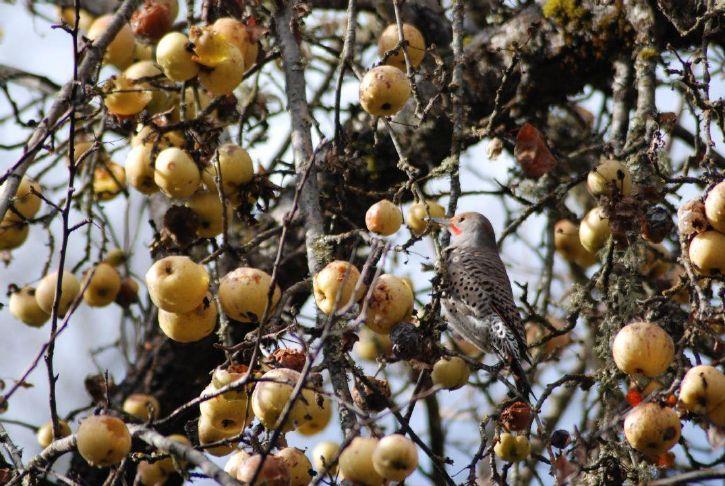
In mid-February apples still remained on a large Britt heritage tree that is planted near the Britt Festival entrance. A variety of birds are consuming the fruit, which is thought to have White Winter Pearmain, Newton and Pipin as parents. The 2023 analysis noted it crisp flesh and good, rich subacid.
Another unique tree on the Britt grounds has a Winesap, Delicious or Pewaukee parent. It is described as spritely and tasting slightly of strawberries. Knapp’s own sampling confirmed the strawberry taste.
One of the uniques is considered “special” since one of its probable parents, “Unknown American Founder #4”, is a parent of many old cultivars in North America. It has tender white flesh, keeps well and has a rich, sweet taste.
Knapp speculates that seven of the trees were likely part of Peter Britt’s original orchard, which was planted to the west of where the Britt house stood. The other three to the south of the home site might have been planted later by Britt’s son, Emil.
Nate Wall, winemaker at Troon Vineyard, offered to collect scions from the four unique and have them grafted onto rootstock as Troon has a cider orchard.
On Jan 7, Deborah Nelson, orchard consultant with Troon, Wall and Knapp surveyed the tree to determine which would have branches suitable for scion collection from the four trees. On Feb. 9 scions were collected in a nearly two hours process.
Grafting will occur in late winter or early spring. Some of the grafted stock will be held at Troon, while Knapp will keep some in her own backyard. She is looking for another vineyard that might be willing to host some of the grafts in case disease should strike at the selected locations.
In order to help these old trees survive as long as possible, judicious pruning would be needed. This would require someone skilled in restoration or rejuvenation pruning for old fruit trees.
“I’m excited about the attention given to these trees, especially the uniques,” Dr. Cameron Peace with WSU’s MyFruitTree project wrote to Knapp after receiving a draft of her report to the council.
“This is what motivates me to keep doing this work for apple enthusiasts across the nation. Your group demonstrates so much caring and community spirit regarding both the historical context of these trees and their future cultivation as new cultivars,” Peace continued. “Effectively, your characterization, documentation, preservation, naming and propagation efforts will add four new cultivars to the public gene pool!”
WSU has a database with over 2,600 varieties of apples.
Naming of the trees should wait until the full DNA test results are back, Knapp said. Jacksonville and the Britt Festival are free to name them as they wish. One individual has contacted the team asking about obtaining naming rights, as they would like to honor a deceased friend.
More help would be welcome for the project, Knapp said. She can be reached at knappcarolr@gmail.com.
Reach Ashland freelance writer Tony Boom at tboomwriter@gmail.com.
Comments are closed.