
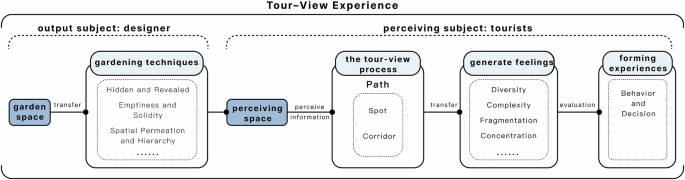
Spatial structure of “tour” and “view” in Ji Xing Garden
Based on space syntax analysis, this section examines Ji Xing Garden’s spatial organization on both the visual layer and the accessible layer.
In the visual layer, the analysis highlights the logic of “view.” Integration identifies two high-integration zones, including the main courtyard’s central pond and a smaller water area in the secondary courtyard, indicating the visually most open and dominant spaces, while other areas show lower integration with more limited visibility. Connectivity reaches its highest value at the central pond of the main courtyard and radiates outward, suggesting that most parts of the garden visually converge toward this water body as the visual core. Depth is relatively high along entrance corridors, narrow paths, and building edges (e.g., S1, C1, C2, C7), implying that these spaces require multiple visual turns to be fully perceived (Fig. 8). Overall, the visual layer analysis reveals a design strategy consistent with the classical garden principle of “vastness and seclusion”—the open central pond acts as the “vast” space of visual release, while the surrounding corridors and minor scenes form the “secluded” parts, using turns, concealment, and layering to evoke curiosity and anticipation during the tour.
Fig. 8: Space syntax analysis of the visual layer in Ji Xing Garden.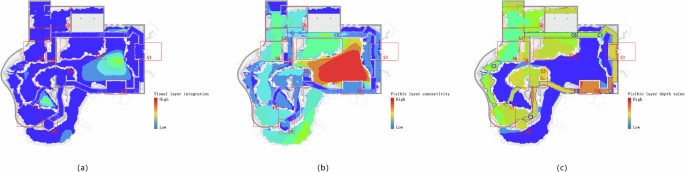
a integration degree; b connectivity; c depth value.
In the accessible layer, the analysis characterizes the movement logic of “tour.” Integration shows that high-integration zones cluster around S6, S7, and S9, indicating the most accessible and connected parts of the garden, whereas low-integration areas, such as S1, S2, and corridors C1, C2, are more isolated and circuitous. Connectivity peaks at the open square before S10, S7, and S9, where multiple paths converge, and route choices are diverse, while low-connectivity areas (C1, C2, C3, C7) are narrow linear corridors with limited alternatives. Depth is higher at S2 and corridors C1 and C2, requiring the most directional turns and producing a more secluded and inward spatial experience, whereas low-depth zones, including S10, S7, and S9 are the most easily reached and central spaces (Fig. 9). Overall, the accessibility analysis reveals the movement logic of visitors: open nodes such as S7 and S10 act as spatial hubs with high accessibility and route diversity, while linear corridors with low connectivity foster a sense of “winding paths leading to seclusion,” echoing the traditional experiential rhythm of Chinese gardens.
Fig. 9: Space syntax analysis of the feasible layer in Ji Xing Garden.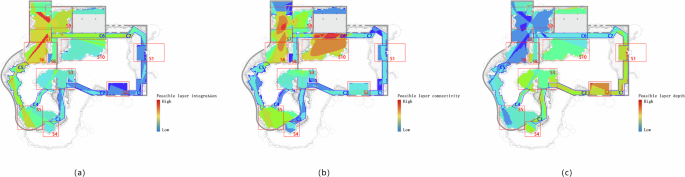
a integration degree; b connectivity; c depth value.
Quantitative analysis of the visual landscape form of Ji Xing Garden
The visual form analysis reveals the specific visual content and experiences perceived by visitors at each spatial node. Based on 83 representative images from Ji Xing Garden, visual form indices were calculated, and classification thresholds for 20 indicators were determined using the natural breaks method (Table 3). The following analysis focuses on 11 key spatial nodes and corridors in Ji Xing Garden.
Table 3 Visual landscape morphological index and its translation in landscape design
At S1 (Entrance), Ji Xing Garden serves as the prologue to the entire tour narrative. Here, the designer adopts the classical Chinese technique of “restraining before revealing,” creating a distinct spatial contrast between inside and outside through the simple intervention of a single wall. Quantitative analysis effectively captures this dramatic transition: from the exterior to the interior, overall visual complexity increases sharply, with SHDI rising from 0.787 to 1.329 (medium→highest), LSI increasing from 3.672 to 5.983 (medium→highest), and SPLIT nearly doubling from 2.681 to 5.515 (medium→highest). Meanwhile, CONTAG, indicating visual coherence, drops from 69.46 to 47.757 (medium→lowest) (Fig. 10). These changes quantitatively demonstrate how, upon entry, the visitor’s visual experience transforms from the simplicity of a continuous wall façade to a richly layered garden panorama. The dominant visual elements also change dramatically: outside the garden, the visual focus is a single architectural wall (PLAND_B = 55.568), whereas inside, the focus moves to carefully arranged rocks and water bodies, with PLAND_R and PLAND_W increasing to 32.556 and 13.425, respectively, and both showing the highest aggregation levels (AI_R, AI_W). In sum, S1 embodies the traditional principle of “concealment and revelation”: the interior is first concealed by high walls, and then revealed as a delicately composed scene—rocks as screens, water as base, trees as reflections, and architecture as backdrop—delivering strong visual impact and an enticing sense of discovery.
Fig. 10: Visual landscape indices of representative viewpoints at S1.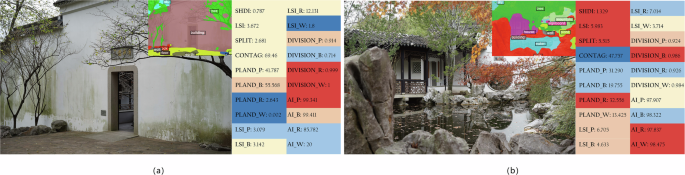
a Outside the entrance (P1); b inside the entrance (P3).
At C1 (Zigzag Corridor connecting S1 and S2), C1 functions as a transitional space, and its core design strategy reflects “stillness within motion,” in which is guided and narrowed along the movement path, creating a calm and introspective experience that perceptually prepares visitors for the next spatial highlight. At viewpoint P5, the scene can be characterized as “Borrowed Branches, Quiet Composition.” As visitors turn from the open entrance into the corridor, visual diversity drops to a medium level (SHDI = 0.962), signaling a shift from visual intensity to calmness. Yet, both shape complexity and fragmentation remain high (LSI = 6.302, SPLIT = 6.813). This complexity arises not from multiple scenic elements, but from the corridor itself (PLAND_B = 57.473), subtly fragmented by the irregular outlines of nearby branches (LSI_P = 6.549). The designer skillfully uses vegetation to “re-compose” the architectural frame, enriching the otherwise monotonous corridor scene (Fig. 11a). At viewpoint P8 (Framed View through the Window), progressing through the corridor, the notion of stillness within motion is most fully expressed here. Visual diversity (SHDI = 0.308), shape complexity (LSI = 1.439), and fragmentation (SPLIT = 1.200) drop to their lowest, while visual coherence (CONTAG = 88.488) peaks. The view is almost entirely enclosed by corridor walls (PLAND_B = 90.819). The only “scene” appears through a lattice window—a glimpse of greenery with extremely high aggregation (AI_P = 99.767). This carefully framed “leaking view” transforms stillness into subtle anticipation, offering a restrained yet evocative moment of beauty (Fig. 11b).
Fig. 11: Visual landscape indices of representative viewpoints along C1.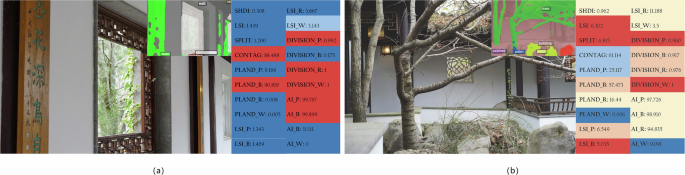
a Borrowed branches (P5); b framed view through the window (P8).
At S2 (Know-Fish Waterside Pavilion), as the core viewing node of Ji Xing Garden’s main courtyard, it creates three layers of distinct visual experiences through subtle shifts in visitors’ viewpoints. At viewpoint P10 (“Leaning on the Railing”), from the pavilion’s side, the view presents a tranquil, layered scene. Visual diversity (SHDI = 1.194) and shape complexity (LSI = 4.126) are high, while coherence (CONTAG) reaches its lowest value, reflecting substantial spatial depth. Vegetation and architecture dominate the frame (PLAND_P = 41.160, PLAND_B = 37.805), complemented by calm water and sparse rocks (PLAND_R = 6.855). The result is a compact yet poetic composition that harmonizes architecture and nature (Fig. 12a). At viewpoint P11 (“Framed View”), at the central viewpoint within the pavilion, the architectural structure itself frames the main scene. Fragmentation (SPLIT = 5.747) and architectural division (DIVISION_B = 0.956) reach their highest levels, as distant elements such as Ting Song Hall are partially screened by foreground plants and stones. The pavilion and the hall thus form a “reciprocal view” across the lake, with sightlines progressing from the near railings, across water reflections, toward the distant hall (Fig. 12b). At viewpoint P12 (“Facing the Water”), a slight turn toward the open water reveals the most complete “opposite view.” Visual diversity peaks (SHDI = 1.315) while coherence drops to its lowest (CONTAG = 49.593), showing the richest, most dynamic moment of perception. Rocks (PLAND_R = 18.341) and water (PLAND_W = 14.546) dominate, echoing the opposite bank’s scenery (Fig. 12c). Philosophically, the pavilion’s name Know-Fish, alludes to the Zhuangzi tale “The Joy of Fish,” symbolizing the harmony between humans and nature. Collectively, these shifting perspectives exemplify the dynamic and contemplative qualities central to the Chinese “tour-view experience.”
Fig. 12: Visual landscape indices of representative viewpoints at S2.
a Leaning on the railing (P10); b framed view (P11); c facing the water (P12).
At C2 (Bridge of the Clear Stream, connecting S2 and S3), C2 connects S2 and S3, guiding visitors through alternating modes of movement and observation to create a rhythmic visual experience. At viewpoint P15 (Corridor View), as one proceeds along the corridor, visual perception becomes simplified, with diversity, shape complexity, and fragmentation remaining at moderate to low levels (SHDI = 0.962, LSI = 3.763, SPLIT = 2.18). Architectural elements dominate the visual field (PLAND_B = 65.22), while plants and rocks occupy smaller portions yet exhibit high fragmentation (DIVISION_P = 0.963, DIVISION_R = 0.996), thereby enriching the otherwise uniform spatial experience with subtle visual accents (Fig. 13a). At viewpoint P14 (“Framed Waterscape”), upon pausing and turning toward the adjacent waterscape, the visual experience transforms dramatically. Although the overall spatial configuration becomes more regular as indicated by lower LSI and SPLIT values, visual diversity increases (SHDI = 0.988). The view is now dominated by vegetation and water (PLAND_P = 65.434, PLAND_W = 17.825). Hanging branches partially veil and reveal the water and distant scenery, while the high aggregation (AI) among plants, rocks, and water produces a continuous, pictorial composition reminiscent of a tranquil Chinese landscape painting (Fig. 13b).
Fig. 13: Visual landscape indices of representative viewpoints along C2.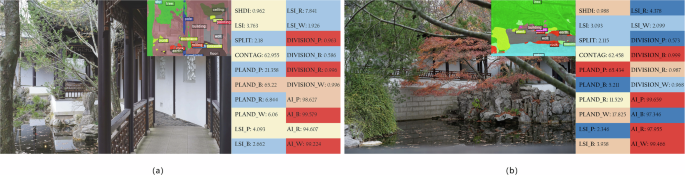
a Corridor view (P15); b framed waterscape (P14).
At S3 (Moon Gate), S3 marks the boundary between the main and secondary courtyards, connecting with C2, C3, and C4. This area functions as an island-like hub linking multiple spatial nodes. At viewpoint P17 (Framed View through the Wall), at the end of the path, the viewer’s gaze is drawn toward S3. Here, visual diversity, shape complexity, and fragmentation are relatively low (SHDI = 0.829, LSI = 3.754, SPLIT = 2.216). The view remains simple and is dominated by architectural elements (PLAND_B = 61.763) with low fragmentation (DIVISION_B = 0.593). In contrast, plants and rocks inside the gate exhibit high fragmentation (DIVISION_P = 0.959, DIVISION_R = 0.997), generating a pronounced visual layering. When seen through the circular opening, the scenery evokes the esthetic of an ink-wash painting (Fig. 14a). At viewpoint P29 (“Passing Through, A Sudden Expansion”), upon stepping through the Moon Gate, the view expands dramatically. Visual continuity drops to its lowest (CONTAG = 54.122), while diversity, complexity, and fragmentation reach their peaks (SHDI = 1.167, LSI = 5.563, SPLIT = 5.426). The proportion of rock formations increases (PLAND_R = 22.9), and the aggregation of plants, water, and rocks remains high (AI_P = 98.802, AI_W = 98.31, AI_R = 97.053). Architectural complexity also peaks (LSI_B = 5.057, DIVISION_B = 0.958). The white walls act as a clean backdrop, emphasizing the foreground layers and creating a sense of both openness and richness. The curving bridge directs both sightlines and bodily movement, reinforcing the rhythm of visual progression (Fig. 14b). Overall, S3 thus produces a striking contrast in visual perception, and its screening view technique divides the courtyards into distinct yet connected spaces, while its framing view effect visually extends them, thereby expanding spatial perception and enhancing the sense of depth and stratification in Ji Xing Garden.
Fig. 14: Visual landscape indices of representative viewpoints at S3.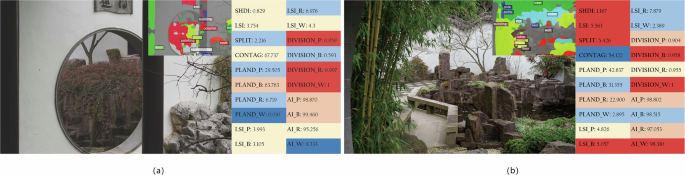
a Framed view through the wall (P17); b passing through, a sudden expansion (P29).
Across C5 (One-Step Bridge), the S6 forecourt, and S7 (Studio of Tranquility), the visual sequence follows a progressive spatial logic, unfolding from distant to near and from exterior to interior spaces. At viewpoint P35 (“Distant Viewing”), visual diversity, complexity, fragmentation, and continuity remain moderate (SHDI = 0.970, LSI = 3.939, SPLIT = 3.258, CONTAG = 62.418), indicating a balanced and well-ordered composition. Vegetation dominates half of the visual field (PLAND_P = 50.41, AI_P = 99.234), while architecture and rocks appear moderately complex yet highly cohesive (LSI_B = 3.047, LSI_R = 7.024, AI_B = 99.256, AI_R = 96.388). The spatial layers unfold progressively—from shrubs in the foreground, to rock formations in the midground, and the Studio of Tranquility and Cool Jade Pavilion in the background—creating visual depth and rhythmic layering (Fig. 15a). At viewpoint P43 (“Approaching the Pavilion”), as visitors move closer to S6, shape complexity and fragmentation increase markedly (LSI = 5.889, SPLIT = 3.745). Architecture becomes the dominant visual element (PLAND_B = 55.018), with clearer structural articulation (LSI_B = 4.538). The visual focus shifts naturally toward the building, reflecting a coherent progression in both spatial configuration and perceptual focus (Fig. 15b). At viewpoint P45 (“Framed View from Within”), upon entering the Studio of Tranquility and looking back toward the courtyard, visual diversity rises to a high level (SHDI = 1.036), indicating a richer composition of landscape elements. However, overall shape complexity and fragmentation decrease to medium–low levels (LSI = 3.826, SPLIT = 2.482). Architecture remains the dominant visual component (PLAND_B = 61.804), with reduced fragmentation and increased cohesion (DIVISION_B = 0.653, AI_B = 99.468). The paired doors function like a “viewing frame,” partially concealing the complex outdoor scenery while incorporating the courtyard view into the interior space, thus emphasizing an inward-to-outward viewing mode (Fig. 15c). Overall, this sequential transition exemplifies the Chinese garden principle of “changing scenery with each step,” revealing how visual hierarchies and spatial depths evolve dynamically through movement and perspective.
Fig. 15: Visual landscape indices of representative viewpoints across C5, the S6 forecourt, and S7.
a Distant viewing (P35); b approaching the pavilion (P43); c framed view from within (P45).
From S7 (Studio of Tranquility) to S8 (Cool Jade Pavilion), the visual sequence transitions from an enclosed corridor experience to an expansive viewing terrace. At viewpoint 46 (“Quiet Corridor”), inside Studio of Tranquility, looking south along the corridor toward the main courtyard, visual diversity, complexity, and fragmentation drop to very low levels (SHDI = 0.028, LSI = 1.197, SPLIT = 1.009), while continuity reaches its peak (CONTAG = 98.844). Architecture dominates the view (PLAND_B = 99.571, AI_B = 99.974), with the straight corridor enclosing sightlines and creating a calm, orderly atmosphere (Fig. 16a). At viewpoint P47 (“Framed Scene in Stillness”), as one moves along the corridor, a window opens toward a bamboo grove. Vegetation becomes noticeably concentrated (AI_P = 98.909), standing out within the architectural frame (PLAND_B = 96.065, PLAND_P = 3.839). The contrast between the solid architectural mass and the light bamboo foliage directs the viewer’s gaze toward the framed opening, momentarily breaking the spatial stillness (Fig. 16b). At viewpoint P49 (“Expansive View”), upon exiting the corridor into S8, the visual field expands dramatically. Morphological complexity rises (LSI = 4.485), and vegetation dominates the view with high concentration (PLAND_P = 73.518, AI_P = 99.371). Architectural forms become more intricate (LSI_B = 4.966, DIVISION_B = 0.973), while the white walls serve as a visual backdrop, accentuating the layered composition of plants, bridges, and rocks. S8 thus functions as a “viewing terrace,” extending sightlines deep into the secondary courtyard (Fig. 16c). Although located at the edge of Ji Xing Garden’s secondary courtyard, S8 allows views across nearly the entire area. It serves as both an observed scene and a viewing point, illustrating how visual sequencing controls sightlines and visitor movement.
Fig. 16: Visual landscape indices of representative viewpoints from S7 to S8.
a Quiet corridor (P46); b framed scene in stillness (P47); c expansive view (P49).
At S9 (Backyard), S9 consists of three small, layered courtyards designed mainly through screened views. White walls divide the spaces, while rocks and plants are arranged in staggered layers, creating a “static viewing” experience that contrasts with the dynamic scenes of the front court. At viewpoint P50 (“Reflections on Plain Walls”), in the first courtyard, visual fragmentation remains low (SPLIT = 2.201), with buildings and rocks dominating the scene (PLAND_B = 64.328, PLAND_R = 18.28). The well-ordered composition of rocks and plants set against white walls produces a serene and balanced spatial impression (Fig. 17a). At viewpoint P53 (“Depth of Bamboo Shadows”), in the second courtyard, spatial complexity and continuity increase (LSI = 4.486, CONTAG = 72.635). Vegetation occupies most of the visual field (PLAND_P = 74.097, AI_P = 99.412), where dense bamboo clusters and scattered rock formations create a secluded, natural atmosphere (Fig. 17b). At viewpoint P55 (“Quiet Alley and Still Rocks”), beyond the final gate extends a narrow alley where plants and rocks prevail (PLAND_P = 46.44, PLAND_R = 23.527) and remain highly cohesive (AI_P = 99.413, AI_R = 98.424). The compact spatial layout and layered composition convey a strong sense of seclusion and tranquility (Fig. 17c). Overall, S9 exemplifies the traditional technique of spatial partitioning: using architecture as solid screens to form a sequence of small, independent courtyards, establishing a contrast between movement and stillness within the garden.
Fig. 17: Visual landscape indices of representative viewpoints at S9.
a Reflections on plain walls (P50); b depth of bamboo shadows (P53); c quiet alley and still rocks (P55).
At C6 (Zigzag Corridor connecting S7 and S10), C6 connects S7 and S10, offering a sequence of changing views along the path. At viewpoint P57 (“Corridor Guidance”), at the initial entry, visual diversity, morphological complexity, and fragmentation all drop to low levels (SHDI = 0.469, LSI = 2.134, SPLIT = 1.709), while visual coherence rises to a high level (CONTAG = 82.149). The view is simple and enclosed, dominated by architectural elements (PLAND_B = 83.515, AI_B = 99.833). Although vegetation occupies a smaller portion, it remains highly concentrated (PLAND_P = 16.039, AI_P = 99.294), mainly distributed on one side outside the corridor, allowing visitors to glimpse the exterior scene within the enclosed space (Fig. 18a). As visitors proceed, the visual composition shifts progressively (Fig. 18b, c), alternating among rock-focused, plant-dominant, and composite scenes. At viewpoint P58 (“Viewing the Peak from the Corridor”), further along, visual diversity increases while coherence declines (SHDI = 1.019, CONTAG = 60.77). The view gradually opens, with rock elements rising to a medium proportion (PLAND_R = 15.211). The garden’s principal feature, the Cloud-Lingering Peak—a Taihu rock nearly 4 m in height—comes into view, exemplifying the classical Chinese rockery esthetic of “porous, slender, and wrinkled.” Background vegetation (PLAND_P = 58.74) enhances the prominence of the peak. The corridor’s slightly elevated position offers a downward perspective, reinforcing the visual hierarchy of the scene. At viewpoint P74 (“Rocks Against the Wall”), at the corridor’s end, visual diversity and fragmentation again drop to low levels (SHDI = 0.660, SPLIT = 1.636), and coherence increases (CONTAG = 73.965). The view becomes enclosed, dominated by vegetation with high concentration (PLAND_P = 77.706, AI_P = 99.557), forming a screen that restores tranquility and privacy. Overall, this corridor transitions from enclosed to open and back again. This corridor uses the scene division technique to divide space into distinct areas, allowing visitors to experience varied sceneries during their walk.
Fig. 18: Visual landscape indices of representative viewpoints along C6.
a Corridor guidance (P57); b viewing the peak from the corridor (P58); c rocks against the wall (P74).
At S10 (Hall of Listening to Pines Forecourt), the open space before S10 provides an unobstructed, extended view, enhancing the sense of spatial openness and visual breadth. At viewpoint P68 (“Viewing the Waterside Pavilion”), visual diversity reaches a very high level (SHDI = 1.261), accompanied by high shape complexity and fragmentation (LSI = 4.724, SPLIT = 4.22). Rock elements occupy a large portion of the visual field (PLAND_R = 30.251), while architectural complexity also increases (LSI_B = 3.898). Across the water, the Bridge of the Clear Stream (C2) is visible, surrounded by rocks and a small water body (PLAND_W = 6.727, AI_W = 99.915), forming an interwoven composition of water, rock, and architecture (Fig. 19a). At viewpoint P69 (“Reflection of Water and Rocks”), visual diversity and complexity remain high (SHDI = 1.209, LSI = 4.804), while visual coherence drops to a very low level (CONTAG = 53.095). Rock elements dominate the view (PLAND_R = 39.683), with the water element at a moderate level but highly concentrated (PLAND_W = 9.425, AI_W = 99.057). Near the water’s edge, viewers’ attention naturally focuses on surface reflections, evoking the poetic imagery of intermingled water and rock compositions (Fig. 19b). Overall, S10 stands out in Ji Xing Garden due to its scale and spatial prominence. The lower visual coherence and wider openness here emphasize the hierarchy and clarity of spatial nodes.
Fig. 19: Visual landscape indices of representative viewpoints at S10.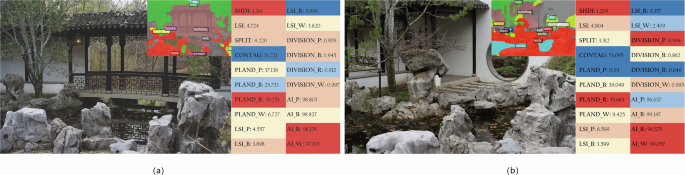
a Viewing the waterside pavilion (P68); b reflection of water and rocks (P69).
At C7(Zigzag Corridor connecting S10 and S1), upon entering C7, the visual experience gradually transitions from openness to enclosure. The corridor, intertwined with vegetation, guides visitors toward the exit, where the central scenery slowly fades from view, concluding the tour in a tranquil and subdued atmosphere. At viewpoint P76 (“Viewing Water Along the Corridor”), visual diversity, morphological complexity, and fragmentation all remain at high levels (SHDI = 1.223, LSI = 4.519, SPLIT = 4.433). Water occupies a relatively large proportion of the view (PLAND_W = 22.604). From the railing vantage point, visitors can still partially view the waterscape of the main courtyard (Fig. 20a). At viewpoint P78 (“Leaves in Veiled Layers”), morphological complexity remains high (LSI = 4.400), with vegetation dominating the visual frame (PLAND_P = 64.720). Architectural complexity and fragmentation reach extremely high levels (LSI_B = 4.960, DIVISION_B = 0.974). Overlapping branches partially obscure the background architecture, producing a subtle and poetic visual composition (Fig. 20b). At viewpoint P79 (“Returning to Serenity”), morphological complexity and fragmentation decrease to medium–low levels (LSI = 2.636, SPLIT = 2.473). The landscape becomes visually simpler, restoring the natural and peaceful atmosphere near the entrance and signifying a calm closure to the viewing sequence (Fig. 20c).
Fig. 20: Visual landscape indices of representative viewpoints along C7.
a Viewing water along the corridor (P76); b leaves in veiled layers (P78); c returning to serenity (P79).
Spatial mapping analysis of visual landscape morphology in Ji Xing Garden
As visitors move through the garden space, they continuously perceive changing visual information. Therefore, a multi-perspective assessment of visual indices offers a more comprehensive and realistic understanding of spatial experience than any single metric. To further explore the visual morphological variations in Ji Xing Garden, the visual indices of all sampling points were spatially mapped (Fig. 21, Table 4).
Fig. 21: Spatial distribution of key visual landscape indices in Ji Xing Garden.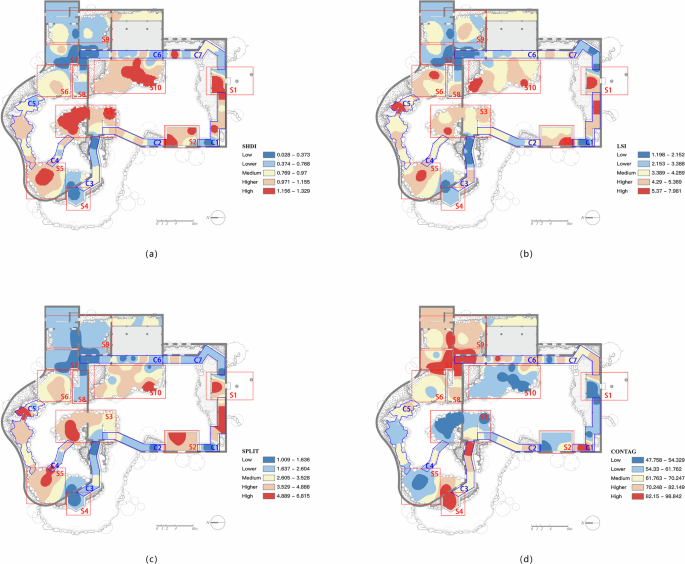
a SHDI; b LSI; c SPLIT; d CONTAG.
Table 4 Analysis of class metric indices of Ji Xing Garden.
Results indicate that areas with high SHDI, LSI, and SPLIT values—primarily around S1, S2, S3, and S10—exhibit pronounced spatial heterogeneity and visual complexity. In contrast, CONTAG exhibits an inverse spatial pattern: its low-value zones coincide with these regions, reflecting weaker visual continuity and broader, visually more intricate sightlines. Conversely, S7 and S9 present medium–low SHDI and LSI values but high CONTAG, indicating visually coherent, well-structured spaces conducive to quiet and enclosed spatial experiences.
At the class level (Table 4), when the visual proportion (PLAND) of a landscape element is high, its LSI and DIVISION values typically remain at low to medium levels, whereas AI tends to stay high.
Vegetation exhibits this pattern most distinctly, particularly in S4, S8, S9, the southern C6 corridor, and C7. In these areas, LSI_P and DIVISION_P remain at low to medium levels, while AI_P is consistently high—indicating that vegetation tends to cluster, concealing visual clutter and enhancing spatial stratification. Architectural elements show similar tendencies in S7, S9, and the northern C6, where LSI_B and DIVISION_B are moderate, but AI_B remains high. This suggests that architectural forms maintain visual dominance through unity and stability, complementing the screening effect of vegetation. Although the physical area of water is considerable, its PLAND values remain low, with only localized increases near S1, S2, and S10. Water seldom becomes the primary visual focus, indicating that in Ji Xing Garden, it primarily enhances atmospheric depth and spatial layering rather than serving as a dominant visual feature.
Comprehensive analysis of the “tour-view experience” in Ji Xing Garden
The overall touring route in Ji Xing Garden forms a closed loop around the central water body, linking pavilions, bridges, and corridors into a continuous visual sequence. As shown in Table 5, the fluctuations in visual landscape indices reveal distinct rhythmic transitions in the “tour-view experience.” By integrating corridor sinuosity and length variation with the three-dimensional alternation between spatial enclosure and openness, we explain the mechanisms underlying these experiential changes (Fig. 22).
Fig. 22: Path morphology and 3D spatial structure analysis of key touring sequences.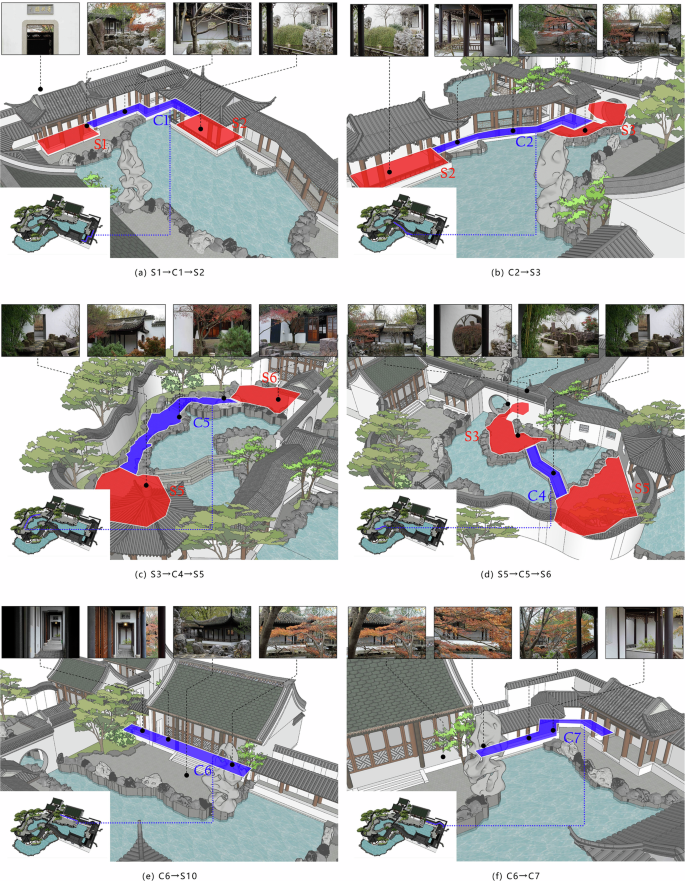
a S1–C1–S2; b C2–S3; c S3–C4–S5; d S5–C5–S6; e C6–S10; f C6–C7. Red areas denote space nodes (S), and blue bands denote corridor segments (C).
Table 5 Visual index line chart
In the S1→C1→S2 sequence, “Suppression before revelation” and narrative unfolding are reflected in sharp viewpoint fluctuations caused by corridor folding and the alternation between spatial openness and enclosure (Fig. 22a). At S1, a “Strong contrast at the entrance” is observed: upon entering node S1, landscape diversity (SHDI) and complexity (LSI) rise sharply, whereas connectivity (CONTAG) decreases. This is because, outside the entrance, the screening wall creates an occluded space that constrains sightlines and strengthens a sense of enclosure. After bypassing the screen, visitors step into a semi-open space where the view suddenly expands, and the panorama of the main courtyard is revealed, markedly increasing visual richness and diversity and producing a strong contrast with the entry condition. Along C1, “Linear guidance and visual rhythm” become prominent: as visitors move through the “linear space” formed by the corridor, sightlines are guided forward and progressively unfold; indices related to visual richness slightly decline, while connectivity increases. This is because much of the visual field is redirected toward the corridor itself. However, at the “folded” segment of corridor C1, the corridor’s turn redirects the gaze back toward the garden interior, filling the view with diverse landscape elements and raising visual richness indices again. As the gaze is subsequently pulled back into the corridor’s semi-enclosed segment, visual diversity and complexity drop once more. Upon reaching S2 (the Know-Fish Waterside Pavilion), the sequence shifts to “Spatial expansion and pause for viewing”: the spatial scale expands abruptly into a “three-sided open space,” encouraging visitors to linger. The gaze re-enters the garden, and visual richness and morphological complexity reach high values again, while connectivity declines. Meanwhile, PLAND_P increases, and DIVISION_P decreases, indicating that vegetation becomes dominant in the visual field and is more aggregated. An increase in LSI_W suggests that the water body exhibits a more natural and sinuous form. Overall, the S1→S2 sequence produces rhythmic fluctuations in visual landscape indices (Table 5) through sinuous corridor guidance and alternating three-dimensional enclosure and openness, creating a progressive narrative experience that unfolds layer by layer.
In the C2→S3→C4→S5 sequence, “Spatial permeability and hierarchical transitions” are manifested through alternating constriction and expansion, together with changes in route geometry (Fig. 22b, c). When moving from S2 into C2, “From linear constriction to panoramic expansion” is observed: visitors’ sightlines are constrained by the corridor’s linearity, leading to low values of visual diversity and complexity. As the lateral spaces gradually open on both sides, visual richness increases in a fluctuating manner. At the midpoint of the corridor, the full panorama of the main courtyard water surface becomes visible, and visual richness reaches a peak within C2 (Fig. 22b). Upon arriving at S3, “Spatial segregation and a peak in visual richness” emerge: S3 functions as a central island where a vertical wall physically separates the main and secondary courtyards. When looking back toward the main courtyard panorama from the island, the unobstructed three-dimensional view toward the water results in another peak in visual richness. Although the island is a single node, its visual landscape is not homogeneous. The moon gate both separates the main and secondary courtyards and allows for mutual visual interpenetration. Visual landscape indices change markedly across the gate, producing a spatial rhythm of “open–constrained–open” transitions. After passing through the moon gate, “Path sinuosity and guided sightlines” become prominent along C4: visitors leave the island (S3) via the characteristic zigzag bridge (C4), and changes in turning angles (path sinuosity) actively guide the direction of gaze. The index variations indicate that even on a limited bridge deck, the visual landscape undergoes rich transformations, demonstrating the modulating role of route geometry in shaping visual perception (Fig. 22c). Finally, when moving from C4 into S5, “Expansion of spatial volume” is evident: the three-dimensional spatial volume expands markedly at this relatively open node, and visual diversity and complexity rise again to the highest levels, enabling visitors to pause and take in the overall landscape of the secondary courtyard.
In the S5→C5→S6 sequence, “Scenes changing as steps move” is reflected in medium-to-high overall visual diversity along the One-Step Bridge (C5). This occurs because the area functions as an “open space” in the secondary courtyard: sightlines are no longer constrained by architectural framing through doors and windows, nor by the corridor’s linear guidance, resulting in a freer and less obstructed touring experience. The rhythmic variation in this sequence is primarily driven by the shifting composition of landscape elements and can be divided into three stages: At node S5, PLAND_R and AI_R both increase and remain high, indicating that rockery elements dominate the view and are highly aggregated, establishing the secondary courtyard’s “natural and rustic” tone. In the middle segment at C5, i.e., when crossing the One-Step Bridge, multiple indices such as SPLIT, SHDI, PLAND_P, and AI_W rise significantly. This is not only due to the rich combination of vegetation and water elements, but also because the bridge introduces subtle vertical change that expands the FOV and creates richer spatial layers, forming a minor climax in the touring experience. In the final segment near S6 (adjacent to Studio of Tranquility), architectural elements gradually shift into the background while vegetation moves to the foreground, serving as a transitional buffer from the outdoor natural courtyard to the indoor architectural space. Throughout this sequence, visitors can appreciate changing scenery and element combinations from multiple directions, vividly experiencing the garden’s “scenes changing as steps move” (Fig. 22d).
In the S6→S7→S8→S9 sequence, “Architectural enclosure and indoor–outdoor transitions” dominate the tour-view experience. Upon arriving at S6 (the open space in front of Studio of Tranquility), the sequence becomes dominated by architectural elements of varying scales and degrees of openness and enclosure. As a result, visual diversity and complexity decrease overall, while connectivity (CONTAG) increases significantly, producing a relatively enclosed and tranquil atmosphere for “static viewing.” From S6 into the interior of Studio of Tranquility (S7) and then to the rear courtyard (S9), visual diversity and complexity show a “Decline followed by a resurgence.” This reflects the movement process from an outer courtyard into an interior space and then into an inner courtyard, forming a visual rhythm of “open–enclosed–open again.” Within this architectural sequence, S8 (Cool Jade Pavilion) represents a peak in PLAND_P, indicating that it is one of the few viewpoints in this area where vegetation can be viewed in a concentrated manner. The introduction of vegetation effectively breaks the monotony of a purely architectural environment and vividly reflects the classical garden design philosophy of mutual penetration between indoor and outdoor scenery.
In the C6→S10→C6→C7 sequence, “Panoramic revelation and reclusive closure” is produced through a transition from enclosure to openness and then back to semi-enclosure (Fig. 22e, f). Along C6, “From enclosure to openness” is observed: the secondary and main courtyards are connected via corridor C6. Although C6 is relatively straight, it effectively modulates the tour-view experience through lateral alternations of enclosure and openness (Fig. 22e). In the early segment after leaving Studio of Tranquility (S7) and entering C6, sightlines are tightened by architectural enclosure, guiding visitors forward. As one side of the corridor gradually opens, the scenery outside Hall of Listening to Pines (S10) enters the visual field, and SHDI, LSI, and SPLIT increase significantly. Meanwhile, decreases in PLAND_B and AI_B indicate a weakening dominance of architectural elements, allowing the panoramic “scroll” of the main courtyard—composed of the lake, rockeries, and buildings—to gradually unfold before the viewer. At S10, “A climax of visual experience” occurs: the three-dimensional space fully opens, and visual richness reaches the highest point in this sequence. This location offers one of the broadest viewsheds; the proportions of water, rockeries, and vegetation increase substantially, enabling visitors to take in the full panorama of the main courtyard and experience a visual climax of the tour. Afterward, along C7, “Sinuous contraction and a poetic ending” are manifested: after arriving at the winding corridor C7, sightlines are again actively guided by the zigzag route (Fig. 22f). The semi-enclosed spatial condition gradually constrains the view, and visual diversity and complexity drop into a low range. At this point, visitors have moved away from the garden’s core scenes and are drawn into a shaded corridor enclosed by vegetation. This transition—from “panoramic vibrancy” back to “deep tranquility”—echoes the traditional literati spirit of retreat and seclusion, bringing the entire garden journey to a poetic close.
Correlation analysis between objective indicators and subjective perceptions
To establish a link between objective visual indicators and users’ psychological experiences, we conducted Pearson correlation analyses between the visual landscape indices from 83 viewpoints and the mean subjective ratings provided by 20 participants. The results reveal significant, multidimensional associations between the visual metrics and subjective perceptions (Fig. 23), supporting the validity of the proposed quantitative framework.
Fig. 23: Heatmap of Pearson correlation coefficients between objective landscape indices and subjective perception ratings.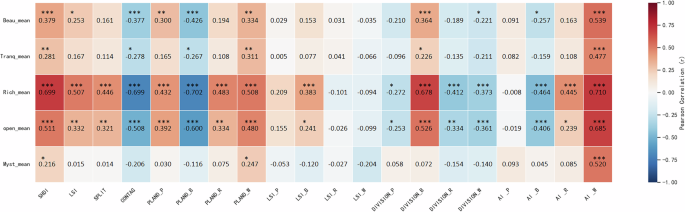
Note: red indicates positive correlation, and blue indicates negative correlation. Color intensity represents the magnitude of the correlation coefficient r. Asterisks indicate statistical significance: *p < 0.05, **p < 0.01, ***p < 0.001.
For visual richness (Rich_mean), a highly significant positive correlation is observed with SHDI (r = 0.699) and a significant positive correlation with LSI (r = 0.507), whereas a highly significant negative correlation is observed with CONTAG (contagion) (r = −0.699). These findings confirm that diversity (SHDI) and morphological complexity (LSI) computed in FRAGSTATS can reflect the “visually abundant” experience perceived by visitors. The strong negative association with contagion (CONTAG) further suggests that, in Ji Xing Garden, fragmented and interwoven landscape configurations elicit a stronger sense of richness than large, homogeneous, single-element patterns. In addition, the proportion of built elements (PLAND_B) is strongly negatively correlated with richness (r = −0.702), indicating that an overly high share of architectural elements weakens perceived visual layering.
For tranquility (Tranq_mean), positive correlations are observed with water aggregation (AI_W) (r = 0.477) and diversity (SHDI) (r = 0.281), whereas negative correlations are observed with contagion (CONTAG, r = −0.278) and the proportion of built elements (PLAND_B) (r = −0.267). These results indicate that, within the touring context of Ji Xing Garden, higher tranquility is more likely to be experienced in open water-view areas enriched by natural elements, rather than in architecturally dense or physically enclosed spaces. This highlights the important role of expansive water surfaces and natural vitality in fostering psychological calmness.
For scenic beauty (Beau_mean), positive associations are observed with water aggregation (AI_W, r = 0.539) and diversity (SHDI, r = 0.379), whereas scenic beauty is negatively associated with the proportion of built elements (PLAND_B, r = −0.426) and contagion (CONTAG, r = −0.377). This implies that when architectural mass occupies a dominant position in the visual field, visitors’ evaluations of scenic beauty decrease markedly. This pattern is consistent with the classical esthetic principle of Chinese gardens, often summarized as “though man-made, it appears as if naturally formed,” suggesting that architecture should remain integrated with, rather than overpower, natural components.
For exploration desire (Myst_mean), the strongest positive correlation is observed with water aggregation (AI_W) (r = 0.520), with weaker positive correlations with water proportion (PLAND_W, r = 0.247) and diversity (SHDI) (r = 0.216). This suggests that, in Ji Xing Garden, the motivation that stimulates visitors’ desire to explore is closely related to water features. The extension and clustering of water elements signal the presence of further scenery ahead, encouraging visitors to move along the shoreline, while diverse landscape elements provide ongoing visual rewards.
For perceived openness (Open_mean), a highly significant positive correlation is observed with water aggregation (AI_W) (r = 0.685) and a highly significant negative correlation with the proportion of built elements (PLAND_B) (r = −0.600). This indicates that perceived openness does not primarily arise from homogeneous empty space, but rather depends on continuous and expansive water surfaces. Conversely, a high share of architectural elements (high PLAND_B) and enclosed spatial structure (high CONTAG) is associated with a markedly stronger sense of enclosure.
Comments are closed.